


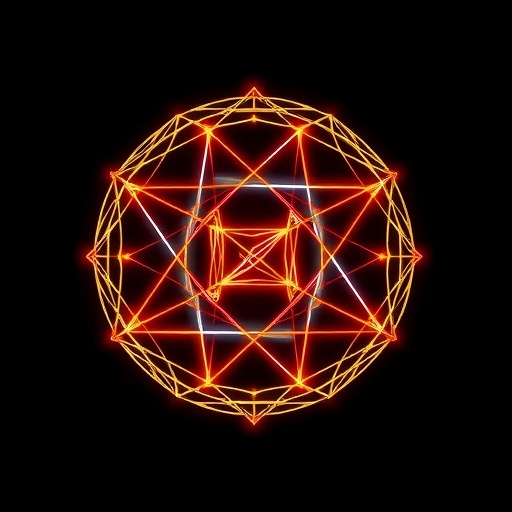
A recent breakthrough in the field of photonics has captured the attention of researchers and technologists worldwide. The pioneering work by Wang, Wu, Wang, and their colleagues has unveiled a novel approach to vectorial lasing with designable topological charges, achieved through a Möbius-like correspondence in quasi-bound states in the continuum (quasi-BICs). This cutting-edge research not only expands our fundamental understanding of light-matter interactions but also opens new pathways for developing lasers with highly configurable properties, with promising applications spanning optical communication, quantum information processing, and advanced imaging systems.
At the heart of this discovery lies the concept of quasi-BICs, a phenomenon wherein resonant modes that ideally would be trapped within a material system exhibit finite lifetimes due to weak coupling with the external environment. Unlike pure bound states in the continuum, quasi-BICs enable controlled energy leakage, thereby providing a delicate balance that can be manipulated for enhanced light emission. The team leveraged this principle to engineer lasing modes with intricately designed vectorial properties, a significant advancement over traditional scalar laser beams whose spatial and polarization profiles remain largely fixed.
One of the key innovations in this study is the utilization of Möbius-like correspondences to direct the topology of the emitted laser beams. Möbius strips, known for their unique single-sided surface and non-orientable characteristics, provide an inspiring analogy for the topological structuring of light in these emergent laser states. By mapping laser mode profiles onto Möbius-like transformations, the researchers achieved control over the topological charge—a quantifier of the phase singularity and vorticity in the light field—allowing the creation of vector beams whose polarization and phase can be finely tuned.
This topological control is particularly crucial for the generation of structured light beams, which possess spatially varying polarization states. Such beams offer superior capabilities for manipulating light-matter interactions as compared to conventional laser outputs. The bespoke vector beams generated through this approach exhibit complex polarization textures including radial and azimuthal patterns, unlocking rich avenues for applications in high-resolution microscopy, optical trapping, and information multiplexing.
Underpinning these achievements is a meticulously designed photonic crystal slab architecture, which supports the quasi-BIC modes crucial for the experiment. The crystal’s periodic arrangement facilitates the coupling between internal resonances and external radiation, permitting the engineering of specific mode lifetimes and polarization states. Advanced numerical simulations complemented experimental work to decode the subtle dependencies between geometric parameters and lasing behaviors, ensuring the reliable reproducibility of the desired vector beams with specified topological charges.
Furthermore, the team demonstrated the robustness of their method by dynamically adjusting design parameters to tailor the vectorial properties of the lasing modes on demand. This flexibility signifies a paradigm shift towards highly customizable laser sources, transcending static device configurations. The ability to confine and manipulate light fields with such precision heralds a new era of photonic devices incorporating topological features once considered theoretical curiosities.
Importantly, the research also delved into the practical implications of these novel lasing modes. With their inherent topological protection, the generated vector beams show resistance to perturbations and scattering, attributes that are highly desirable for reliable optical communication in noisy environments. The intrinsic stability in mode structure further enhances the coherence and brightness of the laser output, making these vector lasers strong candidates for integration into next-generation optical computing platforms.
The experimental setup meticulously combined nanofabrication techniques with high-resolution optical characterization tools. By fabricating photonic lattices with precise dimensional control and employing interferometric measurements, the researchers could confirm the presence of Möbius-like topological features within the quasi-BIC laser modes. Such an intricate experimental design underscores the practical feasibility of realizing complex topological photonic devices with existing technology.
The theoretical framework accompanying this research provides profound insights into the interplay between topological aspects and vectorial properties in lasing systems. By applying advanced mathematical tools to describe the coupling mechanisms and symmetry properties within the photonic structures, the study charts a comprehensive map that guides future explorations into multi-dimensional topological photonics. This conceptual backbone paves the way for extending these principles to other wave systems beyond optics, such as acoustics and spintronics.
In the broader scientific context, this advance resonates with an increasing interest in leveraging topological phenomena to refine the control of fundamental wave properties. The Möbius-like model adds a refreshing dimension to the current catalog of topological descriptions, enriching the toolkit available for engineers and physicists alike to sculpt electromagnetic fields with unprecedented complexity and functionality.
Looking ahead, the implications of harnessing designable topological charges in lasing promise new frontiers in technology and science. Potential applications span secure quantum communication channels utilizing orbital angular momentum states, ultra-sensitive sensing techniques based on topological phase shifts, and compact, versatile light sources for integrated photonic circuits that require tailored spatial and polarization patterns.
As integration with existing photonic platforms progresses, we can anticipate the development of hybrid devices that combine the robustness and flexibility of Möbius-inspired vector lasers with other quantum and classical photonic functionalities. This convergence could lead to transformative devices powering everything from autonomous vehicles’ sensors to quantum-enabled data centers.
In essence, the work by Wang and colleagues stands as a testament to the power of combining topological insight with technical ingenuity. The synergistic approach of blending fundamental physics with applied technology unlocks practical routes to overcome longstanding challenges in laser engineering, carving a niche for topologically enriched light sources that are not only beautiful from a conceptual standpoint but also extraordinarily useful in real-world applications.
This landmark study encapsulates the vibrant interplay between topology and optics, a field rapidly evolving with cross-disciplinary contributions. The Möbius-like correspondence introduced here opens a treasure trove of opportunities, illustrating that abstract mathematical concepts can be translated into tangible technological gains with global impact.
In summary, the demonstration of vectorial lasing with customizable topological charges through innovative quasi-BIC photonic structures marks a significant milestone in light science and technology. It heralds a future where light beams can be engineered with previously unthinkable complexity, precision, and utility. As research in this domain accelerates, the prospects for revolutionary advancements across science, engineering, and industry appear brighter than ever.
Cite Scienmag News
Denise Maddox. (March 30, 2026). Designable Vectorial Lasing via Möbius-Like Quasi-BICs. Scienmag. https://scienmag.com/designable-vectorial-lasing-via-mobius-like-quasi-bics/
Denise Maddox. "Designable Vectorial Lasing via Möbius-Like Quasi-BICs." Scienmag, 30 March 2026, https://scienmag.com/designable-vectorial-lasing-via-mobius-like-quasi-bics/. Accessed 3 September 2026.
Denise Maddox. "Designable Vectorial Lasing via Möbius-Like Quasi-BICs." Scienmag. March 30, 2026. https://scienmag.com/designable-vectorial-lasing-via-mobius-like-quasi-bics/


