


“The study examined the impact of depressive symptoms, antidepressant use, and epigenetic age acceleration on all-cause mortality in postmenopausal women.”

Credit: 2024 Beydoun et al.
“The study examined the impact of depressive symptoms, antidepressant use, and epigenetic age acceleration on all-cause mortality in postmenopausal women.”
BUFFALO, NY- June 10, 2024 – A new research paper was published in Aging (listed by MEDLINE/PubMed as “Aging (Albany NY)” and “Aging-US” by Web of Science) Volume 16, Issue 10, entitled, “Relationships of depression and antidepressant use with epigenetic age acceleration and all-cause mortality among postmenopausal women.”
In this new study, researchers May A. Beydoun, Hind A. Beydoun, Jason Ashe, Michael F. Georgescu, Steve Horvath, Ake Lu, Anthony S. Zannas, Aladdin H. Shadyab, Su Yon Jung, Sylvia Wassertheil-Smoller, Ramon Casanova, Alan B. Zonderman, and Robert L. Brunner from the National Institute on Aging, U.S. Department of Veterans Affairs (Washington, DC), University of Texas Health Science Center at Houston, University of California Los Angeles, University of North Carolina at Chapel Hill, University of California San Diego, Albert Einstein College of Medicine, Wake Forest University School of Medicine, and University of Nevada Reno investigated relations of depressive symptoms, antidepressant use, and epigenetic age acceleration with all-cause mortality risk among postmenopausal women.
“Frequently under-recognized depression is a major contributor to the Global Burden of Diseases [1, 2] while being the most prevalent mental illness among geriatric populations [2].”
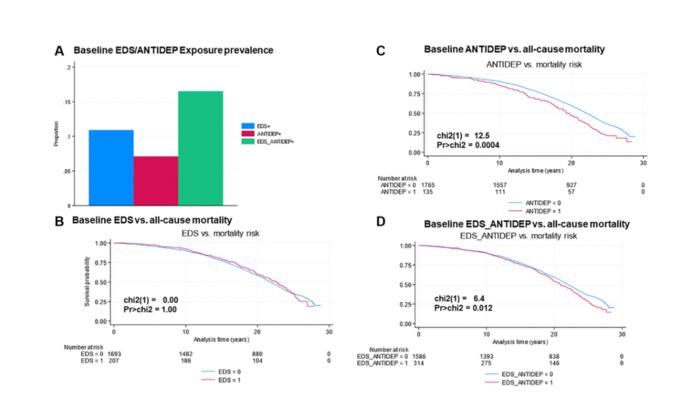
Data were analyzed from ≤1,900 participants in the Women’s Health Initiative study testing four-way decomposition models. After a median 20.4y follow-up, 1,161 deaths occurred. Approximately 11% had elevated depressive symptoms (EDS+), 7% were taking antidepressant medication at baseline (ANTIDEP+), while 16.5% fell into either category (EDS_ANTIDEP+).
Baseline ANTIDEP+, longitudinal transition into ANTIDEP+ and accelerated epigenetic aging directly predicted increased mortality risk. GrimAge DNA methylation age acceleration (AgeAccelGrim) partially mediated total effects of baseline ANTIDEP+ and EDS_ANTIDEP+ on all-cause mortality risk in socio-demographic factors-adjusted models (Pure Indirect Effect >0, P < 0.05; Total Effect >0, P < 0.05). Thus, higher AgeAccelGrim partially explained the relationship between antidepressant use and increased all-cause mortality risk, though only prior to controlling for lifestyle and health-related factors.
“Antidepressant use and epigenetic age acceleration independently predicted increased all-cause mortality risk. Further studies are needed in varying populations.”
Read the full paper: DOI: https://doi.org/10.18632/aging.205868
Corresponding Author: May A. Beydoun
Corresponding Email: baydounm@mail.nih.gov
Click here to sign up for free Altmetric alerts about this article.
About Aging:
Aging publishes research papers in all fields of aging research including but not limited, aging from yeast to mammals, cellular senescence, age-related diseases such as cancer and Alzheimer’s diseases and their prevention and treatment, anti-aging strategies and drug development and especially the role of signal transduction pathways such as mTOR in aging and potential approaches to modulate these signaling pathways to extend lifespan. The journal aims to promote treatment of age-related diseases by slowing down aging, validation of anti-aging drugs by treating age-related diseases, prevention of cancer by inhibiting aging. Cancer and COVID-19 are age-related diseases.
Aging is indexed by PubMed/Medline (abbreviated as “Aging (Albany NY)”), PubMed Central, Web of Science: Science Citation Index Expanded (abbreviated as “Aging‐US” and listed in the Cell Biology and Geriatrics & Gerontology categories), Scopus (abbreviated as “Aging” and listed in the Cell Biology and Aging categories), Biological Abstracts, BIOSIS Previews, EMBASE, META (Chan Zuckerberg Initiative) (2018-2022), and Dimensions (Digital Science).
Please visit our website at www.Aging-US.com and connect with us:
- X, formerly Twitter
- YouTube
- Spotify, and available wherever you listen to podcasts
Click here to subscribe to Aging publication updates.
For media inquiries, please contact media@impactjournals.com.
Aging (Aging-US) Journal Office
6666 E. Quaker Str., Suite 1B
Orchard Park, NY 14127
Phone: 1-800-922-0957, option 1
###
Journal
Aging-US
Method of Research
Observational study
Subject of Research
People
Article Title
Relationships of depression and antidepressant use with epigenetic age acceleration and all-cause mortality among postmenopausal women
Article Publication Date
27-May-2024
Cite Scienmag News
Glenn Wilkins. (June 10, 2024). Depression, antidepressants, epigenetic age acceleration, and mortality in postmenopausal women. Scienmag. https://scienmag.com/depression-antidepressants-epigenetic-age-acceleration-and-mortality-in-postmenopausal-women/
Glenn Wilkins. "Depression, antidepressants, epigenetic age acceleration, and mortality in postmenopausal women." Scienmag, 10 June 2024, https://scienmag.com/depression-antidepressants-epigenetic-age-acceleration-and-mortality-in-postmenopausal-women/. Accessed 4 September 2026.
Glenn Wilkins. "Depression, antidepressants, epigenetic age acceleration, and mortality in postmenopausal women." Scienmag. June 10, 2024. https://scienmag.com/depression-antidepressants-epigenetic-age-acceleration-and-mortality-in-postmenopausal-women/

