


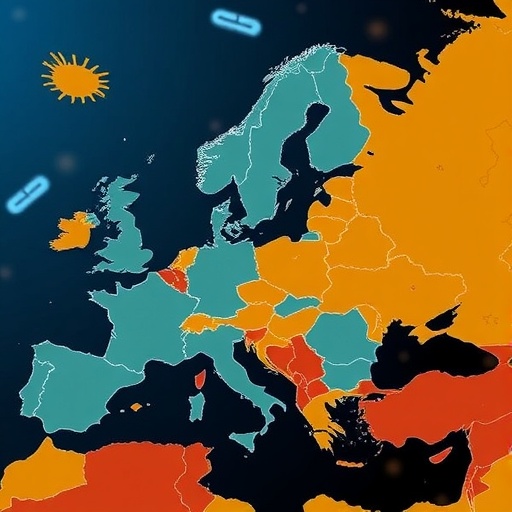
The mounting threat of antimicrobial resistance (AMR) continues to pose one of the most pressing public health crises worldwide. A seminal study recently published in PLOS Medicine sheds new light on this escalating risk, demonstrating how demographic changes in Europe are projected to significantly amplify the burden of drug-resistant bloodstream infections by mid-century. Using extensive computational modeling based on over 12 million blood infection susceptibility tests collected from 29 European countries over a decade, researchers have provided a stark and nuanced forecast of the future landscape of AMR – a landscape shaped not only by microbial evolution, but importantly, by shifting age and sex demographics.
This ambitious modeling effort, led by Gwenan Knight at the London School of Hygiene and Tropical Medicine alongside collaborators from the UK and Australia, represents a pioneering integration of epidemiological surveillance data with demographic projections. The researchers rigorously analyzed bacterial susceptibility patterns from routine clinical blood cultures between 2010 and 2019, stratifying these by patient age and sex to predict incidence rate trajectories through 2050. Their results unambiguously indicate that the incidence of bloodstream infections caused by drug-resistant bacteria is expected to rise substantially, but crucially, this increase will not be uniformly distributed across populations.
One of the most striking findings of the study is the disproportionate burden in older populations, especially those aged 74 years and above. While younger cohorts are predicted to experience relatively stable or even declining rates of resistant infections, the elderly face a steep and concerning escalation. This demographic effect underscores the role that aging populations will play in driving AMR challenges. The immune senescence and co-morbidities common in older adults likely compound vulnerability to infection and resistance development, making this group particularly susceptible to severe outcomes.
Moreover, the study highlights significant sex-based differences, with men projected to see higher increases in drug-resistant infections than women for six of the eight bacteria-antibiotic combinations analyzed. This aspect of the findings draws attention to biological and perhaps behavioral factors contributing to differential infection risks and resistance acquisition between genders, an area that has been underexplored in previous resistance burden models. The research thus calls for greater incorporation of sex as a biological variable in AMR surveillance and intervention planning.
Country-specific variations further complicate the European AMR landscape. The study reveals that national differences in both demographic trends and historic infection rates will lead to heterogeneous burdens across the continent. This variability demands tailored public health responses that consider not only microbial resistance patterns but also demographic realities unique to each country. One-size-fits-all policies are unlikely to be optimally effective in curbing resistance emergence and spread.
Of considerable concern is the study’s conclusion regarding the feasibility of international AMR reduction targets. The United Nations has set ambitious goals to reduce resistant infections by 10% by 2030. However, the modeling suggests that such reductions may only be achievable for approximately two-thirds of bacteria-antibiotic pairs even under optimistic intervention scenarios. This sobering insight illustrates the complexity and resilience of resistance mechanisms, demanding enhanced and multifaceted public health strategies.
Gwenan Knight emphasized that preventing further rises in resistant infections – rather than achieving outright reductions – would represent a substantial public health success, particularly among older adults who are projected to bear the brunt of this burden. The findings reinforce the urgent need to prioritize interventions in vulnerable populations and integrate demographic factors systematically into AMR forecasting and management frameworks.
The study also pushes methodological boundaries by demonstrating the critical importance of combining demographic data with age and sex-stratified infection prevalence in projections. Such comprehensive approaches uncover hidden vulnerabilities and refine predictions, enabling health authorities to better allocate resources and design interventions that align with evolving population structures.
Coauthor Catrin Moore noted the significance of these findings for guiding future research and policy. By elucidating demographic patterns that influence AMR dynamics, the study serves as a blueprint for developing targeted intervention trials, heightened surveillance strategies, and health system adaptations geared toward high-risk groups. The anticipated rise in resistant bloodstream infections among older Europeans, in particular, demands immediate attention to improve patient outcomes and curb mortality linked to drug resistance.
This research draws attention to a sobering future in which demographic shifts act as powerful drivers of antimicrobial resistance, compounding the effects of microbial adaptability and selective antibiotic pressures. It calls for a paradigm shift in our approach to AMR: from purely microbiological and pharmacological solutions toward integrated demographic and epidemiological strategies that anticipate how aging and sex disparities will reshape the burden landscape in coming decades.
As resistance continues to undermine the efficacy of frontline antibiotics, the study highlights the fragility of current progress and the paramount importance of sustained investment in robust surveillance, innovative therapeutics, and precision public health interventions. Ultimately, safeguarding the effectiveness of antibiotics requires an expanded lens that accounts for the complex interplay between human populations and microbial evolution.
The urgency and scope of these findings will resonate across public health, clinical, and policy domains. They underscore that the fight against AMR is as much about understanding who is most at risk within aging societies as about confronting the microbes themselves. Tackling this dual challenge will define the global health agenda in the decades ahead, demanding collaboration, innovation, and vigilance.
Cite Scienmag News
Kristina Jarvis. (November 4, 2025). Demographic Changes May Drive Rise in Drug-Resistant Infections Across Europe. Scienmag. https://scienmag.com/demographic-changes-may-drive-rise-in-drug-resistant-infections-across-europe/
Kristina Jarvis. "Demographic Changes May Drive Rise in Drug-Resistant Infections Across Europe." Scienmag, 4 November 2025, https://scienmag.com/demographic-changes-may-drive-rise-in-drug-resistant-infections-across-europe/. Accessed 4 September 2026.
Kristina Jarvis. "Demographic Changes May Drive Rise in Drug-Resistant Infections Across Europe." Scienmag. November 4, 2025. https://scienmag.com/demographic-changes-may-drive-rise-in-drug-resistant-infections-across-europe/


