

Thursday, October 22, 2026
Science
No Result
View All Result
  • Login
  • HOME
  • SCIENCE NEWS
  • CONTACT US
  • HOME
  • SCIENCE NEWS
  • CONTACT US
No Result
View All Result
Scienmag
No Result
View All Result
Home Science News Technology and Engineering

Delft researchers build light-controlled soft actuator powered by algae

October 22, 2026
in Technology and Engineering
Denise Maddox
By Denise Maddox Scienmag Editorial Profile - Mechanical Engineering
Reading Time: 3 mins read
0
Delft researchers build light-controlled soft actuator powered by algae

Delft researchers build light-controlled soft actuator powered by algae

65
SHARES
587
VIEWS
Share on FacebookShare on Twitter
ADVERTISEMENT

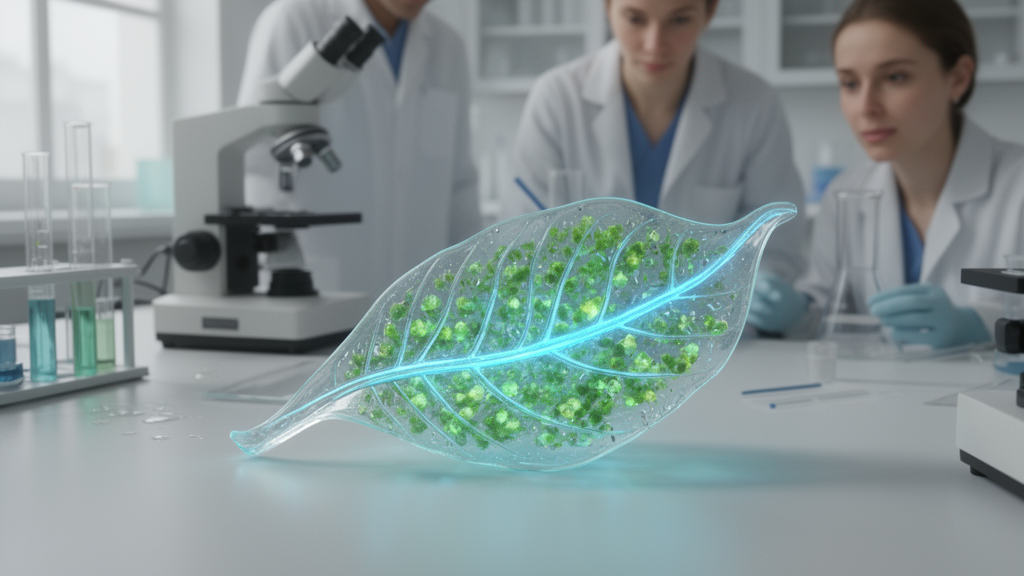
Researchers at Delft University of Technology have developed a proof-of-concept soft robotic actuator that uses living microalgae to convert light-driven metabolism into reversible bending, underwater grasping and object lifting. The experimental device is a green, flexible strip about 2 centimeters long and 1 millimeter thick, formed from two different hydrogel layers with microalgae growing on its surface. Demonstrated in an aquatic setting, the strip hooked and lifted a rubber ring and grasped a small metal ball, according to the researchers’ report in Nature Communications .

The bending mechanism begins with the microorganisms’ metabolism. Under illumination, the algae use light energy and carbon dioxide to make sugars through photosynthesis while also using nitrogen to build cellular components. Together, these processes increase the pH inside the hydrogels.

Because the two layers respond differently to pH changes, they swell to different degrees, forcing the strip to curve. When the light is switched off, the algae use or “burn” their stored cellular fuel and release carbon dioxide, shifting the pH back down. Within 10 seconds, the actuator begins bending in the opposite direction.

The experiments therefore demonstrate a light-responsive, reversible mechanical response rather than a one-time deformation. Lead researcher Marie-Eve Aubin-Tam described the actuator as a proof-of-concept living-material strip whose shape can be modified to produce different movements and functions. The researchers used its bending action for simple underwater manipulation tasks, including lifting a rubber ring and holding a small metal ball.

They do show, however, that photosynthetic organisms can serve as the biological control layer in a soft material that translates metabolic activity into movement, including the manipulation of discrete objects. The project was not designed around a single predetermined application. “We didn’t start with a specific application,” Aubin-Tam said.

“Our goal has always been to bring the research of living materials to new levels. We wanted to explore what becomes possible when living cells are integrated into functional materials.” The team also said its light-controlled bending could eventually be incorporated into blinds or agricultural devices that change shape or orientation in response to light. Those examples are proposed directions for development, not tested products in the reported study.

More broadly, the work offers a platform for investigating soft robotic and biomimetic functions that resemble movements found in nature. Microalgae may also provide a route to soft robotic systems that are relatively autonomous and environmentally responsive. The organisms are plantlike and largely self-sustaining, obtaining energy through photosynthesis.

In principle, an actuator based on this biological process could operate with minimal external energy and for extended periods, the researchers said. The release did not report a measured operating lifetime or energy consumption, so those longer-term possibilities remain unverified. Aubin-Tam nevertheless said the experiment was compelling because it directly visualized metabolism in microorganisms being translated into mechanical motion: “To see synthetic materials actually translate the algae’s biological responses into mechanical motion.” First author Fan Jiang and the team reported the algae-coated hydrogel actuator, its reversible bending and its underwater manipulation demonstrations in the experimental study.

Subject of Research: Experimental development of a light-controlled, microalgae-powered soft robotic actuator

Article Title: A soft robot arm powered by algae and light

Article References: A soft robot arm powered by algae and light. Original publication (Bibliographic details unavailable.)

Image Credits: AI Generated

DOI: Not provided

Keywords: soft robotics, microalgae, light control, biohybrid materials, hydrogel actuator, photosynthesis, underwater robotics, biomimetics, living materials, Delft University of Technology, soft, robot

Cite Scienmag News

Denise Maddox. (October 22, 2026). Delft researchers build light-controlled soft actuator powered by algae. Scienmag. https://scienmag.com/delft-researchers-build-light-controlled-soft-actuator-powered-by-algae/

Denise Maddox. "Delft researchers build light-controlled soft actuator powered by algae." Scienmag, 22 October 2026, https://scienmag.com/delft-researchers-build-light-controlled-soft-actuator-powered-by-algae/. Accessed 22 October 2026.

Denise Maddox. "Delft researchers build light-controlled soft actuator powered by algae." Scienmag. October 22, 2026. https://scienmag.com/delft-researchers-build-light-controlled-soft-actuator-powered-by-algae/


Tags: algae-induced mechanical actuationalgae-powered underwater graspingbiohybrid materialsbiohybrid soft roboticsbiomimeticsDelft University of Technologyenvironmentally friendly soft actuationhydrogel actuatorhydrogel layered actuatorslight controlLight-controlled soft robotic actuatorlight-responsive underwater manipulationliving materialsliving microalgae in soft robotsMicroalgaemicroalgae-based reversible bendingpH-responsive biomimetic devicesphotosynthesisphotosynthesis-driven soft roboticsrobotsoftsoft roboticssustainable algae-powered actuatorsunderwater robotics
Share26Tweet16
Previous Post

Small-cohort nnU-Net study shows promise for pediatric Wilms tumor MRI segmentation

Next Post

Review proposes network-level GPCR control against multiple aging processes

Related Posts

WeanNet transfers learning through fading neural connections
Technology and Engineering

WeanNet transfers learning through fading neural connections

October 22, 2026
Experiment finds CrMnFeCoNi hardens as nanograins grow under torsion
Technology and Engineering

Experiment finds CrMnFeCoNi hardens as nanograins grow under torsion

October 22, 2026
Multi-criteria Genetic Planning Extends Simulated Continuum Robot Lifetime
Technology and Engineering

Multi-criteria Genetic Planning Extends Simulated Continuum Robot Lifetime

October 22, 2026
Laboratory study finds confined FER zeolite enables selective olefin carbonylation
Medicine

Laboratory study finds confined FER zeolite enables selective olefin carbonylation

October 22, 2026
In-Situ Graphene Networks Strengthen Nickel Composites
Technology and Engineering

In-Situ Graphene Networks Strengthen Nickel Composites

October 22, 2026
Engineered yeast produces cheese-making protein but exposes secretion bottlenecks
Science News

Engineered yeast produces cheese-making protein but exposes secretion bottlenecks

October 22, 2026
Next Post
Review proposes network-level GPCR control against multiple aging processes

Review proposes network-level GPCR control against multiple aging processes

  • Mothers who receive childcare support from maternal grandparents show more optimized

    Mothers who receive childcare support from maternal grandparents show more parental warmth, finds NTU Singapore study

    27656 shares
    Share 11059 Tweet 6912
  • University of Seville Breaks 120-Year-Old Mystery, Revises a Key Einstein Concept

    1061 shares
    Share 424 Tweet 265
  • Bee body mass, pathogens and local climate influence heat tolerance

    682 shares
    Share 273 Tweet 171
  • Researchers record first-ever images and data of a shark experiencing a boat strike

    546 shares
    Share 218 Tweet 137
  • Groundbreaking Clinical Trial Reveals Lubiprostone Enhances Kidney Function

    531 shares
    Share 212 Tweet 133
Science

Embark on a thrilling journey of discovery with Scienmag.com—your ultimate source for cutting-edge breakthroughs. Immerse yourself in a world where curiosity knows no limits and tomorrow’s possibilities become today’s reality!

RECENT NEWS

  • Review proposes network-level GPCR control against multiple aging processes
  • Delft researchers build light-controlled soft actuator powered by algae
  • Small-cohort nnU-Net study shows promise for pediatric Wilms tumor MRI segmentation
  • Research report: Artificial intelligence literacy and innovative behavior among clinical nurses: the roles of AI self-efficacy and organizational innovation climate

Categories

  • Agriculture
  • Anthropology
  • Archaeology
  • Athmospheric
  • Biology
  • Biotechnology
  • Blog
  • Bussines
  • Cancer
  • Chemistry
  • Climate
  • Earth Science
  • Editorial Policy
  • Marine
  • Mathematics
  • Medicine
  • Pediatry
  • Policy
  • Psychology & Psychiatry
  • Science Education
  • Science News
  • Social Science
  • Space
  • Technology and Engineering

Subscribe to Blog via Email

Enter your email address to subscribe to this blog and receive notifications of new posts by email.

Join 5,151 other subscribers

© 2025 Scienmag - Science Magazine

Welcome Back!

Login to your account below

Forgotten Password?

Retrieve your password

Please enter your username or email address to reset your password.

Log In
No Result
View All Result
  • HOME
  • SCIENCE NEWS
  • CONTACT US

© 2025 Scienmag - Science Magazine

Discover more from Science

Subscribe now to keep reading and get access to the full archive.

Continue reading