


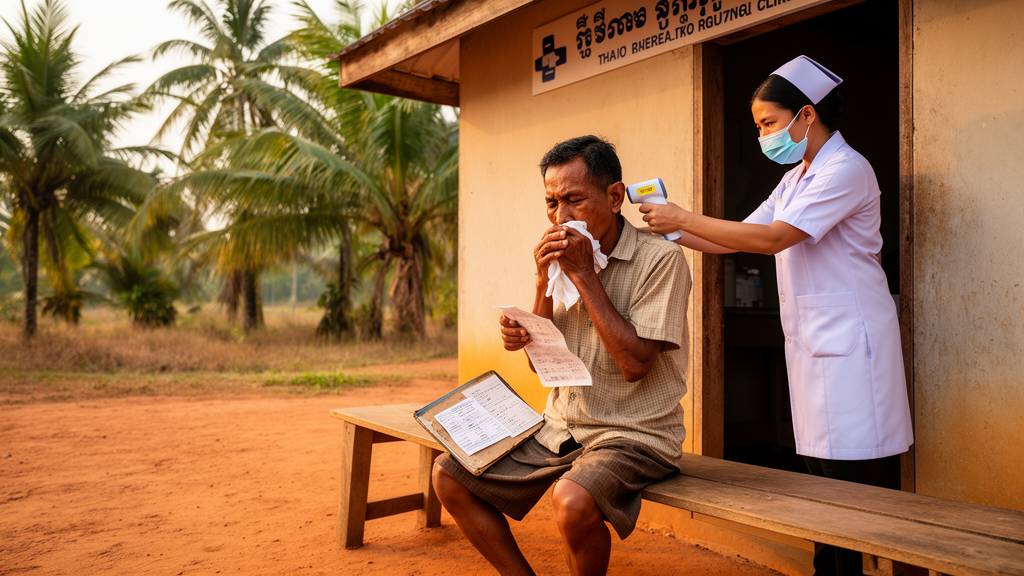
Every day a tuberculosis infection goes undiagnosed, the bacterium quietly damages lung tissue while the patient’s savings drain away. A new cross-sectional study from Cambodia now shows just how tightly these two harms are linked. Among adults newly diagnosed with tuberculosis through active case-finding programs, roughly one in ten had already incurred costs before diagnosis that exceeded 10 percent of their annual household income, and those whose diagnosis came later faced nearly triple the odds of such financial catastrophe compared with people diagnosed sooner.
The research, published in BMC Health Services Research, draws on baseline data from a tuberculosis cohort collected between March and September 2022. The team recruited 711 participants aged 18 and older across 10 operational districts in Cambodia, each of whom had been diagnosed with tuberculosis within one month before recruitment. This design allowed the investigators to capture the full pre-diagnosis period, from the first cough or fever to the moment a laboratory test finally confirmed the disease.
Diagnosis delay was defined as the time from the onset of tuberculosis symptoms to the date of diagnosis. The median delay was 64 days, with a range stretching from a single day to a full year. That means half of the newly diagnosed patients waited more than two months for answers, a window in which untreated tuberculosis can progress substantially and transmission to family members and neighbors continues unchecked.
The cost analysis focused on what researchers call pre-diagnosis catastrophic costs, defined as total tuberculosis-related expenses incurred before diagnosis amounting to at least 10 percent of annual household income. The estimated prevalence at this threshold was 8.6 percent, with a 95 percent confidence interval of 6.6 to 11.1 percent. While that figure may appear modest, it represents a substantial share of households pushed toward financial crisis by a single episode of illness, before any treatment costs even begin.
The technical breakdown of these expenses reveals where the money actually goes. Direct medical costs accounted for 80.6 percent of total pre-diagnosis costs, dwarfing indirect expenses such as transport or lost income during the diagnostic phase. Among participants who sought healthcare before diagnosis, median out-of-pocket spending was highest for private health practitioners, at 90 US dollars with an interquartile range of 31 to 200, followed by pharmacies at 30 US dollars with an interquartile range of 13.88 to 83. In a country where many households live close to the poverty line, these sums can consume weeks or months of earnings.
The pattern of care-seeking is telling. Patients repeatedly turn first to private practitioners and pharmacies rather than public health facilities, paying out of pocket at each stop. Each consultation that fails to yield a correct diagnosis adds another layer of expense while the clock keeps running. By the time many patients reach the public system, they have already cycled through multiple providers, and the accumulated spending has quietly crossed the catastrophic threshold.
To test the statistical association between delay and financial harm, the investigators performed multivariable logistic regression among the 256 participants who reported using health services for tuberculosis symptoms before diagnosis. This restriction matters: it isolates the relationship among people who were actually engaged with the health system, rather than those who never sought care at all. Among this subgroup, a diagnosis delay of 64 days or more was significantly associated with higher odds of experiencing pre-diagnosis catastrophic costs, with a pooled adjusted odds ratio of 2.87 and a 95 percent confidence interval of 1.42 to 5.80. In practical terms, patients whose diagnosis took at least two months faced nearly three times the odds of financial catastrophe compared with those diagnosed faster, after adjusting for other factors.
The findings arrive at a moment when global tuberculosis control faces persistent headwinds. The World Health Organization has long identified catastrophic costs as a key barrier to ending the tuberculosis epidemic, and evidence from Southeast Asia on the link between catastrophic costs and diagnosis delay has been particularly limited. This Cambodian study helps fill that gap with hard numbers from a real-world cohort, showing that the financial damage begins well before treatment starts and grows with every day of diagnostic uncertainty.
For the researchers, the policy implications point in two directions. First, tuberculosis awareness needs strengthening, especially among financially vulnerable populations who may delay seeking care or lack the knowledge to recognize symptoms early. Second, access to timely diagnostic services in public health facilities must improve, so that patients who do seek care are not bounced between private providers and pharmacies that cannot confirm the disease. The study was conducted under the COMMIT project, a community mobilization initiative funded by the U.S. Agency for International Development, and received ethical approval from the National Ethics Committee for Health Research in Cambodia and the Institutional Review Board of the University of Tsukuba.
The broader lesson extends beyond Cambodia. Tuberculosis remains one of the world’s deadliest infectious diseases, and the economics of diagnosis are inseparable from the biology of the epidemic. Every week of delay allows more bacilli to accumulate in the lungs, more transmission events to occur, and more household budgets to erode. The Cambodian data make the case that ending the tuberculosis epidemic requires not just better drugs and vaccines, but faster diagnosis and financial protection from the very first symptom. Until then, patients will keep paying the price, in both health and money, for a disease that could have been caught weeks earlier.
Subject of Research: Diagnosis delay and pre-diagnosis catastrophic costs in newly diagnosed adults with tuberculosis in Cambodia: a cross-sectional study
Article Title: Diagnosis delay and pre-diagnosis catastrophic costs in newly diagnosed adults with tuberculosis in Cambodia: a cross-sectional study
Article References: Eng, S., Teo, A. K. J., Tuot, S., Pall, C., Tep, S., Yi, S., Ichikawa, M., & Prem, K. (2026). Diagnosis delay and pre-diagnosis catastrophic costs in newly diagnosed adults with tuberculosis in Cambodia: a cross-sectional study. BMC Health Services Research. https://doi.org/10.1186/s12913-026-15710-9
Image Credits: AI Generated
DOI: 10.1186/s12913-026-15710-9
Keywords: Diagnosis, delay, pre-diagnosis, catastrophic, costs, newly, diagnosed, adults, tuberculosis, Cambodia, cross-sectional, scientific research
Cite Scienmag News
Ophelia Keating. (October 18, 2026). Delayed TB Diagnosis in Cambodia Drives Catastrophic Costs for Patients. Scienmag. https://scienmag.com/delayed-tb-diagnosis-in-cambodia-drives-catastrophic-costs-for-patients/
Ophelia Keating. "Delayed TB Diagnosis in Cambodia Drives Catastrophic Costs for Patients." Scienmag, 18 October 2026, https://scienmag.com/delayed-tb-diagnosis-in-cambodia-drives-catastrophic-costs-for-patients/. Accessed 18 October 2026.
Ophelia Keating. "Delayed TB Diagnosis in Cambodia Drives Catastrophic Costs for Patients." Scienmag. October 18, 2026. https://scienmag.com/delayed-tb-diagnosis-in-cambodia-drives-catastrophic-costs-for-patients/


