Wednesday, October 28, 2026
Science
No Result
View All Result
  • Login
  • HOME
  • SCIENCE NEWS
  • CONTACT US
  • HOME
  • SCIENCE NEWS
  • CONTACT US
No Result
View All Result
Scienmag
No Result
View All Result
Home Science News Mathematics

Delayed immune responses can push a tumor-immune model into oscillations

October 28, 2026
in Mathematics
Nathaniel Bowman
By Nathaniel Bowman Scienmag Editorial Profile - Precision Oncology
Reading Time: 3 mins read
0
Delayed immune responses can push a tumor-immune model into oscillations

Delayed immune responses can push a tumor-immune model into oscillations

65
SHARES
587
VIEWS
Share on FacebookShare on Twitter
ADVERTISEMENT

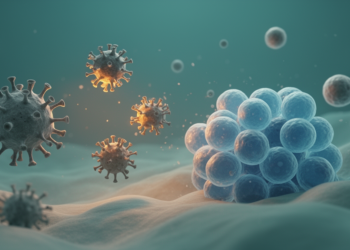
A new mathematical study examines what happens when the immune system’s response to a tumor is treated as delayed, using a fractional-order model of tumor-immune interactions. The work, published in Advances in Continuous and Discrete Models, analyzes a system involving three components: immune effector cells, tumor cells, and interleukin-2, a signaling molecule involved in immune communication.

The model’s key innovation is a time delay that represents the delayed activation and proliferation of effector cells induced by immune stimulation. In biological terms, this reflects the fact that immune cells do not respond instantaneously to signals; their activation and expansion take time. The authors, led by Mengyan Liu, with co-authors including Xiaozhou Feng, Changtong Li, Fei Xie and Xiaofang Guo, published the peer-reviewed article on 9 October 2026.

The study focuses on stability and Hopf bifurcation analysis. For the commensurate-order case of the fractional-order system, the researchers first establish the existence of equilibrium points, the mathematical states at which the populations of tumor cells, effector cells, and interleukin-2 would remain constant over time.

Next, the team analyzes the local stability of the positive equilibrium, the equilibrium in which all three populations are present. This is done by deriving the corresponding characteristic equation, a standard mathematical tool for determining whether small perturbations around an equilibrium decay back to it or grow away from it.

The central analytical move is to treat the time delay as a bifurcation parameter, a quantity whose variation can qualitatively change the system’s behavior. The authors derive sufficient conditions for stability switching, meaning values of the delay at which the positive equilibrium loses its stability, and for the occurrence of Hopf bifurcation at a critical delay value. A Hopf bifurcation marks the point at which a stable steady state gives way to sustained oscillations.

The theoretical results are accompanied by numerical simulations, which serve two purposes: verifying the analytical findings and illustrating how the fractional order and the time delay affect the dynamic behavior of the system.

The simulations support the paper’s main qualitative conclusion: increasing the delay can destabilize the positive equilibrium and lead to sustained oscillations in the modeled tumor-immune dynamics. In other words, the longer the modeled lag in effector cell activation and proliferation, the more likely the system is to shift from a steady state into persistent cycles. The fractional order, meanwhile, affects the critical bifurcation threshold, meaning it changes the delay value at which this stability switch occurs.

The authors frame these findings as theoretical insight into the dynamic mechanisms of tumor-immune interactions, offering a qualitative reference for further mathematical modeling of immunotherapy-related processes. It is important to note the scope of the work: this is a mathematical analysis of a model, not an experimental or clinical study. The results concern the behavior of the equations themselves, and no patient data, experimental measurements, or clinical outcomes are reported in the abstract. Any connection to actual immunotherapy would require further modeling and empirical validation.

Within that scope, the study adds to a growing body of work on delayed tumor-immune models, including prior analyses of fractional-order tumor-immune systems with time delays and of cancer models with delays in tumor-immune interaction and stimulation processes. The contribution here lies in combining the fractional-order framework with a delay-driven stability-switching analysis for a three-component system, and in explicitly quantifying how both the delay and the fractional order shape the onset of oscillations.

Subject of Research: Stability and Hopf bifurcation analysis of a delayed fractional-order tumor-immune interaction model

Article Title: Stability and bifurcation analysis of a delayed fractional-order tumor-immune model

Article References: Liu, M., Feng, X., Li, C., Xie, F., & Guo, X. (2026). Stability and bifurcation analysis of a delayed fractional-order tumor-immune model. Advances in Continuous and Discrete Models. https://doi.org/10.1186/s13662-026-04129-5

Image Credits: AI Generated

DOI: 10.1186/s13662-026-04129-5

Keywords: fractional-order model, tumor-immune dynamics, time delay, Hopf bifurcation, stability analysis, interleukin-2, effector cells, dynamical systems, mathematical modeling, immunotherapy modeling, Stability, bifurcation

Cite Scienmag News

Nathaniel Bowman. (October 28, 2026). Delayed immune responses can push a tumor-immune model into oscillations. Scienmag. https://scienmag.com/delayed-immune-responses-can-push-a-tumor-immune-model-into-oscillations/

Nathaniel Bowman. "Delayed immune responses can push a tumor-immune model into oscillations." Scienmag, 28 October 2026, https://scienmag.com/delayed-immune-responses-can-push-a-tumor-immune-model-into-oscillations/. Accessed 28 October 2026.

Nathaniel Bowman. "Delayed immune responses can push a tumor-immune model into oscillations." Scienmag. October 28, 2026. https://scienmag.com/delayed-immune-responses-can-push-a-tumor-immune-model-into-oscillations/

Tags: bifurcationdelayed immune response in cancerdynamical systemseffector cellsfractional-order mathematical modelsfractional-order modelHopf bifurcationHopf bifurcation in cancer modelsimmunotherapy modelinginterleukin-2interleukin-2 signaling in immune responsemathematical analysis of effector cell proliferationmathematical modelingnonlinear dynamics in cancer immunologyoscillatory behavior in tumor growthstabilitystability analysisstability analysis of tumor-immune systemstime delaytime delay effects on immune activationtumor-immune dynamicstumor-immune interaction modelingtumor-immune system dynamicstumor-immune system equilibrium points
Share26Tweet16
Previous Post

Trained Panel Maps Distinct Sensory Profiles of Agroecological Prickly Pear in Zacatecas

Next Post

Entry-level facilitator training builds master’s students’ confidence and reflective mindset, qualitative study finds

Related Posts

ESG and Chinese Sector Stocks Show Strong Links Under Extreme Market Events
Mathematics

ESG and Chinese Sector Stocks Show Strong Links Under Extreme Market Events

October 28, 2026
Mathematical model shows spraying plus Wolbachia can suppress mosquitoes in finite time
Mathematics

Mathematical model shows spraying plus Wolbachia can suppress mosquitoes in finite time

October 28, 2026
Oil or Bitcoin? Geopolitical risk decides which leads equity markets
Mathematics

Oil or Bitcoin? Geopolitical risk decides which leads equity markets

October 28, 2026
Mathematicians Solve Poisson’s Equation in a Right-Isosceles Triangle with an Explicit Series
Mathematics

Mathematicians Solve Poisson’s Equation in a Right-Isosceles Triangle with an Explicit Series

October 28, 2026
Model probes COVID-19 control after policy relaxation, with breakthrough infection and immune failure
Mathematics

Model probes COVID-19 control after policy relaxation, with breakthrough infection and immune failure

October 28, 2026
Neural operators learn to track changing shapes in free boundary problems, with measured limits
Mathematics

Neural operators learn to track changing shapes in free boundary problems, with measured limits

October 28, 2026
Next Post
Entry-level facilitator training builds master’s students’ confidence and reflective mindset, qualitative study finds

Entry-level facilitator training builds master's students' confidence and reflective mindset, qualitative study finds

  • Mothers who receive childcare support from maternal grandparents show more optimized

    Mothers who receive childcare support from maternal grandparents show more parental warmth, finds NTU Singapore study

    27656 shares
    Share 11059 Tweet 6912
  • University of Seville Breaks 120-Year-Old Mystery, Revises a Key Einstein Concept

    1061 shares
    Share 424 Tweet 265
  • Bee body mass, pathogens and local climate influence heat tolerance

    682 shares
    Share 273 Tweet 171
  • Researchers record first-ever images and data of a shark experiencing a boat strike

    546 shares
    Share 218 Tweet 137
  • Groundbreaking Clinical Trial Reveals Lubiprostone Enhances Kidney Function

    531 shares
    Share 212 Tweet 133
Science

Embark on a thrilling journey of discovery with Scienmag.com—your ultimate source for cutting-edge breakthroughs. Immerse yourself in a world where curiosity knows no limits and tomorrow’s possibilities become today’s reality!

RECENT NEWS

  • Systematic review maps end-of-life psychosocial and spiritual needs in physical disability
  • Text Message Campaign Reached Only a Third of Patients Overdue for Colorectal Cancer Screening
  • FOXO1 Emerges as Candidate Regulator and Biomarker in Hip Dysplasia
  • Regulators, developers and clinicians in Shenzhen voice concerns over medical AI governance

Categories

  • Agriculture
  • Anthropology
  • Archaeology
  • Athmospheric
  • Biology
  • Biotechnology
  • Blog
  • Bussines
  • Cancer
  • Chemistry
  • Climate
  • Earth Science
  • Editorial Policy
  • Marine
  • Mathematics
  • Medicine
  • Pediatry
  • Policy
  • Psychology & Psychiatry
  • Science Education
  • Science News
  • Social Science
  • Space
  • Technology and Engineering

Subscribe to Blog via Email

Enter your email address to subscribe to this blog and receive notifications of new posts by email.

Join 5,151 other subscribers

© 2025 Scienmag - Science Magazine

Welcome Back!

Login to your account below

Forgotten Password?

Retrieve your password

Please enter your username or email address to reset your password.

Log In
No Result
View All Result
  • HOME
  • SCIENCE NEWS
  • CONTACT US

© 2025 Scienmag - Science Magazine

Discover more from Science

Subscribe now to keep reading and get access to the full archive.

Continue reading