


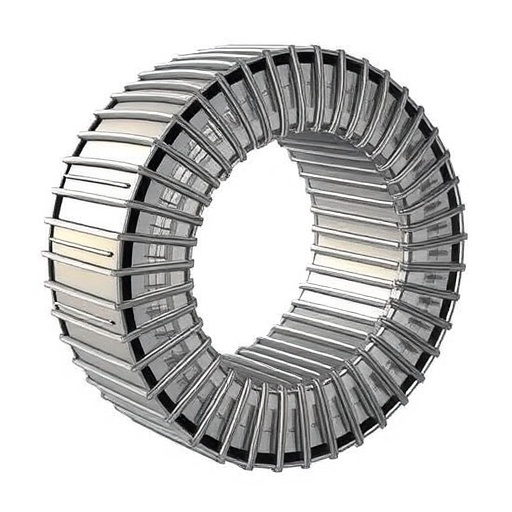
A team led by Li and colleagues has unveiled a flexible MRI receive coil engineered to stay mechanically stable while delivering high-fidelity images across both static scans and changing patient postures. The work addresses a persistent weakness of soft electronics in magnetic resonance: when coils deform, subtle shifts in alignment and electrical performance can degrade signal quality, especially during dynamic or multi-pose acquisitions.
At the heart of the design is a deformation-stabilized structure that uses modulus-transition interfaces. Rather than relying on a uniformly soft or uniformly rigid material, the coil integrates regions with different elastic moduli, creating controlled mechanical gradients. This strategy aims to reduce unwanted bending, warping, and strain concentration—effects that can otherwise translate into reduced sensitivity or spatial distortion.
The researchers position the modulus-transition interfaces as “mechanical buffers.” By tuning how stiffness changes across the coil, the interfaces help maintain effective coil geometry under real-world handling and body contact. In principle, this reduces the variation of key electromagnetic factors, such as coupling and local inductive behavior, which are sensitive to physical conformation.
Unlike classic rigid coil housings that limit comfort and pose versatility, the flexible receive coil targets practical imaging scenarios where subjects may shift. The study emphasizes compatibility with multi-pose dynamic MRI, where consistent receive performance must persist even as the body or coil orientation changes between acquisitions.
To validate the approach, the authors report measurements under both static conditions and multiple poses, comparing image quality and signal fidelity. The results indicate that the modulus-transition concept can suppress deformation-driven performance loss, helping preserve reconstruction quality over time and across configurations.
This development is particularly relevant for clinical and research MRI workflows that require rapid adaptation—such as monitoring motion, evaluating anatomies that are difficult to stabilize, or improving throughput by reducing repositioning constraints.
From a materials and engineering standpoint, the design also suggests a broader pathway for soft wearable medical electronics: mechanical function can be engineered through spatially patterned stiffness transitions rather than through purely geometric reinforcement.
The team’s findings appear in npj Flexible Electronics (2026) and are summarized in the paper “Deformation-stabilized flexible receive coil with modulus-transition interfaces for high-fidelity static and multi-pose dynamic MRI,” DOI: 10.1038/s41528-026-00616-7.
Overall, the work points to a future where flexible MRI hardware can deliver repeatable, deformation-tolerant performance—bringing more reliable imaging to dynamic, posture-varying, and patient-comfort-focused applications.
Cite Scienmag News
Denise Maddox. (July 27, 2026). Deformation-Stabilized Flexible Receive Coil Enables High-Fidelity Static and Dynamic MRI. Scienmag. https://scienmag.com/deformation-stabilized-flexible-receive-coil-enables-high-fidelity-static-and-dynamic-mri/
Denise Maddox. "Deformation-Stabilized Flexible Receive Coil Enables High-Fidelity Static and Dynamic MRI." Scienmag, 27 July 2026, https://scienmag.com/deformation-stabilized-flexible-receive-coil-enables-high-fidelity-static-and-dynamic-mri/. Accessed 4 September 2026.
Denise Maddox. "Deformation-Stabilized Flexible Receive Coil Enables High-Fidelity Static and Dynamic MRI." Scienmag. July 27, 2026. https://scienmag.com/deformation-stabilized-flexible-receive-coil-enables-high-fidelity-static-and-dynamic-mri/


