


As the climate changes, animals are doing what they can to adapt.

Credit: UBC Okanagan
As the climate changes, animals are doing what they can to adapt.
Researchers from UBC Okanagan—which includes partners from Biodiversity Pathways’ Wildlife Science Centre, the Alberta Biodiversity Monitoring Institute, the University of Alberta, and Environment and Climate Change Canada—wanted to evaluate why deer densities in the boreal forest are rapidly increasing.
Over the past century, white-tailed deer have greatly expanded their range in North America, explains Melanie Dickie, a doctoral student with UBC Okanagan’s Wildlife Restoration Ecology Lab.
In the boreal forest of Western Canada, researchers have considered that both changing climate and increased habitat alteration have enabled deer to push farther north. Climate change can create milder winters, while habitat alteration from forestry and energy exploration creates new food sources for deer.
As they conclude their study, researchers caution that what is good for the deer isn’t necessarily suitable for other species, such as the threatened woodland caribou.
Dickie, as well as fellow UBCO and Biodiversity Pathways researchers Drs. Adam Ford, Michael Noonon, Robin Steenweg and Rob Serrouya, have monitored the white-tailed deer’s movement into the western boreal forest for more than five years.
As global temperatures climb, the researchers note that deer expansion is uprooting existing predator-prey dynamics.
“The expansion of white-tailed deer into the boreal forest has been linked to caribou declines,” explains Dickie. “Deer are ecosystem disruptors in the northern boreal forests. Areas with more deer typically have more wolves, and these wolves are predators of caribou—a species under threat. Deer can handle high predation rates, but caribou cannot.”
Understanding white-tailed deer populations continues to be one piece of the caribou recovery puzzle.
“The trick is that human land use and climate are often intertwined. As we move northward, the climate becomes harsher and human land use decreases, making it difficult to isolate these two factors,” says Dr. Serrouya. “The debate over the relative effect of climate or habitat change isn’t unique to deer in the boreal, either; it’s one of the most pressing issues facing applied ecologists globally.”
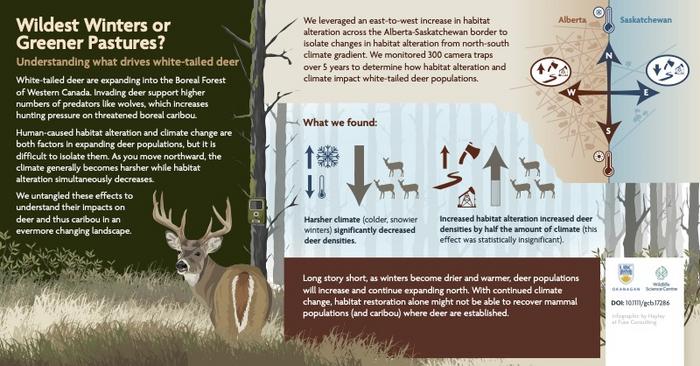
The researchers determined that the northern Alberta-Saskatchewan border provided a convenient experimental location. While both sides have a consistent climate, habitat alteration is, on average, 3.6-fold higher on the Alberta side.
Between 2017 and 2021, the research team maintained 300 wildlife cameras throughout the region to collect motion-triggered images of large mammals. These images were used to estimate white-tailed deer density.
Key findings from the study include that deer density was significantly lower in areas with colder, snowier winters. While human land use was associated with higher deer densities, the effect of human-caused habitat change was much smaller than that of climate.
Winter severity is expected to decline as climate change progresses. This means that deer are expected to keep expanding northwards and increase in abundance, adding an increased risk to the caribou.
“When planning for caribou recovery, we need to consider these new forest residents,” says Dr. Ford. “We are now well into the United Nations Decade on Ecosystem Restoration, but when doing restoration, we have to account for new pathways of species interacting in the food web.”
The research was published today in the journal Global Change Biology.
Journal
Global Change Biology
Method of Research
Observational study
Subject of Research
Animals
Article Title
Habitat alteration or climate: What drives the densities of an invading ungulate?
Article Publication Date
25-Apr-2024
Cite Scienmag News
Sloane Callahan. (April 25, 2024). Deer are expanding north, and that’s not good for caribou. Scienmag. https://scienmag.com/deer-are-expanding-north-and-thats-not-good-for-caribou/
Sloane Callahan. "Deer are expanding north, and that’s not good for caribou." Scienmag, 25 April 2024, https://scienmag.com/deer-are-expanding-north-and-thats-not-good-for-caribou/. Accessed 4 September 2026.
Sloane Callahan. "Deer are expanding north, and that’s not good for caribou." Scienmag. April 25, 2024. https://scienmag.com/deer-are-expanding-north-and-thats-not-good-for-caribou/

