


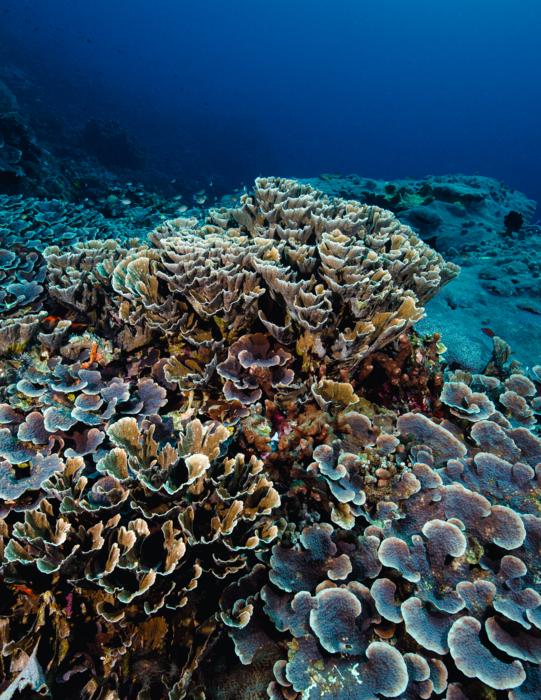
Some deeper areas of the Great Barrier Reef are insulated from harmful heatwaves – but that protection will be lost if global warming continues, according to new research.

Credit: Prof Peter Mumby
Some deeper areas of the Great Barrier Reef are insulated from harmful heatwaves – but that protection will be lost if global warming continues, according to new research.
High surface temperatures have caused mass “bleaching” of the Great Barrier Reef in five of the last eight years, with the latest happening now.
Climate change projections for coral reefs are usually based on sea surface temperatures, but this overlooks the fact that deeper water does not necessarily experience the same warming as that at the surface.
The new study – led by the universities of Exeter and Queensland – examined how changing temperatures will affect mesophotic corals (depth 30-50 metres).
It found that separation between warm buoyant surface water and cooler deeper water can insulate reefs from surface heatwaves, but this protection will be lost if global warming exceeds 3°C above pre-industrial levels.
The researchers say similar patterns could occur on other reefs worldwide, but local conditions affecting how the water moves and mixes will mean the degree to which deeper water coral refuges exist and remain insulated from surface heatwaves will vary.
“Coral reefs are the canary in the coalmine, warning us of the many species and ecosystems affected by climate change,” said Dr Jennifer McWhorter, who led the research during a QUEX PhD studentship at the universities of Exeter and Queensland.
“Coral bleaching is a dramatic sign of the impact humans are having on the planet.
“Our study offers both hope and a warning – hope that some reefs are resilient to current levels of climate change, and a warning that this resilience has its limits.”
The study finds that 3°C of global warming would push mesophotic temperatures in the Great Barrier Reef past 30°C – a recognised threshold for coral mortality.
This does not necessarily mean that all coral would die, but it would place the reef in a state of stress that would increase mortality and possibly cause it to collapse.
Dr McWhorter, now at NOAA’s Atlantic Oceanographic & Meteorological Laboratory, said: “Some shallow-water species are not found in deeper areas – so mesophotic reefs can’t provide refuges for them as shallow reefs are degraded.
“And, as our study shows, mesophotic corals are themselves threatened if global warming continues.”
To calculate their projections of mesophotic reefs warming, the research team considered factors such as wind and tidal mixing of water, and local complexities.
They estimate that, by 2050-60, bottom temperatures on the Great Barrier Reef (30-50 metres) will increase by 0.5-1°C under lower projected greenhouse gas emissions, and 1.2-1.7°C under higher emissions.
Dr Paul Halloran, from Exeter’s Global Systems Institute, said: “To protect coral reefs, we need to understand them better.
“Reefs face multiple threats – not just climate change. By targeting management of these threats on reefs that have the best chance of escaping the worst impacts of climate change, hopefully some healthy reefs can be maintained.
Professor Peter Mumby, from the University of Queensland, said: “There is so much to learn about deeper, tropical coral reefs, especially as we cannot assume that their depth provides a persistent refuge from the consequences of rising global carbon emissions.”
The paper, published in the journal Proceedings of the National Academy of Sciences, is entitled: “Climate change impacts on mesophotic regions of the Great Barrier Reef.”
Journal
Proceedings of the National Academy of Sciences
Article Title
Climate change impacts on mesophotic regions of the Great Barrier Reef.
Article Publication Date
8-Apr-2024
Cite Scienmag News
Sloane Callahan. (April 8, 2024). Deep parts of Great Barrier Reef ‘insulated’ from global warming – for now. Scienmag. https://scienmag.com/deep-parts-of-great-barrier-reef-insulated-from-global-warming-for-now-2/
Sloane Callahan. "Deep parts of Great Barrier Reef ‘insulated’ from global warming – for now." Scienmag, 8 April 2024, https://scienmag.com/deep-parts-of-great-barrier-reef-insulated-from-global-warming-for-now-2/. Accessed 4 September 2026.
Sloane Callahan. "Deep parts of Great Barrier Reef ‘insulated’ from global warming – for now." Scienmag. April 8, 2024. https://scienmag.com/deep-parts-of-great-barrier-reef-insulated-from-global-warming-for-now-2/

