


An international team of researchers, including a Northwestern University chemist, has discovered that metallic minerals on the deep-ocean floor produce oxygen — 13,000 feet below the surface.

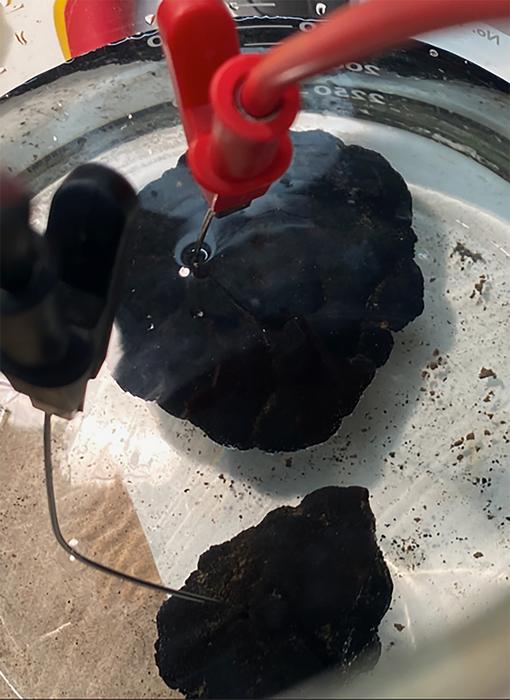
Credit: Franz Geiger/Northwestern University
An international team of researchers, including a Northwestern University chemist, has discovered that metallic minerals on the deep-ocean floor produce oxygen — 13,000 feet below the surface.
The surprising discovery challenges long-held assumptions that only photosynthetic organisms, such as plants and algae, generate Earth’s oxygen. But the new finding shows there might be another way. It appears oxygen also can be produced at the seafloor — where no light can penetrate — to support the oxygen-breathing (aerobic) sea life living in complete darkness.
The study will be published Monday (July 22) in the journal Nature Geoscience.
Andrew Sweetman, of the Scottish Association for Marine Science (SAMS), made the “dark oxygen” discovery while conducting ship-based fieldwork in the Pacific Ocean. Northwestern’s Franz Geiger led the electrochemistry experiments, which potentially explain the finding.
“For aerobic life to begin on the planet, there had to be oxygen, and our understanding has been that Earth’s oxygen supply began with photosynthetic organisms,” said Sweetman, who leads the Seafloor Ecology and Biogeochemistry research group at SAMS. “But we now know that there is oxygen produced in the deep sea, where there is no light. I think we, therefore, need to revisit questions like: Where could aerobic life have begun?”
Polymetallic nodules — natural mineral deposits that form on the ocean floor — sit at the heart of the discovery. A mix of various minerals, the nodules measure anywhere between tiny particles and an average potato in size.
“The polymetallic nodules that produce this oxygen contain metals such as cobalt, nickel, copper, lithium and manganese — which are all critical elements used in batteries,” said Geiger, who co-authored the study. “Several large-scale mining companies now aim to extract these precious elements from the seafloor at depths of 10,000 to 20,000 feet below the surface. We need to rethink how to mine these materials, so that we do not deplete the oxygen source for deep-sea life.”
Geiger is the Charles E. and Emma H. Morrison Professor of Chemistry at Northwestern’s Weinberg College of Arts and Sciences and member of the International Institute for Nanotechnology and the Paula M. Trienens Institute for Energy and Sustainability.
‘Something ground-breaking and unthought-of’
Sweetman made the discovery while sampling the seabed of the Clarion-Clipperton Zone, a mountainous submarine ridge along the seafloor that extends nearly 4,500 miles along the north-east quadrant of the Pacific Ocean. When his team initially detected oxygen, he assumed the equipment must be broken.
“When we first got this data, we thought the sensors were faulty because every study ever done in the deep sea has only seen oxygen being consumed rather than produced,” Sweetman said. “We would come home and recalibrate the sensors, but, over the course of 10 years, these strange oxygen readings kept showing up.
“We decided to take a back-up method that worked differently to the optode sensors we were using. When both methods came back with the same result, we knew we were onto something ground-breaking and unthought-of.”
Hidden ‘geobatteries’ at play
In summer 2023, Sweetman contacted Geiger to discuss possible explanations for the oxygen source. In his previous work, Geiger found that rust, when combined with saltwater, can generate electricity. The researchers wondered if the deep-ocean’s polymetallic nodules generated enough electricity to produce oxygen. This chemical reaction is part of a process called seawater electrolysis, which pulls electrons out of water’s oxygen atom.
To investigate this hypothesis, Sweetman shipped several pounds of the polymetallic nodules, which were collected from the ocean floor, to Geiger’s laboratory at Northwestern. Sweetman also visited Northwestern last December, spending a week in Geiger’s lab.
Just 1.5 volts — the same voltage as a typical AA battery — is enough to split seawater. Amazingly, the team recorded voltages of up to 0.95 volts on the surface of single nodules. And when multiple nodules clustered together, the voltage can be much more significant, just like when batteries are connected in a series.
“It appears that we discovered a natural ‘geobattery,’” Geiger said. “These geobatteries are the basis for a possible explanation of the ocean’s dark oxygen production.”
A new consideration for miners
The researchers agree that the mining industry should consider this discovery before planning deep-sea mining activities. According to Geiger, the total mass of polymetallic nodules in the Clarion-Clipperton Zone alone is enough to meet the global demand for energy for decades. But Geiger looks to mining efforts in the 1980s as a cautionary tale.
“In 2016 and 2017, marine biologists visited sites that were mined in the 1980s and found not even bacteria had recovered in mined areas,” Geiger said. “In unmined regions, however, marine life flourished. Why such ‘dead zones’ persist for decades is still unknown. However, this puts a major asterisk onto strategies for sea-floor mining as ocean-floor faunal diversity in nodule-rich areas is higher than in the most diverse tropical rainforests.”
The study, “Evidence of dark oxygen production at the abysmal seafloor,” was supported by Nauru Ocean Resources Inc., a subsidiary of The Metals Company Inc.
Journal
Nature Geoscience
Article Title
Evidence of dark oxygen production at the abyssal seafloor
Article Publication Date
22-Jul-2024
Cite Scienmag News
Violet Maxwell. (July 22, 2024). Deep-ocean floor produces its own oxygen. Scienmag. https://scienmag.com/deep-ocean-floor-produces-its-own-oxygen/
Violet Maxwell. "Deep-ocean floor produces its own oxygen." Scienmag, 22 July 2024, https://scienmag.com/deep-ocean-floor-produces-its-own-oxygen/. Accessed 6 September 2026.
Violet Maxwell. "Deep-ocean floor produces its own oxygen." Scienmag. July 22, 2024. https://scienmag.com/deep-ocean-floor-produces-its-own-oxygen/

