


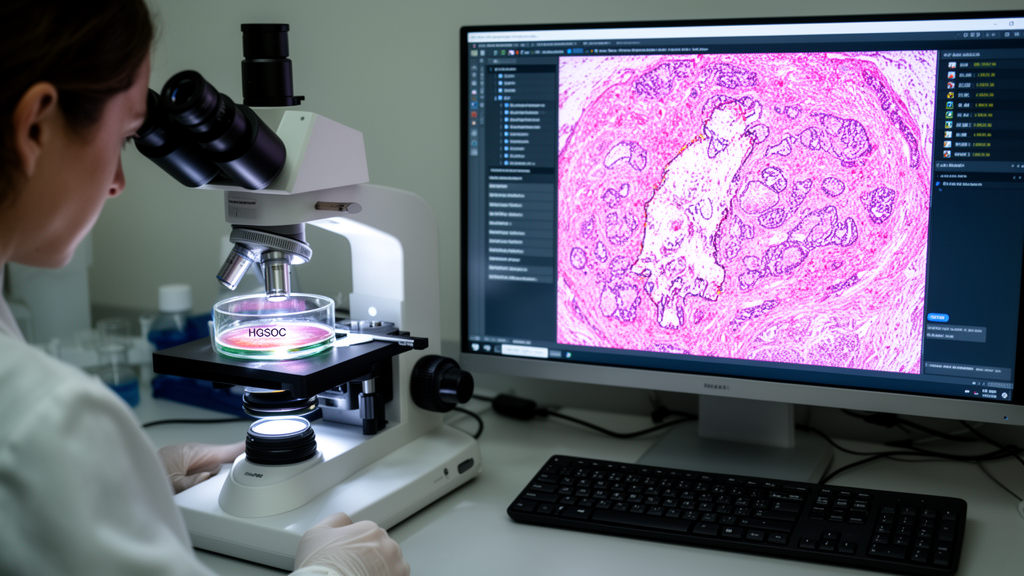
A retrospective computational pathology study found that HRDPath, a multi-model deep-learning system, could infer homologous recombination deficiency (HRD) from routine hematoxylin-and-eosin-stained whole-slide images of high-grade serous tubo-ovarian carcinoma (HGSOC). In the University of Washington Ovarian (UWOV) cohort, the system achieved an area under the receiver operating characteristic curve (AUC) of 0.846 on 29 held-out patients, with 69.2% sensitivity and 93.8% specificity at a fixed 0.5 probability threshold. The researchers also reported comparable performance in two independent public datasets, while emphasizing that broader clinical validation is required before the approach can guide treatment decisions.
HRD is a clinically important feature because HRD-positive HGSOC can be sensitive to platinum-based chemotherapy and poly ADP-ribose polymerase (PARP) inhibitors. Existing genomic tests examine alterations in DNA-repair genes and genome-wide patterns of genomic instability. The study notes that these assays can be variable, costly and time-consuming, and that their prediction of PARP-inhibitor response is less robust in BRCA1/2-wild-type cancers than in cancers with germline or somatic BRCA1/2 mutations. HRDPath was designed to use pathology slides that are routinely produced during diagnosis, without adding a molecular assay. Its output includes both binary HRD status and a continuous prediction intended to correspond to the genomic HRD score.
The main development cohort contained 720 diagnostic slides from 152 patients, including 145 patients with HGSOC and seven with other ovarian cancers. HRD status was assigned with the HRDetect whole-genome sequencing algorithm, which labeled 82 patients HRD-positive and 70 HRD-negative. The training set comprised 493 slides from 117 patients, and the held-out test set contained 138 slides from 29 patients. All slides from a given patient were assigned exclusively to one partition, preventing patient-level data leakage. Two additional cohorts, the TCGA ovarian collection and the PTRC-HGSOC collection, provided independent validation using labels based on a different genomic approach involving loss of heterozygosity, large-scale translocations and telomeric allelic imbalance.
Because a whole-slide image is far larger than the fixed-size inputs used by many image classifiers, HRDPath divides each slide into 1,024-pixel patches, filters background and normalizes staining variation. The remaining patches are converted into numerical features with RetCCL, a self-supervised representation model trained on 32,000 pan-cancer whole-slide images. The architecture has three complementary streams. Dual-Stream Multiple Instance Learning identifies patches that appear informative and pools them into a slide representation. A global Vision Transformer processes the full patch set with self-attention to capture context across the slide. A third local transformer analyzes fixed-size windows centered on regions selected by the first stream, with absolute positional encoding used to preserve spatial relationships.
Information from all slides belonging to a patient is then combined by a patient-level transformer, allowing the model to relate findings across primary tumors and metastatic deposits. The final embedding feeds a multi-task prediction head trained jointly with binary cross-entropy for HRD classification and mean-squared error for continuous HRD-score regression. In ablation tests, the complete model achieved an AUC of 0.846, compared with 0.769 when local windows were used without absolute positional encoding and 0.745 for a more restricted variant. The results indicate that the gain came from the interaction among global context, instance selection and spatially constrained attention rather than from one component alone. Under the same patient-level evaluation framework, HRDPath outperformed comparison systems including DeepHRD, ZoomMIL, CLAM variants and a UNI-based feature pipeline.
Multiple-slide aggregation improved reliability. Predictions were generally consistent among different slides from the same patient, and accuracy exceeded 0.950 when at least six slides were included, corresponding to sensitivity of 0.910 and specificity of 1.000 in that analysis. Including at least two primary-site slides produced average sensitivity of 0.930 and specificity of 0.890, while using only one primary slide reduced sensitivity to a range of 0.769–0.869 and left specificity high. The researchers also developed a patient-level agreement measure that could flag predictions supported by at least 70% of constituent slides. Anatomical diversity alone did not add an independent benefit when adequate primary-site sampling was available. A perfectly separating result across three anatomical locations involved only 13 patients and remains exploratory.
Transfer tests showed that the approach could retain useful performance outside its development cohort. When HRDPath was trained on the TCGA dataset, it reached an AUC of 0.847, with 71.4% specificity and 78.6% sensitivity. In three-fold few-shot experiments on TCGA and PTRC, fine-tuning with only one or two example images per class produced an AUC as high as 0.823, with 70.0% specificity and 98.1% sensitivity. Stain normalization was important for cross-dataset transfer. The model also performed well on abdominal metastases despite having no abdominal slides in the training set, although performance was lower in other pelvic samples and when trained solely on primary tumors. A related model, HRDPath-BRCA, predicted BRCA1/2-associated alterations, including BRCA1 methylation, with an AUC of 0.800, 95.2% specificity and 60.0% sensitivity.
Attention analysis and single-cell morphology measurements provided model-interpretability insights and identified associations between HRD status and tissue features; they did not establish a causal biological mechanism. Although HRDPath received no tumor-segmentation labels, high-attention patches tended to overlap with neoplastic regions, with a mean patch-wise Pearson correlation of 0.34 between model attention and neoplastic-cell proportion. Within highly attended regions, HRD-positive tumors had more rounded and less elongated nuclei, greater local cell density and lower variability in nuclear roundness and area than HRD-negative tumors. The effect sizes were small, with Cohen’s d between 0.225 and 0.262 for the principal nuclear comparisons, and the distributions overlapped substantially. Models based only on aggregated morphology reached a maximum cross-validated AUC of 0.593, showing that the spatial and contextual information used by HRDPath was not reducible to a few simple cellular measurements.
The researchers further grouped highly attended regions into eight visual VAttentionClusters. Four were dominated by neoplastic cells, while others represented fibrotic or stromal tissue, adipose tissue and infarcted tissue. One neoplastic cluster was enriched in HRD-negative cancers, whereas another was enriched in HRD-positive cancers and particularly in tumors with BRCA1/2 alterations. These clusters also varied by anatomical site, suggesting that some phenotypes associated with HRD were shared between primary and metastatic tumors while other microenvironmental features were location-specific. Patient-level analyses found that some neoplastic clusters appeared in both tubo-ovarian and omental samples from the same patient. In exploratory survival analyses, image-based false-positive and false-negative classifications were associated with different survival patterns from genomically concordant cases, but the study did not show that image predictions caused the outcomes or that they improve treatment selection.
Several limitations constrain translation. The work was retrospective, and the researchers were not blinded to data allocation or outcome assessment. The principal cohort came from a single center, while the public validation datasets used different HRD definitions and included a highly imbalanced PTRC cohort with only five HRD-negative patients. The study excluded cases lacking matched molecular annotations or digitized slides, did not impute missing data and did not use treatment information as a predictor. HRDetect is well validated but is not approved by the US Food and Drug Administration. Broader evaluation with multiple clinical HRD assays, more diverse populations and larger balanced cohorts will be needed. The code was not publicly available because of institutional intellectual-property and commercialization processes. The findings therefore support HRDPath as a digital-biomarker candidate and a means of extracting information from routine pathology, rather than as a clinically validated replacement for genomic testing.
Subject of Research: Deep-learning prediction of homologous recombination deficiency from HGSOC histopathology images
Article Title: HRDPath: an explainable multi-model deep learning architecture for predicting homologous recombination deficiency from histopathology images
Article References: Wu, C.-I., Banda, K., Arora, R., Soong, T. R., Radke, M., Dillon, M., Nik-Zainal, S., Swisher, E. M., & Sailem, H. Z. (2026). HRDPath: an explainable multi-model deep learning architecture for predicting homologous recombination deficiency from histopathology images. Nature Communications, 17(1), Article 10870. https://doi.org/10.1038/s41467-026-78430-y
Image Credits: AI Generated
DOI: 10.1038/s41467-026-78430-y
Keywords: HRDPath, HGSOC, homologous recombination deficiency, deep learning, computational pathology, whole-slide images, digital biomarkers, morphology, medical artificial intelligence, BRCA1/2, explainable, multi-model
Cite Scienmag News
Blake Davidson. (October 21, 2026). Deep learning predicts DNA repair deficiency in HGSOC pathology slides. Scienmag. https://scienmag.com/deep-learning-predicts-dna-repair-deficiency-in-hgsoc-pathology-slides/
Blake Davidson. "Deep learning predicts DNA repair deficiency in HGSOC pathology slides." Scienmag, 21 October 2026, https://scienmag.com/deep-learning-predicts-dna-repair-deficiency-in-hgsoc-pathology-slides/. Accessed 21 October 2026.
Blake Davidson. "Deep learning predicts DNA repair deficiency in HGSOC pathology slides." Scienmag. October 21, 2026. https://scienmag.com/deep-learning-predicts-dna-repair-deficiency-in-hgsoc-pathology-slides/


