


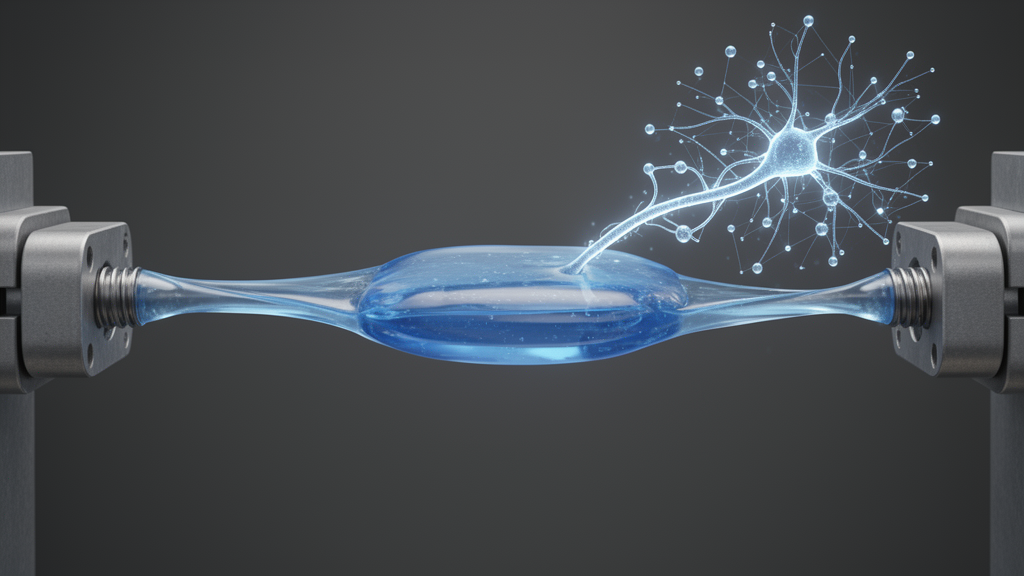
A new deep learning encoder called SIMPLEX has been developed to predict the adhesive strength of multicomponent bio-adhesive hydrogels directly from their composition, and its creators report that it held up under a deliberately difficult test: predicting the performance of formulations it had never seen, collected prospectively from a model-guided screening campaign. The work, published in Frontiers in Materials, addresses a persistent weakness in machine learning for materials discovery, where models are typically judged on randomly shuffled data rather than on the distribution-shifted candidates that arise in real iterative screening.
The model’s full name, Simplex-Inspired Multimodal Predictive Learning Encoder with X-modal Fusion, reflects its design goal: a dual-modality deep encoder built specifically for composition-driven property estimation. A key feature is its gated multimodal fusion component, which learns interactions between components on its own rather than relying on hand-crafted quadratic interaction terms that earlier approaches required. According to the authors, this removes a laborious feature-engineering step and lets the network discover compositional interplay directly from the raw formulation data.
A central contribution of the study is a benchmark intended to be fully reproducible. The researchers compared eight models under unified hyper-parameter tuning and statistical protocols, a level of standardization they argue is missing from prior work on small-sample formulation data, where architectural choices have often been made without systematic guidance. On an internal dataset of 316 hydrogel formulations evaluated under grouped cross-validation, SIMPLEX achieved what the authors describe as first-tier predictive performance, competitive with the strongest classical baselines in the comparison.
The more demanding evaluation came from prospective validation. The team collected 25 new formulations generated by a Bayesian-optimized closed-loop campaign, a process in which the model and an optimization loop steer experiments toward high-performance compositions. This deliberately shifts the test data away from the distribution of the training set, mimicking the situation a screening workflow actually faces: the most interesting new candidates are, by design, unlike the bulk of prior measurements. On this shifted set, SIMPLEX delivered the highest coefficient of determination for adhesion-strength prediction, reaching an R-squared of 0.6712.
That figure, while the best among the models compared, indicates that roughly two-thirds of the variance in adhesion strength was explained on the shifted prospective data, leaving substantial unexplained variation. The authors frame this as meeting the demand for precise quantitative estimation in iterative candidate screening, but the moderate value underscores how difficult out-of-distribution prediction remains for formulation models trained on small datasets.
Beyond raw accuracy, the study probes why the model works. Feature dissection, the authors report, shows that the native compositional representation already captures the dominant composition-property relationships, meaning the model does not depend on elaborate derived features to find the main signals. Component-wise ablation experiments, in which parts of the architecture are removed to measure their contribution, pinpointed the gated multimodal fusion module as the principal driver of performance.
The application domain is bio-inspired adhesive hydrogels, materials whose stickiness depends sensitively on the ratios of multiple components in a mixture design space. Predicting adhesion strength from composition alone, without synthesizing and testing every candidate, is the kind of surrogate modeling task that can accelerate discovery, provided the predictions remain trustworthy when the model is pushed toward novel regions of composition space.
The authors position the work as delivering two things at once: a capable deep encoder, and a rigorous, transparent evaluation paradigm for formulation-driven machine learning. They emphasize that the benchmark, with its eight models, unified tuning and statistical protocols, offers immediately reusable baselines and design principles for other groups working on small-sample formulation problems.
The study, received by the journal in August 2026 and accepted in September, was authored by researchers affiliated with Qingdao Huanghai University, City University of Hong Kong, Zhejiang Normal University, The Hang Seng University of Hong Kong, Nanfang College Guangzhou and Qiqihar University. For the materials machine learning community, the headline result is not simply that another encoder was proposed, but that its advantage was demonstrated on prospectively collected, distribution-shifted formulations rather than on the random splits the authors criticize as unrepresentative of real screening workflows.
Subject of Research: Deep learning prediction of bio-adhesive hydrogel adhesion strength from composition with prospective validation
Article Title: SIMPLEX: composition-space deep learning for bio-inspired hydrogel adhesion with prospective validation on model-discovered formulations and interpretable composition rules
Article References: Shen, T., Lei, X., Lok, H. K., Li, H., Pan, Z., Wang, X., & Fu, X. (2026). SIMPLEX: composition-space deep learning for bio-inspired hydrogel adhesion with prospective validation on model-discovered formulations and interpretable composition rules. Frontiers in Materials, 13, Article 1966940. https://doi.org/10.3389/fmats.2026.1966940
Image Credits: AI Generated
DOI: 10.3389/fmats.2026.1966940
Keywords: deep learning, hydrogels, adhesion strength, composition-to-property prediction, Bayesian optimization, distribution shift, machine learning benchmark, multimodal fusion, materials discovery, mixture design, SIMPLEX, composition-space
Cite Scienmag News
Blake Davidson. (October 29, 2026). Deep Learning Model Predicts Adhesive Hydrogel Strength Under Distribution Shift. Scienmag. https://scienmag.com/deep-learning-model-predicts-adhesive-hydrogel-strength-under-distribution-shift/
Blake Davidson. "Deep Learning Model Predicts Adhesive Hydrogel Strength Under Distribution Shift." Scienmag, 29 October 2026, https://scienmag.com/deep-learning-model-predicts-adhesive-hydrogel-strength-under-distribution-shift/. Accessed 20 November 2026.
Blake Davidson. "Deep Learning Model Predicts Adhesive Hydrogel Strength Under Distribution Shift." Scienmag. October 29, 2026. https://scienmag.com/deep-learning-model-predicts-adhesive-hydrogel-strength-under-distribution-shift/




