


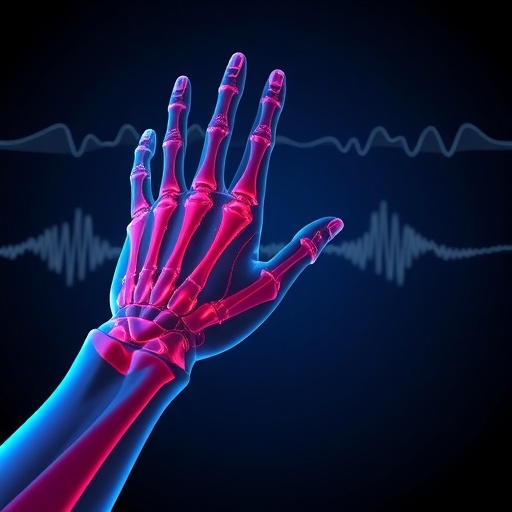
In a groundbreaking advancement poised to revolutionize the fields of neuroprosthetics and neural engineering, researchers have unveiled a novel method to decode phantom limb movements directly from intraneural recordings. This pioneering study, recently published in Nature Communications, showcases how signals from the peripheral nerves can be harnessed to interpret the elusive motor commands of amputees experiencing phantom limb sensations. The implications reach far beyond understanding phantom limb phenomena, suggesting new horizons for next-generation prosthetic control systems that operate with an unprecedented level of dexterity and naturalism.
Phantom limb movements—the phenomenon where amputees feel as though their missing limb is still present and can be moved—have long fascinated neuroscientists and clinicians. Although these sensations do not correspond to physical limb movement, neural substrates generating such experiences persist within the peripheral and central nervous system. Historically, translating these phantom sensations into usable signals for prosthetic limbs has been a formidable challenge, primarily due to the difficulty of recording and interpreting the neural activity associated with these imagined movements without invasive or bulky setups.
The current study addresses these challenges head-on by using intraneural electrodes implanted in the residual nerves of the amputated limb. Unlike traditional surface electromyography or extraneural nerve recordings that provide limited spatial and temporal resolution, intraneural recordings tap directly into individual nerve fascicles. This approach yields high-fidelity data representing the motor intent encoded by the peripheral nervous system, capturing the subtle nuances of neural firing patterns linked with phantom limb motion.
Central to this effort was the deployment of advanced machine learning algorithms tailored to decode motor commands from the complex neural signals harvested intraneurally. Through rigorous training and validation phases, the researchers developed models capable of distinguishing distinct phantom limb movement patterns with remarkable accuracy. This robust decoding ability enables the translation of phantom motor commands into precise control signals for prosthetic devices, ensuring that their operation closely mimics natural limb movements.
Extended testing involved amputee participants who had undergone upper limb amputation and were implanted with intraneural electrode arrays. The participants engaged in tasks involving the imagined movement of their phantom limbs—flexing fingers, rotating wrists, and more. The intraneural recordings obtained during these tasks were analyzed in real-time, producing decoded commands that directly corresponded to the phantom movements envisioned by the users. This level of coherence between neural intent and device output represents a paradigm shift in neural interface technology.
Moreover, the study elucidated the physiological underpinnings of phantom limb movement representation within the peripheral nervous system. Detailed neural mapping revealed that despite the loss of the physical limb, the nerve fascicles continue to carry discrete motor information. This insight challenges prior assumptions that central reorganization alone drives phantom limb sensations and opens new avenues for understanding peripheral nerve plasticity post-amputation.
The technical achievements of this research have immediate applicability in improving prosthetic limb control. The ability to decode phantom limb movements intraneurally means that prostheses can be operated with naturalistic motor commands, enhancing user embodiment and reducing cognitive load. This development promises a future where prosthetic users experience seamless, intuitive integration with their assistive devices, restoring functionality and quality of life.
Importantly, the researchers also highlight the safety and biocompatibility aspects of long-term intraneural electrode implantation. Through careful electrode design and surgical techniques, they ensured stable chronic recordings without significant nerve damage or fibrosis. This establishes a viable pathway for clinical translation, whereby neural interfaces could be reliably implanted in patients for durable, ongoing control of prosthetic limbs.
The interdisciplinary nature of the project—combining neuroscience, biomedical engineering, computer science, and clinical expertise—was crucial to its success. Collaborative efforts enabled integration of cutting-edge hardware, sophisticated decoding algorithms, and patient-centered experimental protocols. This synergy illustrates the power of convergent research strategies to solve complex challenges in neural interfacing and neuroprosthetics.
Looking ahead, the study paves the way for expanding intraneural decoding beyond motor control. Sensory feedback integration, often regarded as the holy grail of prosthetics, could be similarly decoded and delivered via intraneural stimulation, creating bidirectional communication between the peripheral nervous system and artificial limbs. Such enhancements would augment proprioception, tactile sensation, and overall limb awareness, bringing prosthetic experiences even closer to natural limb function.
Furthermore, this technology holds potential applications for other neurological disorders where motor commands are impaired or distorted. Conditions such as spinal cord injury, stroke, and neurodegenerative diseases might one day benefit from intraneural decoding approaches to restore or augment motor functions using neuroprosthetic solutions. The breadth of impact could redefine rehabilitative medicine paradigms.
While the achievements are monumental, the researchers acknowledge challenges ahead including scaling the approach for broader patient populations, optimizing electrode interfaces for diverse nerve anatomies, and integrating multi-modal sensory information streams. Continued innovation in materials science, neural signal processing, and computational modeling will be essential to realize the full clinical potential of intraneural decoding technology.
Ethical considerations also emerge as neural interfaces become more sophisticated and widely implemented. Issues related to patient consent, long-term device management, data privacy, and device security must be carefully addressed alongside technical advancements to ensure responsible deployment in healthcare settings. Stakeholder engagement and governance frameworks will be critical moving forward.
In conclusion, this remarkable demonstration of decoding phantom limb movements from intraneural recordings signifies a transformative leap in understanding and harnessing peripheral nerve signals. By bridging the gap between biological motor intent and artificial limb control, the study sets a new gold standard for neuroprosthetic interfaces. For millions living with limb loss, this breakthrough offers genuine hope for reclaiming natural motor abilities and enhancing human-machine symbiosis in the near future.
Cite Scienmag News
Cassandra Pierce. (February 8, 2026). Decoding Phantom Limb Movements via Intraneural Signals. Scienmag. https://scienmag.com/decoding-phantom-limb-movements-via-intraneural-signals/
Cassandra Pierce. "Decoding Phantom Limb Movements via Intraneural Signals." Scienmag, 8 February 2026, https://scienmag.com/decoding-phantom-limb-movements-via-intraneural-signals/. Accessed 4 September 2026.
Cassandra Pierce. "Decoding Phantom Limb Movements via Intraneural Signals." Scienmag. February 8, 2026. https://scienmag.com/decoding-phantom-limb-movements-via-intraneural-signals/


