

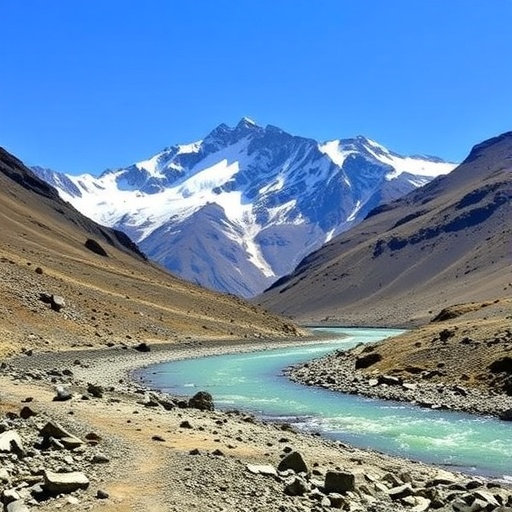
In a groundbreaking initiative poised to transform our understanding of freshwater availability, the Institute of Science and Technology Austria (ISTA) has secured a USD 9.5 million grant from Schmidt Sciences to lead the MountAInWater project—an unprecedented global reanalysis of mountain water resources. This ambitious scientific endeavor is set to harness high-resolution modeling, advanced physical simulations, and artificial intelligence (AI) to evaluate the impacts of climate change on vital mountain hydrological systems, assess critical tipping points, and ultimately inform water security strategies worldwide.
Mountains play a crucial role in the global water cycle, acting as natural reservoirs that supply freshwater to nearly half of humanity. Yet, despite their importance, our knowledge of how climate change alters mountain water availability remains fragmented and limited in spatial resolution. Traditional models have been constrained either by geographic scale or by simplifying assumptions due to computational challenges. MountAInWater seeks to fill this gap by deploying a multi-scale approach that bridges detailed local observations in high-elevation ‘supersites’ with global simulations powered by AI.
The project’s strategy begins with in-depth field campaigns at four geographically and climatically distinct supersites located in the Canadian Rockies, Andes, Pamir Mountains, and the Himalayas. These sites serve as focal points for collecting comprehensive field data, including glacier mass balance, snowpack dynamics, permafrost conditions, and water flux measurements. This unique dataset forms the backbone for refining physical models that capture non-linear processes and tipping points such as phase shifts in precipitation, transitions from sublimation to melt, and complex feedback mechanisms involving airflow and evaporative fluxes over alpine surfaces.
Professor Francesca Pellicciotti, principal investigator and leading glaciologist at ISTA, emphasizes the novelty of integrating these physically rich models with AI-driven computational techniques to achieve global scalability. “By combining physics-based modeling with machine learning algorithms, we can simulate mountain water processes at an unprecedented spatial resolution of one kilometer worldwide. This enables us to project how mountain water resources will evolve under various climate scenarios and pinpoint regions at greatest risk of water scarcity,” she explains.
A major scientific advancement of MountAInWater lies in its ability to capture the intricate non-linear dynamics and ‘tipping points’ of mountain cryospheres. These critical thresholds—such as abrupt glacier retreats, permafrost degradation, and snowpack regime shifts—have profound implications on downstream hydrology but are often overlooked in conventional models. By explicitly simulating these transitions, the project aims to offer novel insights into the future availability and reliability of freshwater supply originating from mountainous terrain.
Scaling from local supersites to a global perspective, the collected data will calibrate and train sophisticated AI models, which serve as surrogate simulators to accelerate computation and extend predictions across all major mountain ranges. According to Adrià Fontrodona-Bach, the project’s scientific coordinator, this hybrid modeling framework overcomes the traditional trade-off between spatial detail and domain size, enabling a comprehensive reanalysis that was previously unattainable.
Once the global reanalysis phase is complete, the project will reverse focus onto specifically identified ‘hotspots’ of hydrological vulnerability—regions predicted to experience significant climatic stress or heightened water scarcity. This zoom-in approach allows researchers to concentrate efforts on areas requiring urgent adaptation strategies and to unravel the ecological, societal, and infrastructural ramifications tied to water resource perturbations.
An innovative tool facilitating this localized engagement is the “Mountain Digital Twin,” an interactive virtual platform that empowers communities and stakeholders to visualize climate impacts dynamically, explore adaptive measures, and co-create sustainable water management solutions. This aspect underscores the project’s commitment to an inclusive and translational science, moving beyond purely academic outputs to actionable, community-informed interventions.
The interdisciplinary strength of MountAInWater is underscored by the diverse expertise converging from six countries. ISTA’s Pellicciotti group leads the project, focusing on glacier hydrology and physical modeling of snow, permafrost, and surface water processes. Complementing this, Professor Francesco Locatello’s team at ISTA specializes in AI-driven data analytics, enhancing model performance and scalability, while incoming Professor Simone Fatichi will address complex climate-ecosystem interactions in mountain environments.
International collaborators further enrich the consortium. Utrecht University and the University of Saskatchewan investigate ecological consequences downstream of mountain water redistribution. ETH Zurich contributes vital remote sensing and field data analyses. The Technical University of Munich and University of Lausanne undertake the development and application of AI models for global-scale reanalysis. Meanwhile, FutureWater and Wageningen University focus on hotspot identification and water allocation simulations. Climate Adaptation Services co-design community-centric adaptation frameworks to mitigate water stress impacts.
Together, this multinational consortium tackles one of the most pressing challenges of the 21st century: how to assure sustainable water availability amid a rapidly changing climate. The integration of detailed field observations, sophisticated physical models, and AI-based approaches offers an unprecedented window into the behavior of mountain water systems, including potential abrupt shifts that could cascade into critical vulnerabilities downstream.
MountAInWater’s findings promise to become an indispensable scientific resource, guiding policymakers, water managers, and communities in devising robust adaptation strategies. By forecasting future water availability with fine spatial granularity and incorporating socio-ecological feedbacks, the project fosters systemic understanding leading to innovatively resilient water governance.
Professor Pellicciotti encapsulates the essence of this grand endeavor: “Our mission is not only to advance the frontier of mountain hydrology and cryospheric science but also to deliver actionable knowledge that supports society’s response to water security challenges. This project embodies the synergy of scientific innovation and societal relevance.”
As the project progresses, the integration of diverse disciplinary insights and the active collaboration with affected communities position MountAInWater at the vanguard of climate science applied to freshwater sustainability. The initiative heralds a new era where mountain hydrology is comprehensively mapped, understood, and managed at a scale commensurate with its critical global importance.
Subject of Research: Mountain water resources, hydrology, cryosphere, climate change impacts, artificial intelligence in environmental modeling
Article Title: MountAInWater: Leveraging AI and High-Resolution Models to Transform Global Mountain Water Security
News Publication Date: Prior to World Water Day, March 22, 2026
Web References:
- Schmidt Sciences VIEW program: https://www.schmidtsciences.org/view/
- Institute of Science and Technology Austria (ISTA): https://ista.ac.at/en/research/pellicciotti-group/
Image Credits: © Marin Kneib | ISTA
Keywords: Mountain water resources, freshwater scarcity, hydrological modeling, glaciology, cryosphere tipping points, artificial intelligence, climate change, water security, snow and permafrost dynamics, high-resolution environmental models


