


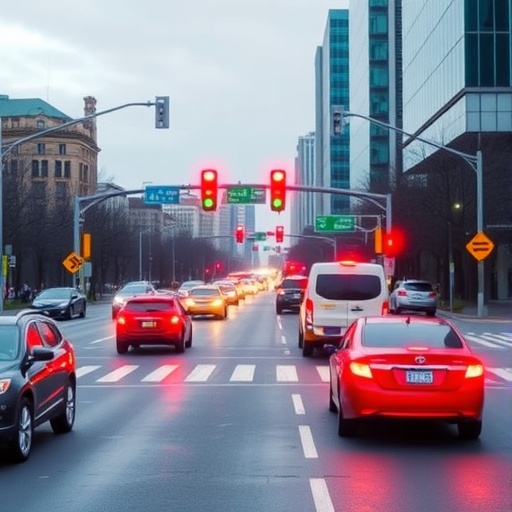
Urban traffic congestion is about to get a technological makeover—at least on paper. A new research study proposes a decentralized system that combines artificial intelligence, Internet of Things sensors, reinforcement learning and the Cardano blockchain to manage traffic in smart cities. The framework, called DRLCB, is designed to predict congestion, detect incidents, respond to changing weather and identify cyberattacks against connected devices, all while distributing decision-making across a network rather than relying on a single central control center. The study, published in Knowledge and Information Systems, argues that this combination could help cities make faster, more secure and more explainable traffic-management decisions as urban road networks become increasingly dependent on connected cameras, sensors, vehicles and roadside infrastructure.
The central challenge is that traffic is not simply a matter of counting cars. Congestion develops through constantly changing relationships between roads, intersections, accidents, weather conditions, traffic signals and driver behavior. In a connected city, these variables generate large volumes of data from heterogeneous sources, including traffic-flow records, accident databases, meteorological observations, IoT devices and digital transaction systems. The researchers, Swati Saha and Preeti Chandrakar of India’s National Institute of Technology Raipur, designed DRLCB to process these streams through a closed-loop perception-and-control architecture. In this arrangement, data are first converted into predictions about the traffic environment. Those predictions then become the state information used by reinforcement-learning agents, which select actions intended to reduce congestion and improve traffic flow.
A major component of the framework is the Dynamic Graph Convolutional Network, or DGCN. Graph-based neural networks are particularly suited to transportation systems because roads and intersections can be represented as connected nodes and edges rather than as isolated data points. A conventional model might treat traffic measurements as a sequence of independent values, but a graph model can represent how congestion at one intersection affects neighboring roads and downstream junctions. The “dynamic” element allows the network to update the effective relationships among locations as traffic conditions change. Spatial information describes where congestion is occurring, while temporal information captures how it evolves. According to the researchers, the DGCN is intended to help the system forecast congestion not only in familiar areas represented in the training data, but also in previously unseen urban regions.
The predicted traffic condition is then transformed into a formal state representation, written as (s_t=f(\hat{y}_t)), where (\hat{y}_t) is the model’s prediction at time (t). This state guides a hierarchical reinforcement-learning system with two levels of decision-making. A high-level policy selects regional strategies, such as prioritizing traffic movement through a congested corridor or coordinating several neighboring intersections. A low-level policy then chooses more specific actions, including adjustments to traffic-signal timing at individual junctions. In mathematical terms, the high-level action is sampled from a policy (\pi^H(s_t)), while the low-level action is selected from (\pi^L(s_t,a_t^H)), meaning that local decisions depend both on the observed traffic state and on the broader regional strategy. This structure is intended to prevent every intersection from acting independently in ways that might solve one bottleneck while creating another nearby.
The researchers also incorporated explainable artificial intelligence through SHAP, or SHapley Additive exPlanations. Complex machine-learning systems can produce highly accurate predictions while offering little insight into why a particular decision was made. SHAP addresses this problem by estimating how strongly individual input features contribute to a prediction. In a traffic setting, an explanation might indicate that a sudden rise in vehicle volume, a nearby accident, rainfall or an unusual sensor pattern had the greatest influence on a congestion forecast. For traffic authorities, such information could make automated recommendations easier to audit and trust. It could also help engineers identify unreliable sensors, discover unexpected patterns and distinguish between a genuine traffic disruption and a data anomaly. The inclusion of XAI is especially important in systems that influence public infrastructure, where decisions need to be reviewed by human operators rather than accepted as unexplained machine outputs.
Security and data integrity are handled through the Cardano blockchain, with the Hydra Layer 2 protocol included to improve scalability. Blockchain technology can create a tamper-resistant record of data exchanges and system events by distributing verification among participating nodes. In the proposed architecture, this could help cities record sensor reports, model-related transactions, security events and traffic-management actions in a manner that is difficult to alter retrospectively. Cardano provides the underlying blockchain platform, while Hydra is designed to support faster off-chain or Layer 2 transactions without requiring every operation to be processed directly on the main chain. The researchers present this arrangement as a way to protect IoT-enabled transportation systems from manipulated records and unauthorized changes. However, blockchain does not automatically guarantee that the original sensor reading was truthful; it primarily helps preserve the integrity of the information after it has entered the system. That distinction remains important for real-world deployment.
To evaluate DRLCB, the study used multiple publicly available datasets covering traffic flow, accidents, weather conditions, IoT cyberattacks and blockchain transactions. The authors report an overall accuracy of 97.92%, an F1-score of 0.979 and a mean absolute error of 0.044. Accuracy and F1-score are classification measures, while mean absolute error measures the average difference between predicted and observed values, making the three metrics relevant to different parts of the proposed system. The framework was compared with several established approaches, including federated learning, deep reinforcement learning, the Generalized Dynamic Spatio-Temporal Graph Convolutional Network and the Spatial–Temporal Fusion Graph Convolutional Network. According to the reported results, DRLCB performed better across traffic prediction, incident detection, weather-impact forecasting and IoT intrusion-detection tasks. The study also reports that blockchain integration improved data reliability without causing significant additional latency in the tested configuration.
The most important evidence for the architecture came from the ablation experiments, in which components of the full system were removed or evaluated separately. These tests indicated that the combination of spatial-temporal DGCNs and hierarchical reinforcement learning was responsible for much of the reported performance improvement. This finding supports the idea that accurate prediction alone is not enough to manage traffic effectively: the prediction must be converted into coordinated actions at multiple geographic levels. The experiments also suggested that blockchain contributed primarily to trustworthiness and data management rather than to prediction accuracy itself. In practical terms, a city could potentially use the DGCN and reinforcement-learning components to forecast and control traffic, while the blockchain layer would provide a shared audit trail for the data and decisions used by that process.
The study arrives as cities worldwide are expanding connected transportation infrastructure, but several questions remain before a system like DRLCB could operate safely on public roads. Dataset-based performance does not necessarily predict how an algorithm will behave when sensors fail, communications are interrupted, traffic patterns change dramatically or malicious actors adapt to the security system. Reinforcement-learning policies also require carefully designed reward functions: optimizing vehicle throughput alone could disadvantage pedestrians, public transport, emergency vehicles or neighborhoods receiving diverted traffic. Blockchain networks introduce their own requirements, including governance, energy and hardware considerations, identity management and agreement over which organizations can validate records. The researchers’ results indicate that decentralization, graph-based prediction, hierarchical control and explainability can be combined into a coherent smart-city framework. The next test will be whether these impressive numbers survive long-term trials with live traffic, diverse cities and human oversight. If they do, traffic lights may evolve from isolated timers into participants in a secure, learning-based urban nervous system.
Cite Scienmag News
Denise Maddox. (August 26, 2026). Decentralized AI and Cardano Blockchain Tackle IoT Traffic Congestion in Smart Cities. Scienmag. https://scienmag.com/decentralized-ai-and-cardano-blockchain-tackle-iot-traffic-congestion-in-smart-cities/
Denise Maddox. "Decentralized AI and Cardano Blockchain Tackle IoT Traffic Congestion in Smart Cities." Scienmag, 26 August 2026, https://scienmag.com/decentralized-ai-and-cardano-blockchain-tackle-iot-traffic-congestion-in-smart-cities/. Accessed 3 September 2026.
Denise Maddox. "Decentralized AI and Cardano Blockchain Tackle IoT Traffic Congestion in Smart Cities." Scienmag. August 26, 2026. https://scienmag.com/decentralized-ai-and-cardano-blockchain-tackle-iot-traffic-congestion-in-smart-cities/


