


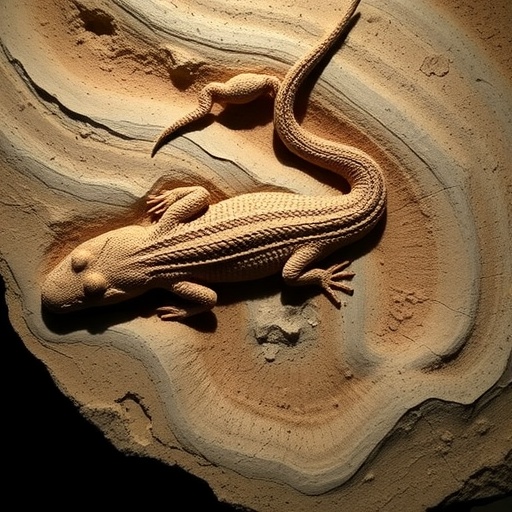
In a remarkable paleontological revelation, researchers from Kyoto University have identified a new genus and species of giant salamander from the Pliocene epoch in Japan. Unearthed in the Ajimu region of Oita prefecture during the late 1990s, three fossilized vertebrae embedded in the Tsubusugawa Formation offer unprecedented insight into amphibian diversity approximately 3.5 million years ago, an era defined by significantly warmer and more humid climatic conditions.
Previously, these vertebrae were tentatively assigned to the genus Andrias, the lineage encompassing today’s largest living amphibians. However, advances in comparative anatomy and a broader specimen database have enabled the team to pinpoint distinguishing morphological traits on the mid-trunk vertebra that diverge from known Cryptobranchidae genera. This morphological novelty prompted the formal designation of a new genus and species: Limnospondylus ajimuensis.
The name Limnospondylus originates from Greek, meaning “lake vertebra,” a nod to the freshwater ecosystems—lakes and marshes—that once dominated Kyushu’s landscape. The species likely measured approximately 1.1 meters in length, a size comparable to modern giant salamanders. Notably, the Ajimu locality is unique in globally preserving fossils of both extinct and extant giant salamander genera, marking it as a vital site for reconstructing the evolutionary history of these ancient amphibians.
The discovery expands the recognized diversity within the Cryptobranchidae family, which had until now included only five genera. Fossils attributed to this family have been found across the Northern Hemisphere, but taxonomic ambiguity often led to their assignment under extant genera like Andrias. This breakthrough suggests that a wealth of undiscovered species may lie hidden in existing fossil collections, warranting reexamination.
Climatic cooling during the Pliocene-Pleistocene transition drastically altered habitats, likely contributing to the extinction of Limnospondylus ajimuensis. Despite this, its relative Andrias japonicus, the Japanese giant salamander, persists in modern-day rivers around Ajimu and other parts of Japan. The continued survival of this species underlines the importance of conserving native amphibian fauna, especially in the face of contemporary threats such as habitat degradation and genetic hybridization with non-native species.
Lead author Masahiro Noda highlights the significance of Japan as a key region for understanding giant salamander evolution, emphasizing that this newfound genus enhances our comprehension of amphibian biodiversity through deep time. This finding not only reshapes the existing phylogenetic framework but also encourages intensified fossil investigations in East Asia.
Published in the peer-reviewed journal PeerJ, this study epitomizes how meticulous fossil analysis can reshape scientific narratives and trigger renewed conservation awareness for enigmatic living relics of prehistoric ecosystems.
Cite Scienmag News
Drew Townsend. (July 9, 2026). Decades-Old Fossils Reveal Extinct Giant Salamander Species Rediscovered. Scienmag. https://scienmag.com/decades-old-fossils-reveal-extinct-giant-salamander-species-rediscovered/
Drew Townsend. "Decades-Old Fossils Reveal Extinct Giant Salamander Species Rediscovered." Scienmag, 9 July 2026, https://scienmag.com/decades-old-fossils-reveal-extinct-giant-salamander-species-rediscovered/. Accessed 4 September 2026.
Drew Townsend. "Decades-Old Fossils Reveal Extinct Giant Salamander Species Rediscovered." Scienmag. July 9, 2026. https://scienmag.com/decades-old-fossils-reveal-extinct-giant-salamander-species-rediscovered/


