

Monday, July 27, 2026
Science
No Result
View All Result
  • Login
  • HOME
  • SCIENCE NEWS
  • CONTACT US
  • HOME
  • SCIENCE NEWS
  • CONTACT US
No Result
View All Result
Scienmag
No Result
View All Result
Home Science News Earth Science

Davemaoite Shows Limited Water Incorporation Under Lower-Mantle Conditions

July 27, 2026
in Earth Science
Reading Time: 2 mins read
0
Davemaoite Shows Limited Water Incorporation Under Lower-Mantle Conditions

Davemaoite Shows Limited Water Incorporation Under Lower-Mantle Conditions

65
SHARES
587
VIEWS
Share on FacebookShare on Twitter
ADVERTISEMENT

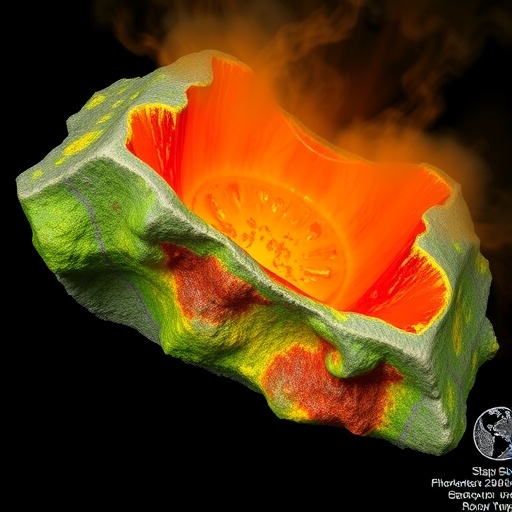
A new study is reshaping how scientists think about Earth’s deep water cycle. In lower-mantle conditions, Ishii and colleagues report that davemaoite—a magnesium-rich mineral thought to exist at extreme depths—does not eagerly take up water. The result challenges the idea that the mantle’s interior could store large amounts of hydrogen just by forming water-tolerant minerals.

Davemaoite is considered an important host phase in the lower mantle because its crystal structure can, in principle, incorporate hydrogen-bearing species. Such incorporation would occur through substitutions inside the lattice, potentially linking water to the mantle’s long-term storage and release mechanisms. But the new findings indicate that this mineral’s capacity for water is “limited,” meaning less hydrogen can be trapped than expected under comparable conditions.

To reach this conclusion, the team investigated how davemaoite responds to simulated lower-mantle environments. They combined experimental constraints with analysis of hydrogen incorporation behavior, focusing on whether water-related defects can form efficiently. The study emphasizes that lower-mantle pressure and temperature do not automatically guarantee substantial hydration in all candidate minerals.

The researchers argue that the lattice chemistry and the energetic cost of inserting water-related defects likely suppress hydrogen uptake. In other words, while hydrogen can be incorporated under some circumstances, the equilibrium under deep-mantle conditions favors only small amounts. This helps explain why certain deep-mantle reservoirs may remain relatively dry despite Earth’s overall water inventory.

Their interpretation carries implications for modeling Earth’s interior. If davemaoite cannot store large water quantities, then other phases—such as hydrous minerals stable at different depths, or scenarios involving transient melt/fluid transport—may need to account for most of the hydrogen budget.

The work also affects how scientists interpret geophysical observations. Seismic signatures and mantle convection models depend on mantle composition and water content, both of which influence mineral rheology and melting behavior. Limited hydration in davemaoite would shift expectations for viscosity and deformation in the lower mantle.

Finally, the study underscores how minerals can behave very differently across pressure-temperature regimes. Water incorporation is governed not only by mineral presence, but by defect formation energetics and structural constraints at depth. The message is clear: deep-mantle hydration may be far more selective than previously assumed.

Subject of Research: Limited water (hydrogen) incorporation in davemaoite under lower-mantle conditions.

Article Title: Limited water incorporation in davemaoite under lower-mantle conditions.

Article References: Ishii, T., Takaichi, G., Nishihara, Y. et al. (2026). Communications Earth & Environment. https://doi.org/10.1038/s43247-026-03856-7

Share26Tweet16
Previous Post

APREAL Fall-Prevention Program Improves Safety for Hospitalized Elderly Patients

Next Post

Dopamine-Linked Brain Network Reconfiguration Dynamics Altered in Parkinson’s Disease

Related Posts

Renewables Ease Energy, Water, and Ecological Strains in Yellow River Basin
Earth Science

Renewables Ease Energy, Water, and Ecological Strains in Yellow River Basin

July 27, 2026
Soil Prophage Enzymes Boost Global Carbon Cycling Potential by Breaking Down Carbohydrates
Earth Science

Soil Prophage Enzymes Boost Global Carbon Cycling Potential by Breaking Down Carbohydrates

July 27, 2026
Planetary trapped waves link South America and Africa through ocean teleconnections
Earth Science

Planetary trapped waves link South America and Africa through ocean teleconnections

July 27, 2026
Environmental Injustice and Transition Pathways for China’s Heavy-Duty Truck Transport
Earth Science

Environmental Injustice and Transition Pathways for China’s Heavy-Duty Truck Transport

July 27, 2026
Assessing Mitigation Pathways for Mercury Emissions from Global Coal Power
Earth Science

Assessing Mitigation Pathways for Mercury Emissions from Global Coal Power

July 27, 2026
Mid-to-late Holocene Cooling Drove Agricultural Changes on the Tibetan Plateau
Earth Science

Mid-to-late Holocene Cooling Drove Agricultural Changes on the Tibetan Plateau

July 27, 2026
Next Post
Dopamine-Linked Brain Network Reconfiguration Dynamics Altered in Parkinson’s Disease

Dopamine-Linked Brain Network Reconfiguration Dynamics Altered in Parkinson’s Disease

  • Mothers who receive childcare support from maternal grandparents show more

    Mothers who receive childcare support from maternal grandparents show more parental warmth, finds NTU Singapore study

    27656 shares
    Share 11059 Tweet 6912
  • University of Seville Breaks 120-Year-Old Mystery, Revises a Key Einstein Concept

    1061 shares
    Share 424 Tweet 265
  • Bee body mass, pathogens and local climate influence heat tolerance

    682 shares
    Share 273 Tweet 171
  • Researchers record first-ever images and data of a shark experiencing a boat strike

    546 shares
    Share 218 Tweet 137
  • Groundbreaking Clinical Trial Reveals Lubiprostone Enhances Kidney Function

    531 shares
    Share 212 Tweet 133
Science

Embark on a thrilling journey of discovery with Scienmag.com—your ultimate source for cutting-edge breakthroughs. Immerse yourself in a world where curiosity knows no limits and tomorrow’s possibilities become today’s reality!

RECENT NEWS

  • Tree Species Diversity Linked to Long-Term Rise in Forest Photosynthesis
  • Nonclassical biosynthetic pathway allows bacteria to synthesize tocopherol
  • Gut microbiome shift links anhedonia and sensation-seeking in prodromal Parkinson’s mice
  • Renewables Ease Energy, Water, and Ecological Strains in Yellow River Basin

Categories

  • Agriculture
  • Anthropology
  • Archaeology
  • Athmospheric
  • Biology
  • Biotechnology
  • Blog
  • Bussines
  • Cancer
  • Chemistry
  • Climate
  • Earth Science
  • Editorial Policy
  • Marine
  • Mathematics
  • Medicine
  • Pediatry
  • Policy
  • Psychology & Psychiatry
  • Science Education
  • Social Science
  • Space
  • Technology and Engineering

Subscribe to Blog via Email

Enter your email address to subscribe to this blog and receive notifications of new posts by email.

Join 5,146 other subscribers

© 2025 Scienmag - Science Magazine

Welcome Back!

Login to your account below

Forgotten Password?

Retrieve your password

Please enter your username or email address to reset your password.

Log In
No Result
View All Result
  • HOME
  • SCIENCE NEWS
  • CONTACT US

© 2025 Scienmag - Science Magazine

Discover more from Science

Subscribe now to keep reading and get access to the full archive.

Continue reading
