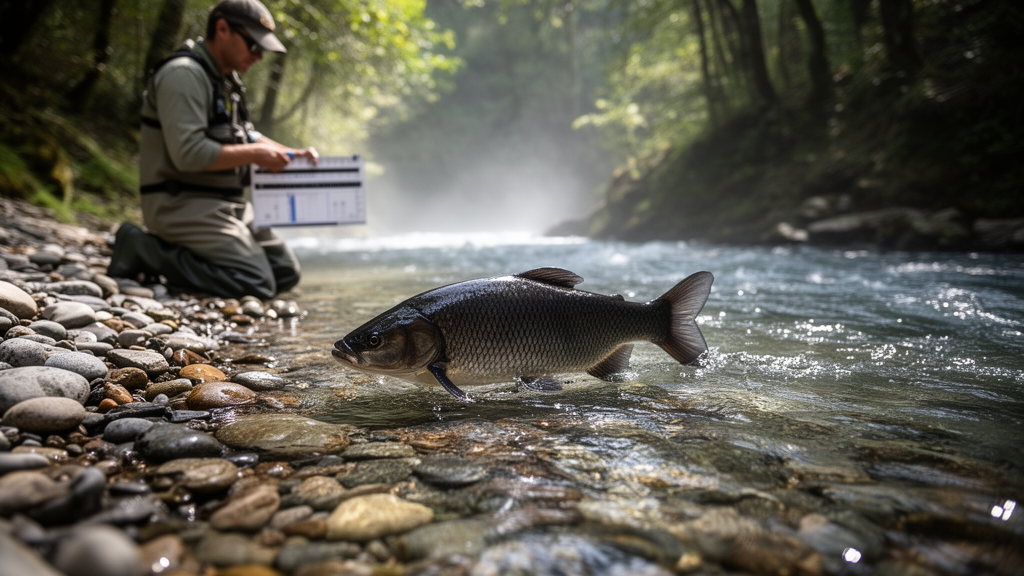
Researchers have produced the first integrated biometric portrait of the dark mahseer (Naziritor chelynoides) from a Nepalese hill stream, reporting that the fish grows with significant negative allometry in the Chidiyar River, meaning that as individuals get longer, they gain weight more slowly than a perfectly proportional fish would. The open-access study, published in BMC Zoology on 13 October 2026, analysed 128 specimens collected between September and December 2025 and found a length-weight exponent of b = 2.519, with a 95% confidence interval of 2.33 to 2.71 that excludes the isometric value of 3. The regression was statistically significant, with a coefficient of determination of R² = 0.841 and p < 0.001.
The dark mahseer is a freshwater cyprinid distributed in Himalayan river systems of Nepal and India, and it is assessed as Vulnerable on the IUCN Red List. In Nepal, its feeding ecology has previously been documented in hill streams, where the species consumes algae, diatoms, insects and other food materials. Earlier work has described its morphological, meristic and osteological characteristics from Indian Himalayan populations, and its length-weight relationship has been reported from the Garhwal Himalaya. However, population-level information that integrates morphometric variation, meristic characters, length-weight relationships and condition indices has remained limited for Nepalese populations, which is the gap the new study set out to address.
The sampling took place along a continuous stretch of the Chidiyar River at Argali, Palpa District, Nepal, a tributary of the Kali Gandaki River, running from upstream coordinates of 27°53′20″ N, 83°29′28″ E to downstream coordinates of 27°55′31″ N, 83°28′33″ E, at an elevation of approximately 430 metres above sea level. Fish were collected opportunistically using cast nets during evening hours, with multiple casts performed across different microhabitats including pools, riffles and runs to ensure representative sampling. The river along the sampled stretch was approximately 7 metres wide and 50 centimetres deep, with rocky and pebble-dominated substrate, moderate water flow and riparian vegetation along the banks. The sampling covered the post-monsoon to early winter season.
Of the 128 individuals collected, all were used for the length-weight relationship and condition factor analyses, with total length measured in centimetres and body weight in grams. Among these, 43 well-preserved specimens were selected for detailed morphometric and meristic analyses, with all morphometric characters measured in millimetres using a digital caliper with 0.01 millimetre precision. Specimens were identified as Naziritor chelynoides (McClelland, 1839) following standardized taxonomic references and FishBase. To reduce size-related variation, morphometric measurements were expressed as percentages of standard length or head length, and the variables were further size-corrected using an allometric transformation method with standard length as the reference variable, a procedure designed to reduce ontogenetic bias and allow meaningful comparison of body shape among individuals.
The meristic results showed remarkably limited variation. Dorsal-fin rays, ventral-fin rays and anal-fin rays were constant among the examined individuals, at counts of 9, 9 and 7 respectively, while pectoral-fin rays varied from 13 to 17. This relative consistency of meristic characters, combined with variation in morphometric measurements, provides additional morphological information for the sampled population. The authors note that the observed meristic ranges can be compared with the species-level morphological and meristic characterization reported previously for Indian populations, but that comparisons among geographically separated populations would be required to determine the extent of broader morphological differentiation.
Principal component analysis of the size-corrected morphometric variables from the 43 individuals revealed that the first two components together explained 34.377% of the total variance. PC1 accounted for 18.852% of the variance and was primarily associated with the variables Panus, PPL and DFB, indicating variation in fin-base dimensions and body proportions, while PC2 explained 15.525% and was mainly influenced by HD, PFL, HW and PVL, reflecting variation in fin length, body depth and head morphology. Only variables with loadings greater than an absolute value of 0.30 were considered significant contributors. The scree plot showed that the first two principal components captured the major portion of variation before a gradual decline in eigenvalues, and the PCA biplot showed a continuous distribution of individuals along PC1 and PC2 without clearly separated clusters.
That continuous distribution, the authors write, suggests no evident morphological subdivision among the sampled individuals. Morphometric variation in N. chelynoides has also been documented in an Indian Himalayan population, and PCA-based analyses have been widely used to summarize morphological variation in Himalayan freshwater fishes and to identify the body dimensions contributing most strongly to observed variation. The study team is careful to point out, however, that because the analysis was based on individuals from a single river system and did not incorporate environmental or genetic data, the observed morphometric variation cannot be attributed to environmental effects, phenotypic plasticity or local adaptation.
The length-weight analysis, based on all 128 individuals, covered total lengths ranging from 7.9 to 22.1 centimetres and body weights from 8.8 to 123.51 grams. The estimated parameters were an intercept a = 0.035 and a growth exponent b = 2.519, with the 95% confidence interval of b not including 3, so the relationship differed significantly from isometric scaling. A log-transformed regression of log₁₀ weight against log₁₀ total length showed a strong linear relationship. The authors emphasize that the b value obtained should be interpreted within the sampled population and size range rather than considered representative of the species as a whole, since length-weight relationship parameters may vary among populations and species. A direct species-specific comparison is available from the Garhwal Himalaya in India, where an earlier study examined 422 individuals of Puntius chelynoides, the name currently recognized as Naziritor chelynoides. Regional comparisons also show contrasts: Pseudecheneis sulcata from the Tamor River in Nepal showed positive allometric growth with b = 3.410, whereas negative allometric relationships have been reported for several freshwater fishes from eastern Nepal.
Condition indices told a consistent story. Fulton’s condition factor K averaged 1.01 ± 0.26, and the relative condition factor Kn also averaged 1.01 ± 0.26. A Kn value close to 1 indicates that observed body weight was generally close to the weight expected from the length-weight relationship estimated in this study. The distribution of K values across total length showed no apparent systematic trend across the sampled size range, suggesting no strong size-related trend in the condition index. An earlier Nepalese study reported an average condition factor of 1.31 for N. chelynoides from Mardi Khola, providing a species-specific reference point, but the authors caution that direct numerical comparison should be made cautiously because condition-factor values may vary with body form, size composition, sampling period and calculation methods. They also stress that K and Kn are relative biometric indices and should not be interpreted directly as measures of physiological health, habitat quality or environmental stress without supporting physiological or environmental measurements.
The study also documented the external morphology of the examined fish, describing an elongated, moderately compressed body with a slightly arched dorsal profile and flattened ventral surface, a broad and slightly depressed head with a blunt snout and subterminal mouth, two pairs of barbels with the maxillary pair longer than the rostral pair, large regularly arranged scales with dark posterior margins forming a reticulated pattern, a complete lateral line, two parallel deep brown and black longitudinal stripes extending from behind the eye along the lateral line to the caudal fin base, and a deeply forked caudal fin. These observations were consistent with previously documented characteristics of the species, although the dataset does not permit particular traits to be attributed to specific environmental conditions. The authors acknowledge several limitations: the study was restricted to a single river stretch and sampling period, the opportunistic use of cast nets may have introduced gear- and habitat-related selectivity, the detailed morphometric and meristic analyses were based on only 43 individuals, and no concurrent environmental or genetic data were collected. These constraints restrict broader interpretation and prevent assessment of whether the observed variation is associated with environmental or genetic factors. Even so, the biometric parameters provide baseline information for the sampled population in the Chidiyar River, and repeated sampling using comparable methods may facilitate detection of temporal changes in size structure, length-weight relationships and condition indices. The authors note that these parameters should be evaluated alongside abundance, recruitment, habitat characteristics, water quality and anthropogenic pressures to provide a more comprehensive basis for population monitoring and conservation assessment, and that further studies using standardized sampling across multiple populations and seasons, together with environmental and genetic data, are needed to determine whether these patterns hold more widely.
Subject of Research: Morphometric variation, length-weight relationship and condition indices of the dark mahseer in a Nepalese hill stream
Article Title: Morphometrics, growth allometry, and condition status of the dark mahseer (Naziritor chelynoides) in a Nepalese hill stream
Article References: Rana, P. (2026). Morphometrics, growth allometry, and condition status of the dark mahseer (Naziritor chelynoides) in a Nepalese hill stream. BMC Zoology, 11(1), Article 32. https://doi.org/10.1186/s40850-026-00294-y
Image Credits: AI Generated
DOI: 10.1186/s40850-026-00294-y
Keywords: dark mahseer, Naziritor chelynoides, Nepal, length-weight relationship, allometry, condition factor, morphometrics, meristics, principal component analysis, hill stream fish, Chidiyar River, fish biology
Cite Scienmag News
Drew Townsend. (October 29, 2026). Dark mahseer in a Nepalese hill stream shows negative allometric growth in first integrated biometric study. Scienmag. https://scienmag.com/dark-mahseer-in-a-nepalese-hill-stream-shows-negative-allometric-growth-in-first-integrated-biometric-study/
Drew Townsend. "Dark mahseer in a Nepalese hill stream shows negative allometric growth in first integrated biometric study." Scienmag, 29 October 2026, https://scienmag.com/dark-mahseer-in-a-nepalese-hill-stream-shows-negative-allometric-growth-in-first-integrated-biometric-study/. Accessed 29 October 2026.
Drew Townsend. "Dark mahseer in a Nepalese hill stream shows negative allometric growth in first integrated biometric study." Scienmag. October 29, 2026. https://scienmag.com/dark-mahseer-in-a-nepalese-hill-stream-shows-negative-allometric-growth-in-first-integrated-biometric-study/