


In a groundbreaking advancement for blood cancer therapies, Dana-Farber Cancer Institute has presented compelling results from the phase 2 CAR-PRISM clinical trial, heralding a new era in the treatment of high-risk smoldering multiple myeloma (SMM). This investigation uniquely explored the application of Chimeric Antigen Receptor (CAR) T-cell therapy at an earlier, precancerous disease stage, revealing unprecedented durable remissions and deep eradication of malignant cells. These findings were unveiled at the American Association for Cancer Research (AACR) Annual Meeting 2026, solidifying CAR T-cell therapy’s promise beyond its current use in relapsed multiple myeloma.
Multiple myeloma is a malignancy rooted in plasma cells within the bone marrow, often preceded by a clinically silent phase termed smoldering multiple myeloma. Characterized by an abnormal accumulation of precursor plasma cells without overt symptoms, high-risk SMM bears a grim prognosis, with approximately half of patients progressing to full-fledged myeloma within two years. The challenge has long been to intercept this progression effectively while minimizing toxicities—a therapeutic gap CAR T-cell technologies are poised to fill.
The CAR-PRISM trial targeted B-cell maturation antigen (BCMA), a transmembrane protein expressed on pathological plasma cells and an established CAR T-cell target. The investigational therapy, ciltacabtagene autoleucel (cilta-cel), previously FDA-approved in 2024 for relapsed multiple myeloma, was administered to twenty patients diagnosed with high-risk smoldering multiple myeloma according to stringent inclusion criteria grounded in the 20/2/20 rule—percentages of bone marrow plasma cells, serum M-protein levels, and involved/uninvolved light chain ratios signaling elevated progression risk.
A critical innovation of this trial was administering cilta-cel before patients underwent exposure to conventional induction chemotherapy, hypothesizing that earlier intervention in a lower disease burden setting would potentiate more effective immune-mediated tumor destruction. This approach leveraged the intactness of patients’ immune functionality at this nascent stage of transformation to maximize CAR T-cell expansion, persistence, and antitumor activity.
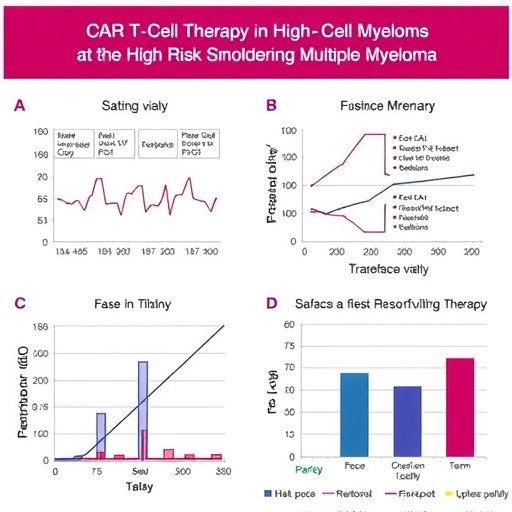
Over a median follow-up of 15.3 months, all treated patients achieved stringent minimal residual disease (MRD) negativity—the deepest measurable level of cancer eradication—within two months post-infusion. Importantly, sustained MRD-negative status was observed with no evidence of disease relapse or mortality, signaling profound and lasting remissions. Some individuals were monitored beyond 18 months, reaffirming the durability of responses, an outcome never before realized at this disease phase using CAR T-cells.
Safety outcomes also underscored the feasibility of this method. The study observed no dose-limiting toxicities or high-grade adverse events, common concerns with CAR T-cell therapies in more advanced, heavily pretreated patients. Cytokine release syndrome (CRS), a frequent immune-related side effect, manifested only in low-grade, manageable forms, with zero cases of severe CRS or neurotoxicity. Transient hematologic toxicities were the most prevalent adverse events, alongside reversible cases of mild-to-moderate neurological symptoms in a subset of patients.
These clinical outcomes strongly align with the underlying hypothesis that CAR T-cell efficacy is enhanced when tumor burden and immunosuppressive microenvironmental factors are minimized. Early interception allows for robust expansion of engineered T-cells in an immunologically hospitable milieu, promoting sustained surveillance and destruction of malignant precursors before they evolve resistance or compromise host immunity.
The CAR-PRISM trial’s success opens avenues for redefining therapeutic paradigms in smoldering multiple myeloma, where the prevailing standard has been watchful waiting until clinical progression demands intervention. The dramatic remission rates reported here suggest that early, definitive immunotherapy could recalibrate management strategies toward durable remissions or even potential cure.
Beyond CAR T-cell therapy, the Dana-Farber team is actively investigating complementary immunotherapeutic approaches, including bispecific antibodies, which simultaneously bind T-cells and tumor antigens to harness endogenous immunity against myeloma precursors. This multipronged immunotherapy research initiative aims to optimize long-term disease control and enhance patient outcomes in early multiple myeloma stages.
Ongoing mechanistic studies are delving into the molecular and immunologic distinctions underlying responses in high-risk SMM compared to relapsed myeloma cases. Insights from these comparisons may reveal biomarkers predictive of CAR T-cell efficacy and inform dosage modulation to further enhance therapeutic windows.
It is also notable that daratumumab, a CD38-targeting monoclonal antibody, gained FDA approval in late 2025 as the first treatment for high-risk smoldering multiple myeloma, marking a paradigm shift from monitoring to proactive intervention. However, CAR T-cell therapy delivers the potential advantage of a one-time, potentially curative infusion, circumventing repeated administrations and chronic toxicities.
Looking ahead, researchers caution that longer-term follow-up and larger multi-center studies are necessary to validate durability and reproducibility. Nevertheless, this trial’s promising safety profile and robust responses provide a new beacon of hope for patients at the cusp of multiple myeloma diagnosis and highlight Dana-Farber’s commitment to translational innovation.
Dr. Omar Nadeem, clinical director of Dana-Farber’s Myeloma Immune Effector Cell Therapy Program, summarized the impact poignantly: “Our early intervention strategy using CAR T-cell therapy has achieved what many thought unattainable—rapid and deep clearance of disease at the earliest detectable stage. This is a transformative milestone that could reimagine cancer interception for millions facing high-risk smoldering myeloma.”
As the oncology field embraces personalized immunotherapy’s full potential, the CAR-PRISM study exemplifies how integrating precise molecular criteria and cutting-edge cellular products can deliver breakthroughs that may ultimately defeat complex hematologic malignancies at their inception.
News Publication Date: April 20, 2026
Web References:
https://www.dana-farber.org/find-a-doctor/omar-nadeem
https://www.dana-farber.org/find-a-doctor/irene-ghobrial
https://labs.dana-farber.org/ghobriallab/people/david-cordas-dos-santos-md
https://www.nature.com/articles/s41591-026-04365-y
References:
Nadeem, O. et al. (2026) “Deep and lasting responses to CAR T-cell therapy in high-risk smoldering multiple myeloma,” Nature Medicine, DOI:10.1038/s41591-026-04365-y
Cite Scienmag News
Ophelia Keating. (April 20, 2026). Dana-Farber Phase 2 Trial Demonstrates Durable and Profound Responses to CAR T-Cell Therapy in High-Risk Smoldering Multiple Myeloma. Scienmag. https://scienmag.com/dana-farber-phase-2-trial-demonstrates-durable-and-profound-responses-to-car-t-cell-therapy-in-high-risk-smoldering-multiple-myeloma/
Ophelia Keating. "Dana-Farber Phase 2 Trial Demonstrates Durable and Profound Responses to CAR T-Cell Therapy in High-Risk Smoldering Multiple Myeloma." Scienmag, 20 April 2026, https://scienmag.com/dana-farber-phase-2-trial-demonstrates-durable-and-profound-responses-to-car-t-cell-therapy-in-high-risk-smoldering-multiple-myeloma/. Accessed 3 September 2026.
Ophelia Keating. "Dana-Farber Phase 2 Trial Demonstrates Durable and Profound Responses to CAR T-Cell Therapy in High-Risk Smoldering Multiple Myeloma." Scienmag. April 20, 2026. https://scienmag.com/dana-farber-phase-2-trial-demonstrates-durable-and-profound-responses-to-car-t-cell-therapy-in-high-risk-smoldering-multiple-myeloma/


