

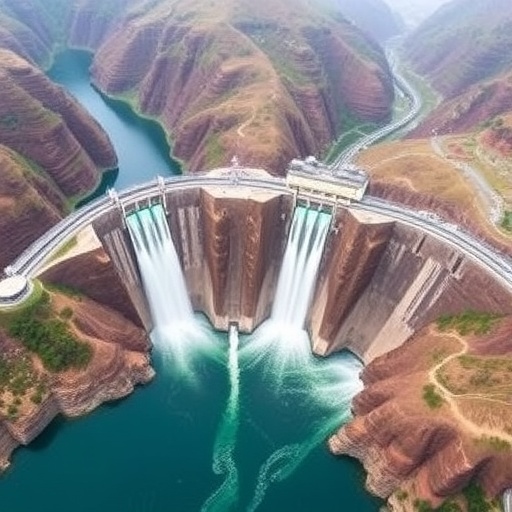
The Yangtze River Basin, one of the largest river systems in the world, has long been recognized for its ecological importance and biodiversity. However, as human activities increasingly impact natural systems, concerns have arisen regarding nutrient export, particularly phosphorus, from this vital waterway. In a groundbreaking study led by a team of researchers, including Zhou, Z., Sun, Y., and Yu, Z., new insights have been provided into the dynamics of phosphorus export in the basin, revealing how dam operations have created unexpected reservoirs of phosphorus that defy earlier predictions of nutrient release.
The research, published in the journal Communications Earth & Environment, sheds light on the striking role of dams in altering the transport and availability of phosphorus in the Yangtze River. Previously, experts anticipated that increasing agricultural runoff and urban development would significantly elevate phosphorus export levels. However, the study illustrates that the construction and operation of dams have transformed these expectations, creating an environment where phosphorus can be sequestered rather than exported to the downstream ecosystem.
In order to understand this phenomenon, the researchers conducted extensive field studies and assessed water samples from various locations along the river. They measured concentrations of phosphorus and other water quality indicators to track how the construction of dams has affected nutrient dynamics. The findings were both surprising and thought-provoking, as they showed that what was once assumed to be a straightforward relationship between land use, nutrient runoff, and water quality is considerably more complex.
Dams, often constructed for hydroelectric power generation and flood control, have been observed to alter the natural flow of water and sediment downstream. This alteration can lead to sedimentation in the reservoirs created by these dams, an unintended consequence that also facilitates the accumulation of phosphorus. The research team utilized models that incorporate both hydrology and biogeochemistry to dissect how changes in water flow influenced the mobility of phosphorus. Their analysis demonstrates that under certain conditions, phosphorus becomes trapped behind dams rather than being transported downstream, thus contributing to localized nutrient enrichment of these reservoir ecosystems.
One of the significant implications of these findings is the impact on aquatic ecosystems. While nutrient enrichment is often detrimental to water quality and can lead to harmful algal blooms, the researchers posited that this localized accumulation may help mitigate the expected increase of phosphorus levels downstream. This nuance in the phosphorus export dynamics introduces a new layer of complexity to river basin management, necessitating a reevaluation of how we approach nutrient management in the context of dam operations.
Furthermore, the study highlights the need for an integrated management approach. Policymakers and environmental managers must recognize the role of anthropogenic modifications to waterways and construct strategies that consider both conservation and the realities of food production. The researchers advocate for a dual approach that respects the ecological balance while simultaneously accommodating the growing demands for agricultural outputs. This approach can help preserve water quality while ensuring that agricultural needs are met without exacerbating the nutrient export issue.
At a larger scale, the findings from the Yangtze River Basin can be seen as a case study that resonates beyond its geographic boundaries. Many river systems worldwide are facing similar challenges, where human interventions such as dam constructions seek to enhance water resource management but inadvertently complicate nutrient cycles. The lessons learned from the Yangtze can inform practices in dam operation, recommending adaptive management strategies that account for both environmental impacts and the need for agricultural resilience.
Ecosystem resilience is likely tied to maintaining a balanced phosphorus cycle, and this research provides empirical evidence of the need for ongoing monitoring of nutrient dynamics in river systems altered by human intervention. As climate change continues to impact hydrological cycles and nutrient transport, the interplay between dams and nutrient sinks will become increasingly significant.
Moreover, the research underscores the importance of utilizing advanced modeling techniques and interdisciplinary collaboration in understanding these complex systems. By bringing together biogeochemists, hydrologists, and ecologists, the researchers were able to develop a comprehensive viewpoint on the interactions between physical, chemical, and biological processes within the river ecosystem. This collaborative framework is essential as the scientific community strives to develop scalable solutions to river management that prioritizes both ecological and socioeconomic sustainability.
As discussions around water quality and nutrient management evolve, stakeholders must engage in dialogue that includes local communities, policymakers, and scientists. The incorporation of traditional ecological knowledge, alongside contemporary scientific understanding, can lead to more effective stewardship of river basins. Involving the community can enhance the relevance and applicability of research findings, fostering a sense of ownership over local water systems and their health.
The ongoing work surrounding phosphorus dynamics in the Yangtze River Basin represents more than just a scientific achievement; it is an urgent call to action for environmental stewardship. As society grapples with the ramifications of climate change and resource depletion, the lessons from this study can serve as vital touchpoints for how we steward our natural resources into the future. The implications of dam-driven phosphorus sinks challenge conventional wisdom and invite a reexamination of nutrient management within freshwater ecosystems.
Researchers emphasize that while the dams exhibit an unexpected role in slowing the anticipated increase of phosphorus exports, this does not absolve the potential risks associated with nutrient build-up. Continued research is necessary to gauge long-term impacts on both aquatic life and water quality. The ultimate goal should be to ensure that management practices evolve alongside scientific understanding, fostering not only a healthier Yangtze River but a sustainable future for all water systems.
These findings also present an opportunity to explore innovative restoration projects that address both sediment management and nutrient retention, enhancing overall biodiversity within watershed ecosystems. By leveraging the knowledge gained from the Yangtze River Basin, future projects can tailor interventions based on scientific evidence, promoting ecological health while also meeting human needs.
As a culmination of their research, the authors highlight the critical need for long-term monitoring to capture changes over time, ensuring that phosphorus management adjusts in response to evolving ecological conditions. This study serves as a reminder of the dynamic interplay between human-made structures and natural ecosystems, emphasizing the necessity for adaptive management strategies that integrate recent scientific insights.
In conclusion, Zhou, Z., Sun, Y., and Yu, Z. have opened up a new chapter in our understanding of nutrient dynamics in river systems, particularly in the context of dam operations. Their findings advocate for fresh perspectives on managing phosphorus export, shifting the narrative from potential ecological threats to nuanced opportunities for mitigation through informed management. As research continues in this pivotal area, the collaboration between science and policy will undeniably shape the future of our rivers.
Subject of Research: Phosphorus export dynamics in the Yangtze River Basin and the impact of dam constructions.
Article Title: Dam-driven phosphorus sinks reversed the anticipated increase in phosphorus export from the Yangtze River Basin.
Article References:
Zhou, Z., Sun, Y., Yu, Z. et al. Dam-driven phosphorus sinks reversed the anticipated increase in phosphorus export from the Yangtze River Basin. Commun Earth Environ (2025). https://doi.org/10.1038/s43247-025-03087-2
Image Credits: AI Generated
DOI: 10.1038/s43247-025-03087-2
Keywords: Phosphorus dynamics, Yangtze River, dam operations, nutrient management, ecological health.


