


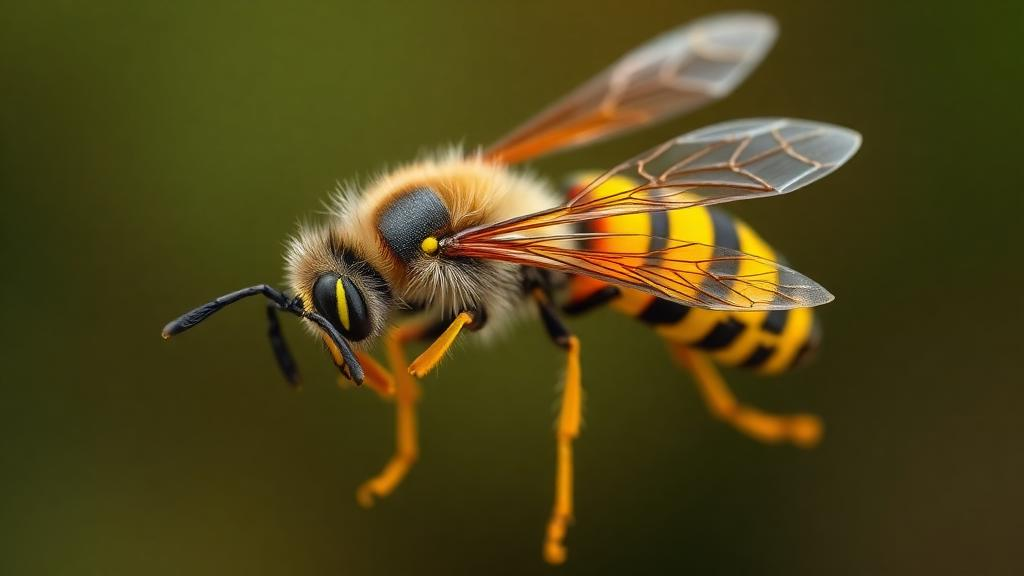
A museum-based and photographic survey of the Czech Republic found conspicuous warning colouration in 900 of 1,221 species of bees and wasps examined, or 73.83%. The analysis also identified similar aposematic patterns in three major groups of bee and wasp mimics: 36 of 43 clearwing moth species, 322 of 424 hoverfly species and 104 of 205 longhorn beetle species. Black-and-yellow, a category that also included white or creamy-white markings, was the dominant pattern among the aposematically coloured species in all four groups surveyed.
Aposematic colouration is associated with animals that are unpalatable, toxic or otherwise dangerous, and can take the form of conspicuous contrasting colours such as black with yellow or red. Among bees and wasps, aposematic signals are associated with the sting, although some non-stinging groups can also display warning-like coloration. The survey classified patterns into four categories: black-and-yellow, including white or creamy white; black-and-red; black-yellow-red; and metallic. The first three were pigment-based, whereas metallic coloration arose through physical effects within the insect cuticle.
The study examined the fauna of the Czech Republic, which the authors described as rich in the groups considered and representative of the European fauna for them. Its principal subject was Hymenoptera: Aculeata, or bees and wasps, with the families Bethylidae, Dryinidae, Embolemidae and Formicidae excluded because they have different life strategies. The three main mimic groups were clearwing moths in Lepidoptera, hoverflies in Diptera and longhorn beetles in Coleoptera. Species lists were drawn from established regional faunas for bees, wasps and each mimic group.
Colouration was assessed separately for males and females using the first author’s private collection, the National Museum in Prague and major online photographic resources, including iNaturalist, Flickr and Biolib. A species was recorded as aposematic when it possessed one of the four designated pattern types, with records made for body colour and body hairs. Bands of yellow or white hairs counted as aposematic patterns, as did combinations of black and red body colour with white hairy spots or bands. When males and females differed in colouration, the researchers entered half of each pattern for that species in the dataset.
Clearwing moths had the highest proportional representation of aposematic species in the comparison, with 36 of 43 species, or 83.72%. Hoverflies followed with 322 of 424 species, or 75.94%. Longhorn beetles had a lower overall prevalence, with 104 of 205 species, approximately 50.73%, displaying aposematic coloration. Despite these differences, black-and-yellow was the most frequent pattern in each of the four groups. It appeared in 271 of the 322 aposematic hoverflies, or 84% of that aposematic subset, and in 51% of the aposematic longhorn beetles recorded in the analysis.
The other patterns were less common overall but had distinctive distributions. Black-and-red coloration accounted for 23% of aposematic longhorn beetles, the highest proportion among the groups, compared with 8% of aposematic hoverflies. Metallic coloration was also relatively prominent in longhorn beetles, reaching 22% of their aposematic species. Among the bees and wasps, bees included 433 aposematic species, representing 71% of the bee species analyzed, and black-and-yellow was especially prominent among non-parasitic bees. In many of those species, the pale component of the pattern was produced by bands or spots of body hairs rather than pigmented skin.
Family-level comparisons revealed still greater concentrations of particular signals. Every cuckoo wasp in the family Chrysididae had metallic coloration and no other recorded aposematic type. Black-and-red was strongly represented in spider wasps, Pompilidae, while black-and-yellow predominated in Vespidae. Black-yellow-red coloration was more prevalent in Mutillidae. On average, the aposematic share of species in Chrysididae was only slightly above half that of Apoid wasps, which comprised 165 of 281 species, or 58%. These contrasts show that a broad survey category can conceal sharply different colour patterns among related insect lineages.
Foraging strategy also corresponded with differences in warning coloration. Nesting predators and nesting herbivores had similar proportions of aposematic representatives, while 96% of the parasitic species examined used aposematic signals frequently. Almost 87% of breeding herbivores had black-and-yellow coloration, whereas that pattern occurred in only 21% of parasites. Metallic coloration was the most common pattern among parasites at 34%, but the authors noted that this result was driven by cuckoo wasps. With Chrysididae excluded, metallic coloration was absent from the other parasitic species, and the three pigment-based patterns were approximately equally common, each accounting for between 32% and 40%.
Males and females differed in coloration in 67 of the 1,221 bee and wasp species, or 5.49%. One recurring arrangement involved females with white hair bands that were absent or less pronounced in males, as in several Andrena and Eucera species. More pronounced differences appeared in the cuckoo bees Ammobatoides abdominalis and Epeoloides coecutiens, whose males were cryptically coloured while their females had aposematic black-and-red patterns with white markings. Several Mutillidae and Pompilidae also combined aposematic females with entirely black males. In some Mutillidae, the difference coincided with wingless females and winged males, although the survey did not experimentally test the function of the dimorphism.
Sex-related differences also appeared among the mimics. Twenty-six hoverfly species showed some distinction between the sexes, usually the absence or reduction of yellow or red markings in males. Eight longhorn beetle species differed, and in most of them males were cryptically coloured while females were aposematic. Tetropium castaneum showed the reverse pattern, while the male Oxymirus cursor was black and the female metallic. No sex-based colour difference was recorded among the clearwing moth species examined, although Synanthedon culiciformis combined black-red with metallic coloration and S. cephiformis combined black-yellow with metallic coloration. Some mimics also reproduced behaviour as well as appearance: certain clearwing moths imitate the flight and buzzing of their models, while Plagionotus arcuatus resembles a wasp most strongly when moving.
The survey identifies a regional pattern of widely shared warning signals, but it does not directly measure predator responses, attack rates or survival benefits. Its authors interpret the abundance of aposematism among bees and wasps as compatible with protective mutual resemblance, while clearwing moths and other similarly coloured insects may gain protection through Batesian mimicry of defended models. They also note that coloration can serve purposes beyond defence, including thermoregulation, and that chemical communication may mediate some interactions between parasitic insects and their hosts. The analysis is geographically limited to the Czech fauna, relies on visual records from collections and photographs, and condenses varied patterns into four broad categories. Within those limits, it shows that nearly three-quarters of the bee and wasp species examined carried aposematic patterns and that clearwing moths, hoverflies and longhorn beetles displayed many of the same combinations.
Subject of Research: Comparative survey of aposematic colour patterns in Czech bees, wasps and their principal mimic groups
Article Title: Proportions of aposematic colouration in bees and wasps ( Hymenoptera , Aculeata ) and their main mimics – hoverflies, clearwing moths and longhorn beetles
Article References: Bogusch, P., & Zahradníková, A. (2025). Proportions of aposematic colouration in bees and wasps (Hymenoptera, Aculeata) and their main mimics – hoverflies, clearwing moths and longhorn beetles. Journal of Hymenoptera Research, 98, 325-338. https://doi.org/10.3897/jhr.98.141208
Image Credits: AI Generated
Keywords: aposematism, warning colouration, bees, wasps, hoverflies, clearwing moths, longhorn beetles, mimicry, Czech Republic, insect colouration, Proportions, aposematic
Cite Scienmag News
Gavin Prescott. (October 20, 2026). Czech survey maps warning colours in bees, wasps and mimic insects. Scienmag. https://scienmag.com/czech-survey-maps-warning-colours-in-bees-wasps-and-mimic-insects/
Gavin Prescott. "Czech survey maps warning colours in bees, wasps and mimic insects." Scienmag, 20 October 2026, https://scienmag.com/czech-survey-maps-warning-colours-in-bees-wasps-and-mimic-insects/. Accessed 20 October 2026.
Gavin Prescott. "Czech survey maps warning colours in bees, wasps and mimic insects." Scienmag. October 20, 2026. https://scienmag.com/czech-survey-maps-warning-colours-in-bees-wasps-and-mimic-insects/


