


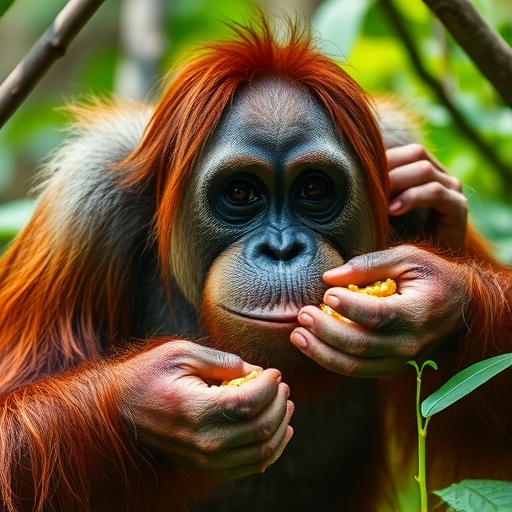
In a groundbreaking study published in Nature Human Behaviour, researchers have illuminated a fascinating aspect of orangutan behavior and cognition that has profound implications for our understanding of cultural evolution and dietary adaptability in primates. The study, titled “Culture is critical in driving orangutan diet development past individual potentials,” highlights the interplay between social learning and individual dietary choices, shedding light on how culture shapes the feeding behaviors of these intelligent apes beyond what their solitary foraging skills would otherwise dictate.
The research, led by a team of scientists including Emma Howard-Spink, Christopher Tennie, and Tania Mitra Setia, spanned various habitats across Southeast Asia, where the isolation and varied environment of orangutan populations present a unique opportunity to study the influence of cultural practices on diet. The study involved meticulous observations and assessments of the dietary preferences of wild orangutans, revealing a remarkable adaptability that stems not merely from instinct but from social learning and cultural transmission.
Orangutans, long recognized for their cognitive abilities and dexterity, showcase an impressive array of food choices, which has historically been attributed to their individual learning experiences. However, the findings from Howard-Spink and her colleagues suggest that their foraging behaviors are heavily influenced by the culture within their respective communities. This cultural facet significantly enhances the dietary repertoire available to them, enabling them to exploit a wider range of food sources and navigate the complex ecological challenges they face in the wild.
The implications of this research ripple beyond academic curiosity, potentially influencing conservation strategies aimed at ensuring the survival of orangutan populations. Understanding the cultural dimensions of orangutan feeding habits can inform habitat preservation efforts, as the loss of social structures within these populations could hinder the passing down of vital dietary knowledge essential for their survival. This realization emphasizes the urgent need for targeted conservation practices that foster not just habitat preservation but also social and cultural continuity among these primates.
Through detailed fieldwork, the researchers documented the various feeding strategies employed by different orangutan communities, noting pronounced variations in diet composition influenced by learned behaviors. These behaviors included the use of tools for accessing hard-to-reach food sources, as well as preferences for specific fruit types that are favored by particular communities. Such disparities underscore the significance of cultural learning and social interaction in shaping the dietary habits of these animals.
Moreover, the study draws parallels between human and orangutan cultures, proposing that similar mechanisms of cultural evolution may govern both species. Just as human populations have adapted their diets across regions through the sharing of culinary knowledge, orangutans too navigate their environment in a manner heavily predicated on social learning. This comparative insight not only enriches our understanding of primate behavior but also raises thought-provoking questions about the origin and evolution of culture itself in the animal kingdom.
The findings also invite a broader debate regarding the definition of culture in non-human species, challenging the anthropocentric perspectives often prevalent in the study of animal behavior. By establishing that orangutans engage in culturally diverse feeding practices that transcend individual abilities, the researchers advocate for a re-evaluation of how we perceive intelligent behavior and cultural complexity across different species. This shift in perspective could lead to a deeper appreciation of the cognitive landscapes that define not just primates, but various forms of animal life.
In light of these developments, researchers encourage further studies to explore how orangutan populations adapt to changing environmental conditions, particularly in the face of habitat destruction and climate change. As the challenges facing these majestic creatures intensify, understanding the role of culture in their survival becomes paramount. The study underscores the importance of preserving not only the ecological niches that orangutans inhabit but also the rich social networks that support their cultural learning.
Furthermore, the researchers highlight the critical need for interdisciplinary approaches in wildlife conservation, integrating insights from anthropology, psychology, and ecology. Such collaboration is imperative in fostering innovative solutions that address the multifaceted threats faced by orangutans and other at-risk species. The insights gained from this research could catalyze new conservation strategies that prioritize cultural preservation alongside ecological integrity.
In conclusion, Howard-Spink et al.’s study offers a profound look into the complexities of orangutan diets, driven by cultural influences that extend beyond individual capabilities. This groundbreaking research not only enhances our understanding of orangutan behavior but also contributes significantly to the broader discourse on animal culture and intelligence. As we continue to grapple with the challenges of conservation and climate change, the lessons drawn from this study may inspire more effective methods for protecting both the biodiversity and cultural richness of the natural world.
Ultimately, the implications of this research touch upon critical issues in conservation biology and animal ethics. Recognizing the importance of culture in dietary adaptability may shift how policymakers and conservationists approach their efforts to safeguard not only the ecological settings that foster orangutan populations but also the social structures that serve as the bedrock of their cultural practices.
This study serves as a clarion call for further exploration into the intricate lives of orangutans, encouraging a deeper connection between human observers and these remarkable primates as stewards of their own cultural and ecological heritage.
Howard-Spink, E., Tennie, C., Mitra Setia, T. et al. Culture is critical in driving orangutan diet development past individual potentials.
Nat Hum Behav (2025). https://doi.org/10.1038/s41562-025-02350-y
Cite Scienmag News
Daisy Hatcher. (November 24, 2025). Culture Drives Orangutan Diet Beyond Individual Limits. Scienmag. https://scienmag.com/culture-drives-orangutan-diet-beyond-individual-limits/
Daisy Hatcher. "Culture Drives Orangutan Diet Beyond Individual Limits." Scienmag, 24 November 2025, https://scienmag.com/culture-drives-orangutan-diet-beyond-individual-limits/. Accessed 4 September 2026.
Daisy Hatcher. "Culture Drives Orangutan Diet Beyond Individual Limits." Scienmag. November 24, 2025. https://scienmag.com/culture-drives-orangutan-diet-beyond-individual-limits/


