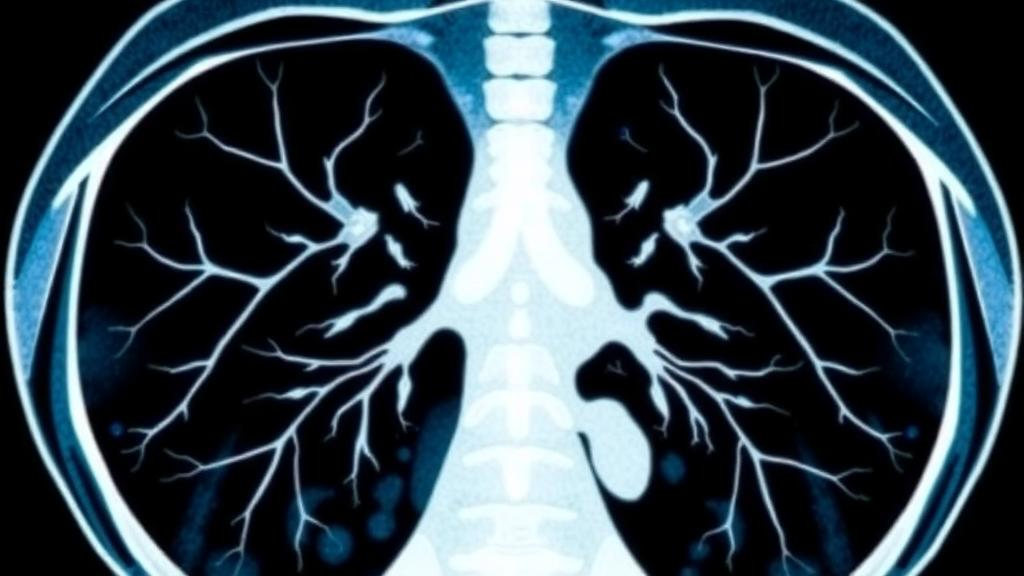
Chest X-rays are the workhorse of lung medicine: cheap, fast, and available almost everywhere. But for artificial intelligence, they are a frustratingly difficult input. The two-dimensional projection flattens ribs, vessels, and organs on top of one another, blurring the very lesions that signal pneumonia, COVID-19, or a growing tumor. Computed tomography, by contrast, slices the chest into cross-sectional views that reveal pulmonary abnormalities with striking clarity. The catch is that CT scanners are expensive and far less accessible, particularly in the low-resource clinics where a reliable screening tool would matter most. A new study published in Discover Artificial Intelligence by Preeti Sharma, Govind Murari Upadhyay, and Devershi Pallavi Bhatt of Manipal University Jaipur proposes an elegant compromise: let CT teach the X-ray model what to look for.
The technique at the heart of the work is knowledge distillation, a machine-learning paradigm first popularized by Geoffrey Hinton and colleagues, in which a large, capable teacher network transfers what it has learned to a smaller student. Traditionally, teacher and student work on the same kind of data, and the teacher’s soft probability outputs are mimicked by the student. Here the researchers break both conventions. Their framework, called CTGuideNet, trains a teacher exclusively on CT images and then transfers knowledge across modalities to student networks that classify chest X-rays, working at the level of internal feature representations and spatial attention maps rather than output probabilities.
The teacher itself is deliberately lightweight. Rather than deploying a massive pretrained backbone such as DenseNet or a Vision Transformer, the team built a custom convolutional network of five blocks, with filters increasing from 32 to 256, followed by adaptive average pooling and a fully connected classifier. It was trained from scratch on 8,408 lung CT images spanning four categories: COVID-19, pneumonia, lung tumor, and normal tissue, drawn from public datasets including COVID-CTset, the Pneumonia CT Scan Image Dataset, and LIDC-IDRI. The final teacher reached 98.10 percent accuracy and a 98.11 percent F1-score on the CT task, with perfect precision and recall for COVID-19 and 100 percent recall for pneumonia, confirming it had learned genuinely discriminative, lesion-sensitive representations.
On the student side, the researchers evaluated five pretrained convolutional neural network architectures: VGG16, ResNet18, ResNet50, MobileNetV2, and EfficientNet-B0. Each was adapted for single-channel grayscale input and given a new five-class classification head covering COVID-19, bacterial pneumonia, viral pneumonia, lung tumor, and normal. Because these architectures produce feature embeddings of different dimensions, for example 1,280 dimensions for EfficientNet-B0 and 2,048 for ResNet50, while the teacher emits a compact 256-dimensional vector, the team inserted a small learnable projection network after each student’s pooling layer. Two fully connected layers with ReLU activation map every student embedding into the teacher’s 256-dimensional space, where both vectors are L2-normalized so that training emphasizes semantic similarity rather than feature magnitude.
The training objective combines three terms: the standard cross-entropy classification loss on labeled X-rays, a normalized feature distillation loss that pulls the projected student embedding toward the frozen teacher’s embedding, and a spatial attention transfer loss that aligns attention maps so the student focuses on the same disease-relevant lung regions the CT teacher learned to prioritize. Crucially, the researchers avoid logit-level distillation entirely, which frees the teacher and student from sharing an output space. The teacher’s single pneumonia class is never forced onto the student’s bacterial and viral subclasses; instead, it supplies generic disease-sensitive priors about inflammatory abnormalities, while subclass discrimination is learned purely from labeled X-ray data.
The most distinctive contribution, however, is the architecture-aware component. In preliminary experiments, applying identical distillation weights across all networks produced inconsistent convergence and suboptimal results. Different backbones, it turns out, respond very differently to external supervision. VGG16 and MobileNetV2 tolerated strong feature and attention guidance, likely because their hierarchical or compressed representations benefit from external regularization. Residual networks such as ResNet18 and ResNet50 required weaker, adaptive supervision, since aggressive feature matching initially destabilized the shortcut-driven identity mappings that define residual learning. EfficientNet-B0, with its compound scaling and built-in squeeze-and-excitation attention, resisted direct spatial alignment altogether and instead received a semantic-adaptive strategy in which only high-level embeddings were aligned using weak cosine-based supervision with a small coefficient of 0.0005.
The payoff was largest exactly where it matters most: when data is scarce. In experiments using only 500 chest X-rays, 100 per class, CT-guided supervision improved classification by up to 10 percentage points over baseline training. ResNet50 showed the biggest jump, rising from 71 to 81 percent accuracy with its macro F1-score climbing from 70.01 to 80.67 percent, while VGG16 improved from 66 to 73 percent. EfficientNet-B0, guided by the semantic strategy, achieved the highest overall accuracy of 82 percent. Tumor detection, one of the hardest tasks in low-data radiology because nodules can be subtle and partially occluded, saw a dramatic gain in ResNet50, with tumor sensitivity soaring from 50 to 83.33 percent after CT-guided supervision.
The team then stress-tested the framework. Scaling experiments with 1,000, 5,000, and 10,000 X-rays revealed a non-linear relationship between dataset size and the value of CT guidance: at 5,000 images the students briefly outperformed their guided counterparts, apparently because they could already learn radiographic representations independently, but at 10,000 images CT guidance again won, with EfficientNet-B0 reaching 94.60 percent accuracy. Repeated runs across eight random seeds confirmed that the guided MobileNetV2 consistently beat the baseline on accuracy, precision, recall, and F1-score, with paired t-tests and Wilcoxon signed-rank tests confirming statistical significance at p below 0.05. An ablation study showed that feature distillation and attention transfer only help when combined with architecture-aware weighting; each component alone underperformed the baseline.
Qualitative evidence came from Grad-CAM visualizations, which highlight the image regions driving a network’s decisions. Baseline models produced scattered, diffuse activations, sometimes fixating on irrelevant anatomy and mislabeling tumor cases as normal. The CT-supervised models generated concentrated, high-intensity activations localized to infected or abnormal lung regions, and correctly identified tumors that the baselines missed. External validation on the JSRT lung nodule dataset, 247 posterior-anterior chest radiographs from Japanese institutions, extended the findings across datasets: the guided MobileNetV2 reached 86 percent accuracy versus 78 percent for the baseline, its F1-score rose from 56 to 77 percent, and recall for non-nodule cases improved from 16 to 50 percent while nodule sensitivity stayed above 97 percent, meaning fewer false alarms without losing lesion detection.
The implications reach well beyond one benchmark. Because the framework requires no paired CT-X-ray scans from the same patient, it can exploit the abundant diagnostic richness of CT without the cost of joint imaging, and because the students include lightweight architectures like MobileNetV2, the resulting models remain deployable on modest hardware. The authors caution that their datasets came from multiple institutions with differing scanner protocols, that the external validation required swapping the five-class head for a binary one, and that future work should explore paired CT-CXR data, richer teacher supervision that distinguishes bacterial from viral pneumonia, and larger multi-center cohorts. Still, the central lesson stands: when labeled X-ray data runs short, the detailed knowledge locked inside CT scans can be distilled into cheaper, faster models, provided the teaching is tuned to each architecture’s way of seeing.
Subject of Research: Cross-modality knowledge distillation from CT to chest X-ray models for low-data lung disease classification
Article Title: Adaptive architecture-aware CT-guided knowledge distillation for low-data lung disease classification from chest X-rays
Article References: Sharma, P., Upadhyay, G. M., & Bhatt, D. P. (2026). Adaptive architecture-aware CT-guided knowledge distillation for low-data lung disease classification from chest X-rays. Discover Artificial Intelligence, 6(1), Article 1422. https://doi.org/10.1007/s44163-026-02239-3
Image Credits: AI Generated
DOI: 10.1007/s44163-026-02239-3
Keywords: knowledge distillation, chest X-ray, computed tomography, lung disease classification, cross-modality transfer, CTGuideNet, deep learning, convolutional neural networks, low-data learning, medical imaging, MobileNetV2, Grad-CAM
Cite Scienmag News
Barbara Leach. (October 10, 2026). CT Scans Teach Chest X-ray AI to Spot Lung Disease With Far Less Data. Scienmag. https://scienmag.com/ct-scans-teach-chest-x-ray-ai-to-spot-lung-disease-with-far-less-data/
Barbara Leach. "CT Scans Teach Chest X-ray AI to Spot Lung Disease With Far Less Data." Scienmag, 10 October 2026, https://scienmag.com/ct-scans-teach-chest-x-ray-ai-to-spot-lung-disease-with-far-less-data/. Accessed 10 October 2026.
Barbara Leach. "CT Scans Teach Chest X-ray AI to Spot Lung Disease With Far Less Data." Scienmag. October 10, 2026. https://scienmag.com/ct-scans-teach-chest-x-ray-ai-to-spot-lung-disease-with-far-less-data/