


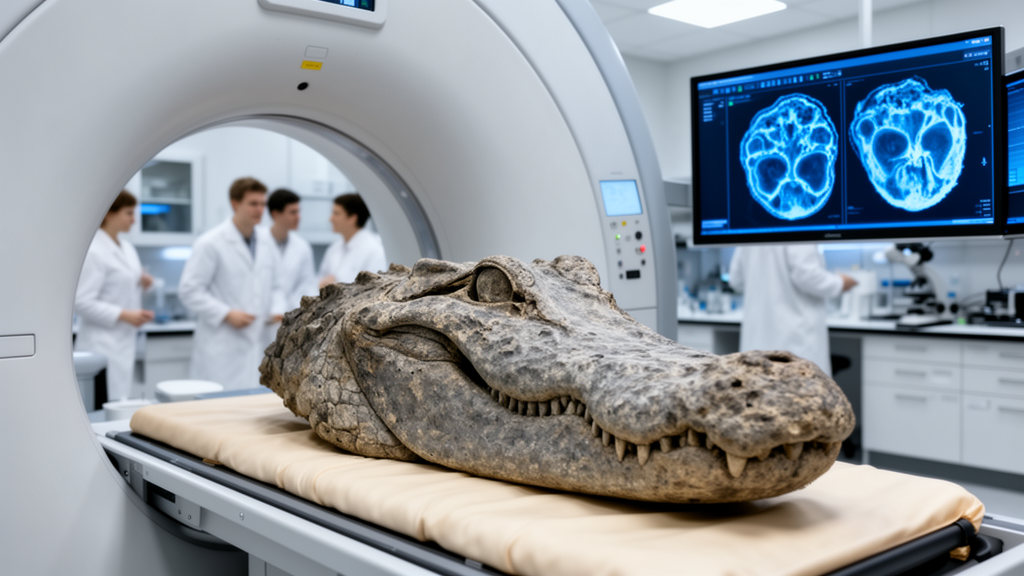
Researchers have unveiled a detailed anatomical map of the inner skull cavities of Diplocynodon tormis, an extinct alligatoroid that roamed the Iberian Peninsula during the Middle Eocene. By utilizing high-resolution computed tomography, scientists were able to reconstruct the complex internal structures of the holotype specimen, providing unprecedented insights into the sensory and cognitive capabilities of this ancient reptile. The study, published in the Fossil Record, marks a significant advancement in understanding the neuroanatomy of fossil crocodylians, a group that has persisted on Earth for over 200 million years with relatively few major changes in body plan.
The specimen, designated as IPS36361, was recovered from the Teso de la Flecha site in Salamanca, Spain. It represents an almost complete skull, although several bones from the posterior basicranium are missing. To overcome these preservation gaps, the team scanned the specimen at the Hospital Universitari Mútua de Terrassa using a standard X-ray CT system. The resulting 542 slices, with an inter-slice distance of 0.5 mm, allowed for the creation of a precise three-dimensional model. This digital reconstruction revealed the paranasal air sinuses, the dorsal region of the forebrain, the olfactory tracts, and the nasopharyngeal ducts, structures that are typically obscured by the dense bone of the skull in physical specimens.
The nasal cavity of Diplocynodon tormis displays a complex network of air passages that are characteristic of crocodylians. The nasal airway runs anteroposteriorly from the nares to the secondary choanae, divided into the nasal passage and the nasopharyngeal ducts. The olfactory region, one of the largest chambers in the skull, is bilobate and features a sagittal groove on its dorsal surface. This region is surrounded by the pterygoids, maxillae, and frontals, and it connects directly to the olfactory lobes of the brain. The nasopharyngeal ducts, which are two parallel tubes oriented posteroventrally, join in a common passage before opening into the secondary choanae, a feature that aligns with the anatomy of extant alligatoroids.
Comparative analysis of the paranasal sinus system further supports the phylogenetic position of Diplocynodon tormis as a basal alligatoroid. The sinuses are located in the snout, lateral and ventral to the nasal airway passage, and are composed of a complex of diverticula enclosed by the maxillae. The dorsal alveolar canal, which houses the maxillary branch of the trigeminal nerve, is oriented anteroposteriorly and connects with the nasal cavity via the medial subnarial anastomosis. This anatomical arrangement is similar to that found in other alligatoroids, such as Allodaposuchus and Arenysuchus, but distinct from the more derived crocodyloids. The preservation of these structures in the fossil record provides crucial evidence for the evolutionary history of the respiratory and sensory systems in crocodylians.
The study also estimated the neurosensorial capabilities of Diplocynodon tormis by analyzing the relative sizes of the olfactory bulbs and cerebral hemispheres. The olfactory ratio, a metric used to gauge olfactory acuity, was calculated for both the holotype and a paratype specimen, STUS-344. The paratype exhibited an olfactory ratio of 1.76, which falls within the expected range for alligatoroids, while the holotype had a slightly lower ratio of 1.64. These values are lower than those observed in crocodyloids, which typically range from 1.79 to 1.82, suggesting that Diplocynodon tormis possessed an acute but not as sharp olfactory sense as its more distant relatives. This finding reinforces the hypothesis that the relative size of the olfactory bulb has a strong phylogenetic signal, independent of the overall size of the animal.
Visual acuity was assessed by examining the relative volume of the optic lobe in the brain of the paratype specimen. The optic lobe accounted for 16% of the total brain volume in STUS-344, a value that is lower than that of other medium-sized crocodylians, such as Caiman crocodilus and Osteolaemus tetraspis, which have relative volumes between 19% and 22%. This suggests that Diplocynodon tormis may have had less developed visual capabilities compared to its contemporaries. The difference in optic lobe size could be attributed to variations in ecological niche or behavioral adaptations, although further studies are needed to confirm this interpretation. The absence of preserved ocular structures in the fossil record limits the precision of these estimates, but the relative volume of the optic lobe remains a reliable proxy for visual acuity in crocodylians.
Cognitive capabilities were evaluated using the Reptile Encephalization Quotient, a metric that adjusts brain volume for body mass to account for size-related differences. The REQ for the paratype of Diplocynodon tormis was calculated to be 1.12, a value that is within the general range for crocodylians but lower than that of other medium-sized specimens. This suggests that the cognitive abilities of Diplocynodon tormis were less developed than the average for its size class. The encephalization quotient in crocodylians is often correlated with ontogenetic state and body size rather than phylogenetic position, but the lower REQ of D. tormis indicates a potential difference in neural development. Additional specimens of this taxon are required to further evaluate the encephalization quotient and to determine whether this lower value is a consistent feature of the species.
The findings of this study contribute to a broader understanding of the evolutionary patterns of inner skull cavities in crocodylians. The similarity between the inner skull cavities of Diplocynodon tormis and those of other alligatoroids supports its position as a basal member of the Alligatoroidea clade. The mosaic of crocodylian plesiomorphies and alligatoroid synapomorphies observed in the brain shape of D. tormis further reinforces this phylogenetic placement. The use of CT scanning and 3D modeling has revolutionized the study of fossil neuroanatomy, allowing researchers to access and analyze structures that were previously inaccessible. As more fossil specimens are scanned and analyzed, the evolutionary history of the crocodylian sensory and cognitive systems will become increasingly clear, providing valuable insights into the adaptive strategies that have allowed this lineage to survive for millions of years.
Despite the detailed insights provided by this study, several limitations remain. The partial preservation of the holotype specimen, particularly the absence of the hindbrain and ventral brain regions, restricts the scope of the neuroanatomical analysis. The measurements of the cerebral hemispheres in the holotype may not be as precise as required due to the incomplete preservation of this region. Additionally, the lack of preserved inner ear structures in both specimens prevents any assessment of hearing capabilities in Diplocynodon tormis. Future studies incorporating more complete specimens and a wider range of fossil crocodylians will be essential to fully understand the evolutionary trajectories of the inner skull cavities and their associated sensory and cognitive functions. The data from this study, however, provides a robust foundation for these future investigations and highlights the importance of non-invasive imaging techniques in vertebrate paleontology.
Subject of Research: Neuroanatomy and sensory capabilities of the extinct alligatoroid Diplocynodon tormis
Article Title: New data on the inner skull cavities of Diplocynodon tormis ( Crocodylia , Diplocynodontinae ) from the Duero Basin (Iberian Peninsula, Spain)
Article References: Serrano-Martínez, A., Luján, À. H., García-Pérez, Á., & Fortuny, J. (2025). New data on the inner skull cavities of Diplocynodon tormis (Crocodylia, Diplocynodontinae) from the Duero Basin (Iberian Peninsula, Spain). Fossil Record, 28(1), 67-77. https://doi.org/10.3897/fr.28.133743
Image Credits: AI Generated
DOI: 10.3897/fr.28.133743
Keywords: Diplocynodon tormis, Crocodylia, Neuroanatomy, CT Scanning, Paleontology, Alligatoroidea, Olfactory Ratio, Encephalization Quotient, Iberian Peninsula, Middle Eocene, data, inner
Cite Scienmag News
Gavin Prescott. (October 18, 2026). CT Scans Reveal Inner Skull Secrets of Ancient Crocodilian. Scienmag. https://scienmag.com/ct-scans-reveal-inner-skull-secrets-of-ancient-crocodilian/
Gavin Prescott. "CT Scans Reveal Inner Skull Secrets of Ancient Crocodilian." Scienmag, 18 October 2026, https://scienmag.com/ct-scans-reveal-inner-skull-secrets-of-ancient-crocodilian/. Accessed 18 October 2026.
Gavin Prescott. "CT Scans Reveal Inner Skull Secrets of Ancient Crocodilian." Scienmag. October 18, 2026. https://scienmag.com/ct-scans-reveal-inner-skull-secrets-of-ancient-crocodilian/


