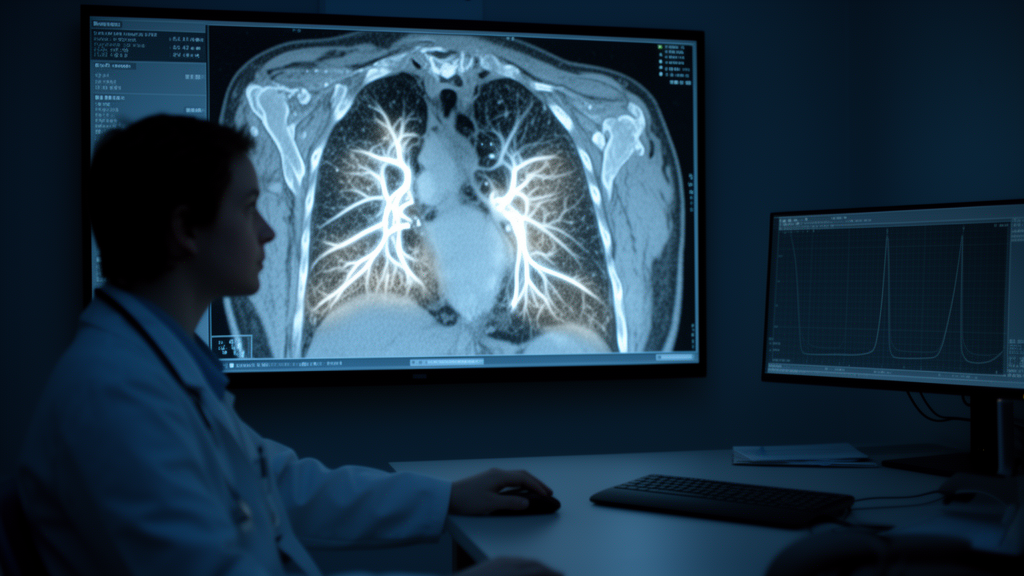
Children who develop plastic bronchitis as a complication of Mycoplasma pneumoniae pneumonia often need more than one bronchoalveolar lavage to clear the branching, plastic-like casts that obstruct their airways. Deciding whether a second lavage is necessary has lacked a uniform standard, leaving clinicians to judge case by case. A new multi-center retrospective study, published in BMC Pediatrics, reports the development and validation of a machine-learning model that combines computed tomography radiomics features with clinical variables to predict the need for secondary lavage in these young patients.
The study included pediatric patients aged 14 years or younger with Mycoplasma pneumoniae pneumonia complicated by plastic bronchitis, admitted to two tertiary hospitals in China between October 2019 and October 2024. The researchers extracted and preprocessed clinical variables and CT radiomics features, selecting features using LinearSVC, and identified significant clinical predictors with univariate logistic regression. Six machine-learning algorithms were then trained and validated on independent datasets, with performance evaluated by area under the receiver operating characteristic curve, accuracy, sensitivity, specificity, and decision curve analysis. Shapley Additive exPlanations values were used to interpret how the models reached their predictions.
In total, 219 patients were analyzed, divided into a training set of 104, an internal validation set of 27, and an external testing set of 88. Three laboratory markers emerged as significantly associated with the need for a second bronchoalveolar lavage: lactate dehydrogenase, C-reactive protein, and D-dimer levels. The best-performing approach was a combined model built on the ExtraTrees algorithm using the Gini impurity criterion, which achieved the most stable results across datasets, with AUROC values of 0.889 in training, 0.842 in internal validation, and 0.826 in external testing.
Decision curve analysis showed that the combined model delivered consistently higher net clinical benefit than models relying on radiomics alone or clinical variables alone, suggesting that integrating imaging texture information with laboratory data adds predictive value beyond either source by itself. The SHAP interpretation singled out a CT texture feature, wavelet_HHL_glszm_GrayLevelVariance, along with LDH and CRP levels, as the most influential inputs. Elevated LDH and CRP increased the predicted probability of needing secondary lavage, while the texture features showed variable directional effects on the prediction.
The authors conclude that the combined radiomics-clinical model could be used to predict the risk of secondary bronchoalveolar lavage in children with Mycoplasma pneumoniae pneumonia complicated by plastic bronchitis, and that such predictions could enhance clinical decision-making and support more personalized management strategies. Because the study is retrospective and conducted at two Chinese tertiary centers, its findings reflect the populations and data available in that setting, and the reported performance figures describe model discrimination in the analyzed datasets rather than outcomes of clinical deployment. The article was shared early as accepted, peer-reviewed research carrying a permanent DOI, with a final Version of Record to follow.
Subject of Research: A machine-learning model combining CT radiomics and clinical variables to predict repeat bronchoalveolar lavage in children with mycoplasma pneumoniae pneumonia and plastic bronchitis
Article Title: Development and validation of a CT radiomics–clinical machine-learning model for predicting the need for repeat bronchoalveolar lavage in children with mycoplasma pneumoniae pneumonia complicated by plastic bronchitis
Article References: Pang, G.-F., Zhang, Y.-X., Yi, Y., Zhang, X.-J., Zou, Z., Qian, Y.-F., Ni, H.-P., Shi, F., & Guo, W.-L. (2026). Development and validation of a CT radiomics–clinical machine-learning model for predicting the need for repeat bronchoalveolar lavage in children with mycoplasma pneumoniae pneumonia complicated by plastic bronchitis. BMC Pediatrics. https://doi.org/10.1186/s12887-026-07924-x
Image Credits: AI Generated
DOI: 10.1186/s12887-026-07924-x
Keywords: plastic bronchitis, Mycoplasma pneumoniae pneumonia, bronchoalveolar lavage, CT radiomics, machine learning, ExtraTrees, SHAP, lactate dehydrogenase, C-reactive protein, D-dimer, pediatrics, BMC Pediatrics
Cite Scienmag News
Harold Sullivan. (October 29, 2026). CT-Based Machine-Learning Model Predicts Which Children Need Repeat Lung Lavage. Scienmag. https://scienmag.com/ct-based-machine-learning-model-predicts-which-children-need-repeat-lung-lavage/
Harold Sullivan. "CT-Based Machine-Learning Model Predicts Which Children Need Repeat Lung Lavage." Scienmag, 29 October 2026, https://scienmag.com/ct-based-machine-learning-model-predicts-which-children-need-repeat-lung-lavage/. Accessed 29 October 2026.
Harold Sullivan. "CT-Based Machine-Learning Model Predicts Which Children Need Repeat Lung Lavage." Scienmag. October 29, 2026. https://scienmag.com/ct-based-machine-learning-model-predicts-which-children-need-repeat-lung-lavage/