


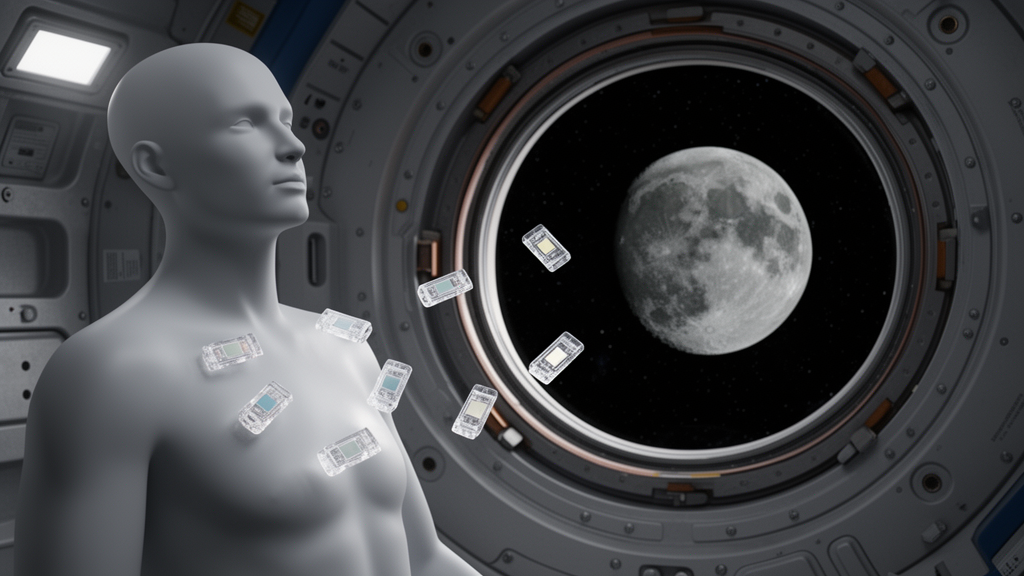
When the uncrewed Orion capsule of NASA’s Artemis I mission swung around the Moon in late November and early December 2022, it carried more than ten thousand tiny crystals inside two human phantoms, silently registering every particle of ionizing radiation that tore through them. Among these were several dozen experimental fluorescent lithium fluoride detectors developed at the Institute of Nuclear Physics of the Polish Academy of Sciences (IFJ PAN) in Cracow. A method for reading the information stored in those crystals has now been published in the journal Radiation Measurements, offering preliminary estimates of the radiation doses astronauts would face near the Moon and revealing how differently that environment behaves compared with low Earth orbit.
The detectors are passive devices, and their operating principle is elegantly simple. As particles of ionizing radiation pass through a lithium fluoride crystal, they produce defects in the material’s crystal lattice, which begin to act as color centers. During laboratory readout, these centers are excited by blue light and, in response, emit red fluorescence that can be observed under a microscope. In effect, the crystals work like photographic film: once they have been exposed to radiation, the tracks left by individual particles must be analyzed optically, one by one. Prof. Pawel Bilski of IFJ PAN, a co-author of the paper, describes them in exactly these terms, noting that the tracks left by individual particles must be analyzed optically under a microscope after exposure.
The crystals flew as part of the MARE experiment, short for Matroshka AstroRad Radiation Experiment, which was installed aboard Orion for the Artemis I mission. Several dozen of the experimental lithium fluoride detectors were placed in both human phantoms, and some of them were highly enriched in the lithium-7 isotope. Cracow’s contribution to the experiment was considerably larger still, because the institute also supplied nearly 600 crystalline detectors of another type, thermoluminescent detectors, which record dose through a different physical mechanism. Together, the two detector families allowed the researchers to cross-check their measurements of the complex radiation field beyond low Earth orbit.
Reading the particle tracks recorded in the vicinity of the Moon turned out to be quick and straightforward, and this is where the lithium fluoride technology shows a decisive practical advantage. Conventional passive track detectors made of plastic must undergo chemical etching before they can be read out, a cumbersome and time-consuming step. Lithium fluoride crystals require no such chemical treatment at all; a standard fluorescence microscope is sufficient to observe the tracks directly. The real challenges arose only when the team attempted to extract quantitative information from the images, which required the development of non-trivial methods for calibrating the results against a radiation field unlike anything encountered in a laboratory.
That fundamental difficulty stemmed from the very nature of cosmic radiation. In typical physics experiments, detectors are irradiated with beams consisting of particles of a single type, all having well-defined energies and a precisely known direction of incidence. Cosmic radiation, by contrast, arrives from all directions and contains all naturally occurring types of particles and atomic nuclei, spanning a very broad energy range. When observed under a microscope, the recorded tracks therefore run in every conceivable direction. In addition to the track segment lying within the focal plane, a region roughly one micrometer in size, the camera also captures a blurred glow from the remaining portions of each track, and this glow affects the fluorescence intensity, the primary parameter used to assess ionization density.
The geometry of the tracks was not the only complication. Tracks left by highly ionizing particles appeared as continuous, clearly defined lines, whereas weakly ionizing particles could leave behind only a series of discrete, separated dots rather than unbroken trails. This difference in appearance also affected the fluorescence intensity of the tracks, further complicating the task of converting optical signals into reliable dose values. The Cracow team responded by applying a series of corrections and developing software to remove the background interfering with the measurements, an effort that ultimately allowed the fluorescent detectors to be validated against the established technology flying alongside them.
The validation succeeded to a striking degree. According to Prof. Bilski, after the corrections were applied, the results differed by no more than 15 percent from those obtained using conventional track detectors across the entire overlapping range of energy deposition values. Moreover, the fluorescent crystals recorded numerous particle tracks corresponding to energy deposits below the detection threshold of the detectors used to date, meaning the new technique does not merely match the old one but extends the measurable range toward weaker, harder-to-detect events. For a passive detector that fits in millimeters rather than centimeters, that combination of accuracy and sensitivity marks a significant technical milestone.
The physics recorded inside the phantoms also tells a story about the radiation environment itself. During the earlier MATROSHKA experiment aboard the International Space Station more than a decade ago, low-energy protons trapped in the Van Allen radiation belts surrounding Earth accounted for part of the dose deposited in the phantoms. These protons lost their energy at different depths within the mannequins, producing a markedly non-uniform distribution of radiation doses throughout their bodies. Near the Moon, however, the Van Allen belts are absent, and galactic cosmic radiation dominates instead. Its energies are so high that the particles can pass through the entire human body, depositing only part of their energy along the way, so the dose distribution recorded inside the phantoms during Artemis I was essentially uniform.
This contrast leads to one of the most interesting conclusions of the study. Low-energy protons trapped by Earth’s magnetic field within the Van Allen belts can account for the majority of the radiation dose received by astronauts in low Earth orbit, so near the Moon that substantial contribution simply disappears. The measurements from the MARE experiment indicate that, although total radiation doses near the Moon are higher than those in Earth orbit because of the considerable levels of galactic radiation, the difference is not as large as one might intuitively expect. The absence of the belt protons partially offsets the stronger galactic component, a nuance that matters for anyone planning crewed missions into deep space.
The fluorescent lithium fluoride detectors themselves were grown using the Czochralski method and were developed at IFJ PAN a decade ago, with continuous improvements ever since. Their main advantages include their small size, on the order of millimeters rather than centimeters, which makes them convenient for people to wear; better track resolution than conventional chemically etched plastic detectors, allowing higher radiation doses to be recorded with clearly distinguishable tracks; and a broad range of detectable particle types and energies, enabling a better assessment of total radiation exposure. Furthermore, lithium fluoride detectors, particularly those enriched in the lithium-6 isotope, can be used to record neutron doses, since neutrons then undergo reactions with lithium nuclei, locally producing secondary charged particles that interact with the material in much the same way as external ionizing radiation. The MARE research was supported by a grant from the National Science Centre, Poland, under its OPUS programme, and the published results, appearing in Radiation Measurements in 2026, give mission planners and radiation physicists a validated new tool for characterizing the deep-space radiation field that future lunar crews will have to endure.
Subject of Research: Passive lithium fluoride fluorescent track detector measurements of cosmic radiation doses inside phantoms during the Artemis I lunar mission
Article Title: Artemis I: Crystals of experimental detectors record radiation doses near the Moon
Article References: Artemis I: Crystals of experimental detectors record radiation doses near the Moon. Original publication (Bibliographic details unavailable.)
Image Credits: AI Generated
DOI: Not provided
Keywords: Artemis I, cosmic radiation, lithium fluoride detectors, MARE experiment, Orion spacecraft, radiation dosimetry, Van Allen belts, galactic cosmic rays, IFJ PAN, lunar missions, fluorescent nuclear track detectors, space radiation
Cite Scienmag News
Bethany Barker. (October 25, 2026). Crystal detectors reveal cosmic radiation doses near the Moon on Artemis I. Scienmag. https://scienmag.com/crystal-detectors-reveal-cosmic-radiation-doses-near-the-moon-on-artemis-i/
Bethany Barker. "Crystal detectors reveal cosmic radiation doses near the Moon on Artemis I." Scienmag, 25 October 2026, https://scienmag.com/crystal-detectors-reveal-cosmic-radiation-doses-near-the-moon-on-artemis-i/. Accessed 25 October 2026.
Bethany Barker. "Crystal detectors reveal cosmic radiation doses near the Moon on Artemis I." Scienmag. October 25, 2026. https://scienmag.com/crystal-detectors-reveal-cosmic-radiation-doses-near-the-moon-on-artemis-i/


