


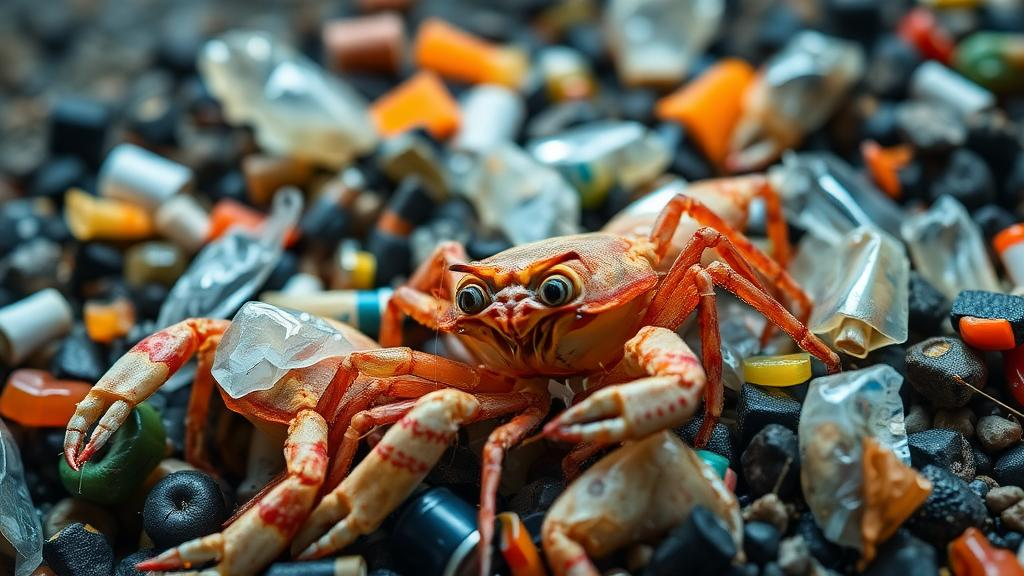
Plastic pollution has become one of the defining environmental challenges of the twenty-first century, and a new review in the journal Ecotoxicology brings together the scattered evidence of what it is doing to one of the most ecologically important groups of aquatic animals: crustaceans. Led by Mahdi Banaee of Behbahan Khatam Alanbia University of Technology in Iran, together with researchers from Türkiye, India and Italy, the synthesis argues that crabs, shrimp, crayfish and their relatives are not merely passive victims of plastic debris but highly informative sentinels whose biology reveals, layer by layer, how microplastics and nanoplastics damage living systems. The timing could hardly be more urgent. Global inputs of plastics to the oceans are projected to rise from roughly 11 million metric tons in 2016 to 44 million tons by 2060, and the particles that slip into waterways show no sign of stopping there.
The review traces the full journey of these contaminants from source to sediment. Microplastics and nanoplastics originate from single-use packaging, synthetic textiles, fishing gear, industrial waste and the slow fragmentation of larger debris. They reach rivers, lakes and coastal seas through urban runoff, wastewater effluents and even atmospheric deposition, and because many particles are denser than water or become fouled by microbial biofilms, they ultimately settle into sediments. That is precisely where benthic crustaceans live and feed. By sifting through contaminated mud, grazing on biofilms and consuming prey that have already ingested plastic, animals such as crayfish, fiddler crabs, shrimp and horseshoe crabs encounter plastic at concentrations far higher than those measured in the open water column. Their wide distribution across marine, brackish and freshwater habitats, combined with their central position in aquatic food webs, makes them ideal bioindicators of plastic pollution.
Once in contact with a crustacean, plastic particles find multiple routes inside the body. The review confirms uptake through ingestion, through the filtration surfaces of the gills, and through direct dermal contact, which is particularly significant during molting, when the old exoskeleton is shed and the new cuticle is still soft and permeable. From these entry points, particles are biodistributed to the hepatopancreas, the gut, the gills and the hemolymph, the crustacean equivalent of blood. Studies cited in the review have detected microplastics in the edible muscle tissues of commercially important species such as the Pacific whiteleg shrimp Litopenaeus vannamei and the giant river prawn Macrobrachium rosenbergii, raising questions that extend beyond ecology into food safety. In red swamp crayfish, researchers have even documented bio-mediated fragmentation, in which digestive processing breaks larger microplastics into smaller fragments that may penetrate tissues more deeply.
What happens next follows a disturbingly consistent sequence that the authors describe as a progression from physical interference to cellular damage to whole-organism dysfunction. At the coarsest level, particles can obstruct the digestive tract or physically dilute the nutritional value of food. At the cellular level, the dominant mechanism is oxidative stress: plastic particles trigger the overproduction of reactive oxygen species, overwhelming antioxidant defenses and damaging lipids, proteins and DNA. Histopathological lesions in the hepatopancreas, gut and gills have been documented repeatedly across species, from polyethylene-exposed whiteleg shrimp to polystyrene-exposed crayfish. Genotoxic effects, including DNA strand breaks and altered expression of apoptosis-related genes in the hepatopancreas of juvenile prawns, indicate that the damage reaches the genome itself.
Beyond individual cells, the review catalogs a cascade of physiological disruptions. Immune suppression emerges as a recurring theme, with hemocytes, the circulating immune cells of crustaceans, showing impaired function after plastic exposure, and lysozyme and other immune-related genes being downregulated in shrimp fed contaminated feed. The gut microbiome, increasingly recognized as a pillar of crustacean health, falls into dysbiosis: studies on crayfish, brine shrimp and Chinese mitten crabs all report shifts in intestinal microbial communities following microplastic or nanoplastic exposure, some of which persist even after the animals are returned to clean water. Endocrine disruption adds another layer of complexity. Plasticizers such as phthalates and bisphenols leach from particles and interfere with hormone signaling, and nanoplastic exposure has been shown to disturb sex hormones, alter vitellogenin levels and impair gonadal development in shrimp and crayfish.
Osmoregulation, the delicate ionic balancing act that allows crustaceans to thrive in waters of varying salinity, is also compromised. Proteomic analyses of nanoplastic-exposed whiteleg shrimp gills reveal disturbances in ion transport proteins, and experiments with fiddler crabs show that salinity modulates both microplastic accumulation and osmoregulatory toxicity. Metabolism suffers in parallel: lipid metabolism is altered in the hepatopancreas of redclaw crayfish, energy metabolism shifts in the oriental river prawn, and growth rates decline in species from brine shrimp to horseshoe crabs. Perhaps most striking for an animal group defined by its armor, molting itself is disrupted. Polystyrene nanoplastics reduce molting frequency in adult Macrobrachium nipponense, polyethylene terephthalate microfibers alter molting patterns in whiteleg shrimp, and microplastics weaken the mechanical properties of the exoskeleton, leaving animals structurally and developmentally vulnerable.
The consequences ripple outward into behavior and reproduction. Hermit crabs exposed to microplastics show impaired cognition and disrupted contest behavior, undermining the shell-selection decisions that determine their survival. Whiteleg shrimp exposed to microplastics display impaired appetite, olfaction and digestion, eroding the sensory and motivational machinery of feeding. Reproductive disorders complete the picture: polystyrene microplastics induce male reproductive toxicity and transgenerational effects in freshwater prawns, microplastics combined with the hormone-mimic bisphenol A hamper gonadal development in whiteleg shrimp, and microplastic fibers reduce reproduction in Pacific mole crabs at environmentally relevant concentrations. For populations, these sublethal effects matter more than acute lethality, because they erode fitness quietly across generations.
One of the review’s most consequential arguments concerns co-exposure. In the real world, crustaceans never encounter plastics alone. The particles act as vectors for heavy metals, pesticides, pharmaceuticals and other pollutants, adsorbing these chemicals onto their surfaces and enhancing their bioavailability. Experiments show that polystyrene microplastics increase lead bioaccumulation and health damage in the Chinese mitten crab, that microplastics enhance copper-induced immunotoxicity in red swamp crayfish, and that combined exposure to nanoplastics and metals or antibiotics produces oxidative stress and gut damage in juvenile horseshoe crabs exceeding what either stressor causes alone. Environmental variables amplify the problem further: warming increases microplastic accumulation and physiological toxicity in fiddler crabs, temperature modulates the physiological response of crayfish to polyethylene, and climate change is expected to alter the behavior, distribution and risk profile of freshwater microplastics overall.
The review also confronts the question of trophic transfer, the movement of plastics up food chains. Nanoplastics have been shown to pass from brine shrimp to fish, from microalgae through crustaceans to small yellow croakers, and from American horseshoe crab eggs to shorebirds, demonstrating that crustaceans can serve as both recipients and conduits of plastic contamination. Accumulation kinetics studies in water fleas and mysids confirm that transfer between trophic levels is measurable and biologically meaningful. Yet the authors identify significant gaps that still block a complete risk picture: methodologies for sampling, identifying and quantifying microplastics remain poorly standardized, long-term monitoring data are scarce, and trophic transfer in freshwater and aquaculture settings is especially under-studied, even though shrimp ponds and crayfish farms are demonstrably contaminated.
The authors’ conclusion is a call for integrated risk assessment frameworks that account simultaneously for particle characteristics such as size, polymer type and shape, for environmental variables such as temperature and salinity, and for multi-stressor interactions that dominate real ecosystems. Encouragingly, some mitigation avenues are emerging, including evidence that biofloc microorganisms can enhance shrimp resistance to microplastics and that Spirulina supplementation can remediate some intestinal damage in exposed crayfish. But the central message stands: crustaceans, from the smallest copepod to the largest crab, are integrating the entire toxicological spectrum of plastic pollution in their tissues, their genes and their behavior. Reading them carefully, the review argues, is one of the best ways humanity has of understanding what the plastic age is doing to aquatic ecosystems, and of acting before projected emissions quadruple the burden.
Subject of Research: Toxicological effects of microplastics and nanoplastics on crustaceans
Article Title: Integrated toxicological approach to microplastics and nanoplastics in crustaceans
Article References: Banaee, M., Shakeri, R., Günal, A. Ç., Yüce, P. A., Trivedi, A., & Faggio, C. (2026). Integrated toxicological approach to microplastics and nanoplastics in crustaceans. Ecotoxicology, 35(8), Article 175. https://doi.org/10.1007/s10646-026-03155-z
Image Credits: AI Generated
DOI: 10.1007/s10646-026-03155-z
Keywords: microplastics, nanoplastics, crustaceans, ecotoxicology, oxidative stress, bioaccumulation, endocrine disruption, gut microbiome, trophic transfer, multi-stressor toxicity, aquatic pollution, bioindicators
Cite Scienmag News
Sloane Callahan. (September 30, 2026). Crustaceans Reveal the Full Toxic Toll of Microplastics and Nanoplastics. Scienmag. https://scienmag.com/crustaceans-reveal-the-full-toxic-toll-of-microplastics-and-nanoplastics/
Sloane Callahan. "Crustaceans Reveal the Full Toxic Toll of Microplastics and Nanoplastics." Scienmag, 30 September 2026, https://scienmag.com/crustaceans-reveal-the-full-toxic-toll-of-microplastics-and-nanoplastics/. Accessed 4 October 2026.
Sloane Callahan. "Crustaceans Reveal the Full Toxic Toll of Microplastics and Nanoplastics." Scienmag. September 30, 2026. https://scienmag.com/crustaceans-reveal-the-full-toxic-toll-of-microplastics-and-nanoplastics/


