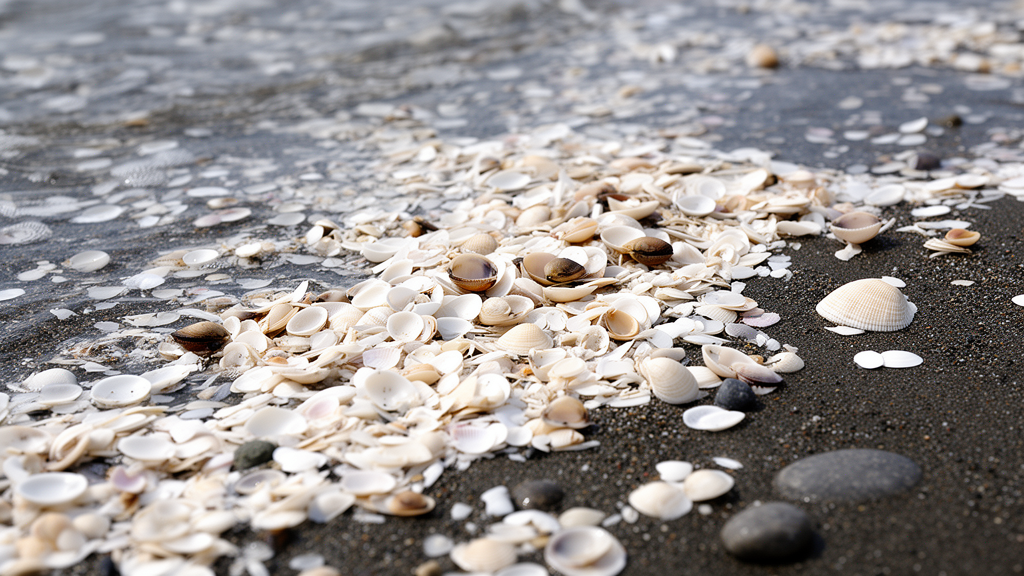
Juvenile Pacific littleneck clams grew better in acidified seawater when crushed shell was mixed into their sediment, according to a 90-day controlled experiment published in the journal Biogeosciences. The study, led by Hannah Kempf of the University of California, Davis, found that adding shell hash — fragments of crushed clam shell roughly a quarter to half a centimetre across — raised the pH of the water trapped between sediment grains and largely erased the genetic signature of acidification stress in the animals’ mantle tissue.
Ocean acidification is a mounting problem for calcifying organisms. As the ocean absorbs anthropogenic carbon dioxide, carbonate chemistry shifts toward lower concentrations of carbonate ions, the building blocks of calcium carbonate shells and skeletons. Surface ocean acidity has risen by roughly 30 percent since pre-industrial times, and for animals such as clams and mussels, building shell under low-pH conditions becomes energetically costly, while acidic water can actively dissolve existing shell material.
For animals that live buried in sediment, the chemistry they experience is not simply the chemistry of the seawater above them. Infaunal organisms such as littleneck clams live within pore water — the fluid filling the spaces between sediment grains — which is generally lower in pH than the overlying water and is shaped by microbial redox reactions, mineral dissolution and precipitation, and the mixing activities of burrowing animals. This complexity makes the impact of acidification on infaunal species difficult to predict, and it also opens a possible lever for mitigation: change the sediment, and you change the water the animal actually lives in.
The idea is not new. Adding pulverized shell to beach sediments is one component of Indigenous mariculture systems along the Northwest coast of North America, where clam gardens built and tended for millennia have been shown to host larger clam populations and greater intertidal biodiversity. In the region around Bodega Bay, California, archaeological sites document clam bed management by the Coast Miwok, who have lived in what is now western Marin County for at least 8,000 years. Scientific studies have pointed in the same direction: in the northeastern United States, adding shell hash to mudflats raised pore water pH and increased settlement of the clam Mya arenaria, and rearing tanks enriched with mussel shell improved larval shell development under high carbon dioxide conditions. Yet other studies have found little or no effect, leaving the question open and likely dependent on species, habitat and regional oceanography.
To test the hypothesis directly, the researchers raised juvenile Leukoma staminea — a venerid clam that burrows 5 to 15 centimetres into the sediment along nearly the entire west coast of North America — under four conditions for 90 days: control seawater at pH near 7.8 with plain sand, acidified seawater at pH near 7.4 with plain sand, and both pH levels with sand containing 10 percent by weight of crushed shell from two native Bodega Bay species. All clams came from a single controlled spawn of parents collected from Bodega Harbor, and 30 juveniles were placed in each of eight buckets run in duplicate treatments.
The team sampled overlying seawater three times a week for pH, salinity, temperature and dissolved oxygen, and drew pore water from 8 centimetres depth in the substrate once a week for precise spectrophotometric pH and alkalinity measurements. The results were clear on the chemistry: shell hash consistently elevated pore water pH, aragonite saturation state and total alkalinity relative to the acidified treatment without shell. Statistical models showed total alkalinity was significantly affected by the seawater treatment and saturation state by sediment type.
Growth told a consistent story. Of the clams that survived to day 90, 130 were measured after staining with calcein, a fluorescent dye that marks the shell edge at the start of an experiment so new growth can be measured precisely. Percent new growth differed significantly with overlying pH: clams in acidified water grew 6.4 percent with shell hash and 4.7 percent with sand alone, while clams in control water grew 7.9 percent and 7.7 percent respectively. Although the interaction between acidification and sediment type did not reach statistical significance, the pattern suggests that clams grow better in shell-amended sediment under low-pH conditions. Shell weight and tissue weight differences among treatments were not statistically significant, which the authors attribute to their limited replication — only two buckets per treatment — and high variability in the starting sizes of the juvenile cohort.
The most novel part of the work came from gene expression. The researchers sequenced the mantle transcriptome of 24 clams and identified 284 differentially expressed genes across treatments. The acidified treatment without shell hash clustered apart from all others in principal components and correlation analyses, while the acidified treatment with shell hash was largely indistinguishable from animals raised in non-acidified water — no more than 11 of the 284 genes differed in any pairwise comparison excluding the acidified-only condition. In other words, the genetic fingerprint of acidification stress essentially disappeared when shell hash was present. Among the annotated genes were several resembling DNA repair proteins, a perlucin-like protein involved in calcium carbonate precipitation, and a putative monocarboxylate transporter hypothesized to shuttle ions to sites of biomineralization.
The authors are careful about scope. This was a laboratory experiment with quartz sand chosen to minimize confounding geochemical reactions, controlled pH in header tanks, and no tidal forcing, microbial community complexity or natural sediment chemistry. Field studies of shell hash have been mixed: one found shell hash reduced variability but not overall values of pore water pH at a cobble-sand beach in British Columbia and had no discernible effect on a nearby organic-rich mudflat, while another measured a modest pH increase of about 0.09 units in a New Brunswick mudflat that faded within two months — a timeframe consistent with estimates that biogenic shell material has a dissolution half-life of roughly 50 days. Species responses to acidification also vary widely, with a recent meta-analysis showing calcification declines under moderate acidification that differ substantially by species and life stage.
Within those limits, the study provides the first experimental evidence that genetic changes associated with acidified water are lost when shell hash is added, alongside clear support for the buffering hypothesis at the pore water scale. The authors conclude that shell hash appears best suited to local habitat engineering or the creation of acidification refugia rather than broad-scale intervention, and that any implementation in coastal settings should proceed site by site and in partnership with Indigenous communities whose clam-tending practices anticipated this line of research by millennia. They call for further work on scalability, efficacy and safety, and on whether buffering extends to the water-sediment interface where larvae settle — the zone where corrosive conditions may matter most for the next generation of shellfish.
Subject of Research: Whether adding crushed shell to sediment buffers pore water chemistry and protects juvenile Pacific littleneck clams from ocean acidification
Article Title: Shell hash promotes growth in Pacific littleneck clams (Leukoma staminea) by altering pore water chemistry
Article References: Kempf, H. L., Griffin, A. J., Ng, G., Hill, T. M., Schneider, T. D., Carlson, S. J., & Gold, D. A. (2026). Shell hash promotes growth in Pacific littleneck clams ( Leukoma staminea ) by altering pore water chemistry. Biogeosciences, 23(20), 7627-7642. https://doi.org/10.5194/bg-23-7627-2026
Image Credits: AI Generated
Keywords: ocean acidification, shell hash, clams, Leukoma staminea, pore water chemistry, biogeosciences, clam gardens, calcification, gene expression, Indigenous mariculture, Bodega Bay, shellfish aquaculture
Cite Scienmag News
Violet Maxwell. (October 29, 2026). Crushed shells buffer acidic sediments and help young clams grow. Scienmag. https://scienmag.com/crushed-shells-buffer-acidic-sediments-and-help-young-clams-grow/
Violet Maxwell. "Crushed shells buffer acidic sediments and help young clams grow." Scienmag, 29 October 2026, https://scienmag.com/crushed-shells-buffer-acidic-sediments-and-help-young-clams-grow/. Accessed 30 October 2026.
Violet Maxwell. "Crushed shells buffer acidic sediments and help young clams grow." Scienmag. October 29, 2026. https://scienmag.com/crushed-shells-buffer-acidic-sediments-and-help-young-clams-grow/