


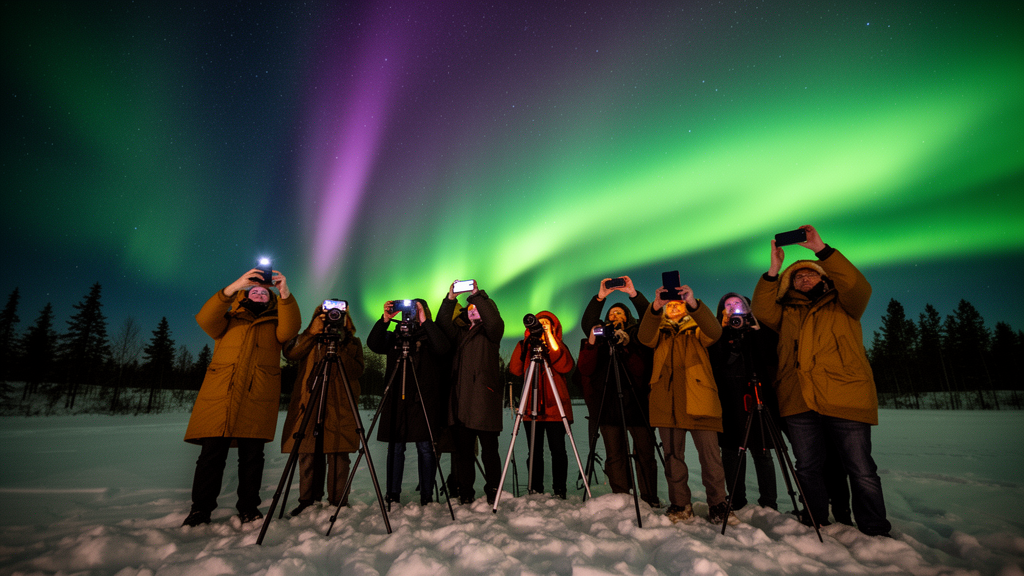
When the most powerful geomagnetic storm in two decades swept across the planet in May 2024, millions of people stepped outside, looked up, and photographed one of the most spectacular auroral displays in living memory. Many of them also did something quietly revolutionary: they filed structured reports about what they saw with a citizen science platform called Aurorasaurus. Now, a team led by Elizabeth MacDonald of NASA’s Goddard Space Flight Center, with colleagues at the New Mexico Consortium, has released the full scientific archive of those crowdsourced observations, documenting in unprecedented detail what ordinary observers recorded during the rare superstorms of 2024 and opening the dataset to researchers worldwide.
The new technical report, published in Frontiers in Astronomy and Space Sciences, details Aurorasaurus data across the operational lifetime of the project, which has been running since September 2014. The centerpiece is the archive of direct web reports through July 2025, with particular emphasis on two extraordinary events: the Gannon storm of May 10 to 13, 2024, and a second superstorm on October 10 to 13 of the same year. A superstorm is conventionally defined as a geomagnetic storm whose minimum Dst index, a measure of the ring current disturbance at mid-latitudes, reaches minus 250 nanotesla or lower. Such events are exceedingly rare, and global observations of aurora during them are so scarce that the behavior of aurora at low latitudes remains poorly understood.
The Gannon storm was driven by an unusual sequence of multiple coronal mass ejections, enormous eruptions of magnetized plasma from the Sun that struck Earth’s magnetic field in succession. It was the largest storm of its kind since November 2003 and, notably, the first superstorm to be captured by widespread consumer digital cameras. The event also included coincident solar energetic particles and a rare ground level enhancement, with extreme increases in ionization in the upper atmosphere. During the storm, the Aurorasaurus platform received 6,415 direct reports, which the team believes is the largest number of aurora sightings ever reported globally as participatory science for a single event. The October storm, though less intense at minus 390 nanotesla in the faster SYM-H index, still generated 1,589 reports and provides an important comparative case.
What makes the dataset scientifically valuable is not just its size but its structure. Each web report includes whether the observer saw or did not see the aurora, a submission timestamp, reported observation start and end times, geographic location, and a series of optional structured fields covering sky conditions, auroral colors, auroral types, activity level, and location in the sky. Users may attach photographs. From the geographic coordinates, the team derived geomagnetic parameters, specifically magnetic latitude, magnetic longitude, and magnetic local time, using the Altitude-adjusted Corrected Geomagnetic coordinate library. These magnetic coordinates are essential because they account for the position of Earth’s magnetic pole with respect to auroral behavior; the planet effectively rotates beneath the auroral oval, which is typically broadest around magnetic midnight.
Transforming raw crowdsourced submissions into a scientifically usable database required a reproducible, three-part processing pipeline written in Python. The first stage transforms the raw backend database into a standardized format, with automated screening and manual review identifying test reports, spam, and personally identifiable information, which are removed or redacted. The second stage applies scientific filters. Reports exceeding 12 hours in duration are removed, since longer observations likely indicate data entry errors. Negative reports in which users indicated cloudy skies or bright conditions from light pollution or moonlight are also filtered, because obscured conditions cannot confirm or rule out the presence of an aurora. An optional third filter removes duplicates identified through automated screening and manual resolution. For the Gannon storm, the team tested this duplicate protocol, flagging observations with identical entries across attributes such as observation times, country, state, and form answers, then manually reviewing each flagged pair. Examining images and location coordinates proved decisive: some identical entries had unique images and were therefore not duplicates, while true duplicates tended to lie within about a kilometer of each other.
After cleaning, 5,109 of the 6,415 Gannon storm reports remained, of which 58.2 percent were positive sightings accompanied by images, 20.0 percent were positive without a photo, and 21.8 percent were negative reports. For the October storm, 1,623 of 1,757 raw reports survived cleaning, with 61.9 percent containing images. The team notes that more than half of reports now contain images, compared with only about 20 percent in the project’s early years, reflecting the spread of smartphones capable of directly capturing aurora. In the project’s infancy, users famously submitted photographs of the back of their camera screens; today the phone itself takes the shot in the field. The full cleaned dataset is offered in both raw and scientific formats through an open-access Zenodo repository, accompanied by interactive, open-source Jupyter Notebooks that enable exploration, visualization, and comparison of auroral observations with geophysical data.
The release is not without caveats, which the team documents candidly. Like many citizen science datasets, Aurorasaurus observations reflect uneven geographic participation and contain spatial reporting biases, so the data are not appropriate for deriving absolute abundances or magnitudes. Most reports during both storms originated from mid- and high-latitude regions of the Northern Hemisphere, particularly North America and Europe, where the platform’s user base is most active, and the Southern Hemisphere showed less coverage simply because there are fewer land areas where aurora may be visible. The platform is limited to English, although widespread AI translation tools now allow broader use. Photographs are also removed from the public data release to protect photographers’ rights under the project’s terms of use, though images are available to researchers who contact the team. In the age of generative AI, the authors note, protecting photographers’ rights and data quality matters more than ever, and having humans in the loop remains essential.
The scientific payoff of the archive is already visible in the color and type distributions it captures. Green aurora, produced at the 557.7 nanometer emission line of atomic oxygen, dominates, peaking at about 100 kilometers altitude where atomic oxygen is densest. Red aurora appears in three major storm-time varieties: the blood-red great red aurora visible to the naked eye, the Stable Auroral Red arcs that can range from subvisual to visual with a pure 630 nanometer oxygen emission, and high-altitude oxygen emissions that can be seen from great distances, including just over the horizon. Pink arises when more energetic electrons penetrate deeper into molecular nitrogen, while blue comes from resonant scattering of sunlight by ionized nitrogen molecules at high altitude. During the Gannon storm, reports of green, pink, and red peaked between 45 and 55 degrees magnetic latitude, with red reported at lower latitudes. Intriguingly, the team observed proportionally more blue and purple reports during the May storm and more red during the darker October event, a seasonality effect consistent with color mixing under shorter nights.
Among the most scientifically tantalizing records are the furthest equatorward reports, which deserve detailed scrutiny because the lowest latitude of auroral visibility is an important proxy for storm strength that can be compared with historical events predating modern geophysical instruments. The team highlights one extraordinary case: an extremely low latitude camera-only report from Oman, where two astrophotographers photographing a dark sky site captured unusual red emissions. After contacting a NASA enthusiast and translator in Oman, who reached the lead author, the time, location, and astrometry were confirmed as consistent with red aurora at the same time as a well-documented peak of activity over Europe. The authors argue that modern, plentiful reports open a time-domain view of the lowest-latitude aurora on hourly or sub-hourly frames, an advantage over the often singular accounts of extreme events in the historical record, and they draw a parallel to the mid-nineteenth century, when telegraphs and railroads drove standardized timekeeping that enhanced the precision of distributed auroral and geomagnetic observations.
The project’s impact extends well beyond the database itself. Aurorasaurus catalyzed the concept of NASA’s Heliophysics Big Year, a global celebration of the Sun’s influence on Earth running from October 2023 to December 2024 that coincided with solar maximum, and it contributed to the citizen-science-driven discovery of STEVE, the subauroral phenomenon first identified through aurora chaser photographs. The team’s Ambassador program of superusers, virtual journal clubs, semiannual Report-A-Thons that gathered backdated reports from the 2024 superstorms, and a Winter Field School at the University of Alaska Fairbanks all aim to build a new generation of space scientists. With nearly 8,000 observations from the two superstorms, more than half including a photo, and a documented, reproducible workflow, the team hopes amateurs and professionals alike will integrate the data into space weather research. As the authors put it, this feedback loop of greater understanding leads to better data, which leads to greater understanding.
Subject of Research: Space Physics
Article Title: Crowdsourced aurora observations during geomagnetic superstorms: the Aurorasaurus open science database
Article References: MacDonald, E., Natsheh, F., Edson, L. B., & Heavner, M. (2026). Crowdsourced aurora observations during geomagnetic superstorms: the Aurorasaurus open science database. Frontiers in Astronomy and Space Sciences, 13, Article 1883317. https://doi.org/10.3389/fspas.2026.1883317
Image Credits: AI Generated
DOI: 10.3389/fspas.2026.1883317
Keywords: aurora, citizen science, geomagnetic storm, heliophysics, open science, space weather, Aurorasaurus, Crowdsourced, observations, during, geomagnetic, superstorms
Cite Scienmag News
Albert Anderson. (October 15, 2026). Crowdsourced aurora observations during geomagnetic superstorms: the Aurorasaurus open science database. Scienmag. https://scienmag.com/crowdsourced-aurora-observations-during-geomagnetic-superstorms-the-aurorasaurus-open-science-database/
Albert Anderson. "Crowdsourced aurora observations during geomagnetic superstorms: the Aurorasaurus open science database." Scienmag, 15 October 2026, https://scienmag.com/crowdsourced-aurora-observations-during-geomagnetic-superstorms-the-aurorasaurus-open-science-database/. Accessed 15 October 2026.
Albert Anderson. "Crowdsourced aurora observations during geomagnetic superstorms: the Aurorasaurus open science database." Scienmag. October 15, 2026. https://scienmag.com/crowdsourced-aurora-observations-during-geomagnetic-superstorms-the-aurorasaurus-open-science-database/


