


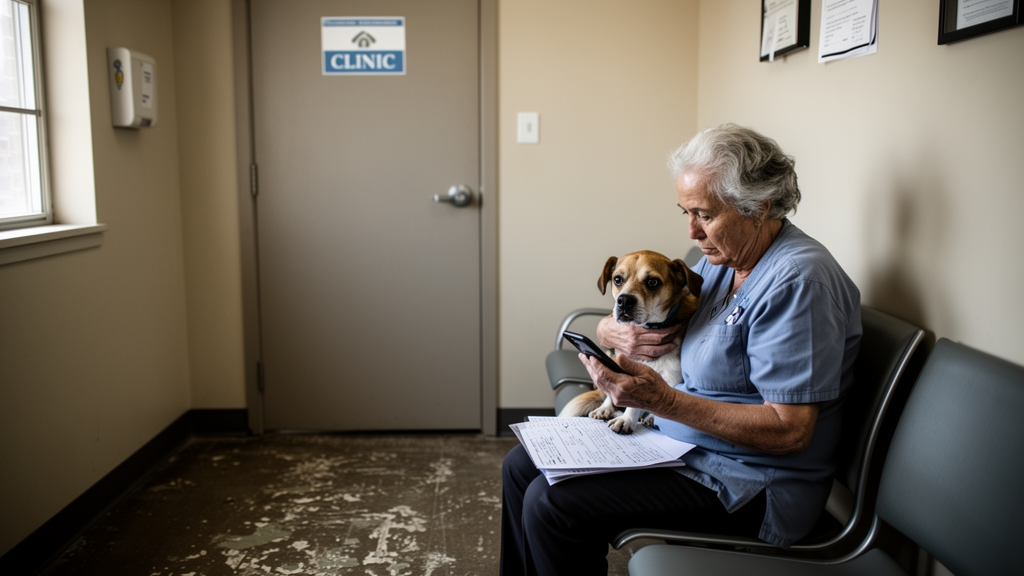
In a cross-sectional survey of adults aged 50 and older caring for companion animals, difficulties obtaining and scheduling veterinary appointments and reaching veterinary staff were independently associated with greater stress about a pet’s health. The association persisted after researchers adjusted for gender identity, education, general health, frequency of veterinary visits and perceived pet health. In the final hierarchical regression model, which included 133 participants with complete data, the access-and-communication measure accounted for an additional 5.1% of the variance in owner stress beyond the demographic and health-related variables included in the model. The full model explained 35.0% of the variance in stress, showing that practical friction within veterinary systems was measurably associated with caregivers’ psychological burden rather than being explained solely by the perceived severity of an animal’s illness.
The study, published in Frontiers in Veterinary Science on October 22, 2026, examined whether perceived barriers to veterinary care predicted owner stress among 150 adults recruited through a lifelong learning institute affiliated with a large public university in the western United States. Eligible participants were at least 50 years old and currently owned or actively cared for a companion animal. Respondents completed an anonymous online survey and could receive a $25 Amazon gift card for participating. Because some questions were unanswered, valid sample sizes differed for individual descriptive statistics, while listwise deletion reduced the final regression sample to 133 participants. The results therefore describe associations within a relatively small, volunteer-recruited community sample rather than the experience of all older pet owners.
Owner stress was measured with one survey question asking how often respondents felt stressed or worried about their pet’s health, using a five-point scale from “never” to “very often.” Perceived veterinary access and communication barriers were captured through a four-item composite: difficulty obtaining an appointment when needed, difficulty making appointments, difficulty speaking with the veterinarian by phone and difficulty contacting veterinary assistants with care-related questions. The scheduling item was reverse-coded, and the other items were harmonized so that higher scores consistently represented greater difficulty. Averaging these items produced the Veterinary Care Barriers score. Its internal consistency was acceptable for exploratory use, with a Cronbach’s alpha of 0.77, but the measure had not undergone formal external validation and combined related questions with slightly different response formats.
Before adjustment, perceived veterinary barriers correlated with owner stress at r = 0.31, with p < 0.001. The researchers then built the hierarchical regression in two stages. The first included gender identity, education level, self-rated general health, frequency of veterinary visits and perceived pet health status; it explained 29.8% of the variance in stress. Adding the Veterinary Care Barriers composite raised the explained variance to 35.0%, a statistically significant increment of 5.1%. In that final model, barriers remained associated with higher stress at B = 0.32, SE = 0.10, standardized β = 0.248 and p = 0.002. Perceived pet health was the strongest statistical predictor, with standardized β = 0.470 and p < 0.001, while frequency of veterinary visits was inversely associated with stress at β = −0.203 and p = 0.007.
The comparison between pet health and system-level barriers is central to the result. Poor perceived pet health was more strongly associated with stress, consistent with the greater caregiving demands and uncertainty that can accompany caring for a sick animal. Nevertheless, the access-and-communication measure contributed explanatory power beyond that clinical and demographic profile. A separate moderation model tested whether the relationship changed according to pet health. The interaction between Veterinary Care Barriers and pet health status was not statistically significant, β = 0.03, p = 0.72. In this sample, therefore, the association between barriers and stress did not detectably differ across levels of perceived pet health. The authors noted that limited variability in perceived barriers, pet health or owner stress may have reduced the analysis’s ability to detect a subtle interaction.
Financial assistance did not explain stress in the same way. A separate survey item asked whether reduced-cost or pro bono services had been discussed. When that item was analyzed alongside the barriers composite, it was not a significant independent predictor of stress, β = 0.10, p = 0.228, and did not meaningfully increase explained variance. This result does not show that veterinary costs are unimportant or that financial support is unnecessary. The question captured only whether such services had been discussed, rather than measuring the full burden of veterinary spending, insurance coverage, medication purchases, diagnostic testing or decisions to decline recommended treatment. The finding instead indicates that, within this survey, discussion of financial mitigation was not detectably associated with stress once operational access and communication barriers were considered.
Participants were predominantly women, educated beyond high school and in generally good or excellent health. Among the final regression sample, mean stress was 2.81 on the five-point scale and mean perceived barriers were 1.63, with both measures scaled so that higher values represented greater stress or access difficulty. Age was available for 121 respondents and averaged 71.05 years, with a standard deviation of 7.89. Most respondents reported veterinary visits at least once a year, and many perceived their pets’ health as excellent or good. Model diagnostics did not indicate problematic multicollinearity: tolerance values ranged from 0.792 to 0.973 and variance inflation factors from 1.028 to 1.263. The Durbin–Watson statistic was 2.03, while visual inspection of residual histograms, normal probability plots and residual scatterplots indicated approximately normal residuals and no substantial departure from regression assumptions.
The findings are best understood as evidence of association, not proof that clinic workflows cause stress. Because the survey was cross-sectional, it could not establish whether difficult access and communication increased stress or whether people already experiencing high stress judged veterinary systems as more burdensome. The study also relied on self-report rather than objective measures such as the number of days until an appointment is available, the time required for a clinic to return calls or messages, or whether a pet’s condition requires urgent, extended or specialized care. Perceived barriers are meaningful experiences in their own right, but they may not correspond directly to measured operational performance. Recruitment from a single lifelong learning program may additionally limit generalizability because participants who engage in community education and volunteer in research may differ from older pet owners with different incomes, health conditions, disabilities or patterns of veterinary use.
Within those limits, the results identify scheduling and communication friction as a plausible component of the caregiving environment surrounding older adults. The study did not test an intervention, so it cannot establish that any particular clinic change would reduce stress or improve animal health. It does, however, show that difficulty contacting staff and arranging care remained associated with owner stress even when pet health, visit frequency and participants’ general health were taken into account. The authors identify clearer workflows, consistent documentation and follow-up, individualized after-visit instructions, accessible communication formats and navigation supports as possible targets for future evaluation. Longitudinal, qualitative, mixed-methods and quasi-experimental research would be needed to determine the direction and timing of the relationship, explain how owners experience uncertainty, and test whether redesigned systems can ease psychological strain while remaining feasible for veterinary teams.
Subject of Research: Associations between veterinary access barriers and stress among older adult companion-animal caregivers
Article Title: Veterinary access and communication barriers as predictors of owner stress among older adults
Article References: Perley, R. M. (2026). Veterinary access and communication barriers as predictors of owner stress among older adults. Frontiers in Veterinary Science, 13, Article 1815971. https://doi.org/10.3389/fvets.2026.1815971
Image Credits: AI Generated
DOI: 10.3389/fvets.2026.1815971
Keywords: veterinary care access, owner stress, communication barriers, older adults, companion animals, caregiving burden, pet health, cross-sectional survey, Veterinary, access, communication, barriers
Cite Scienmag News
William Thompson. (October 22, 2026). Cross-sectional survey links veterinary access barriers to older caregivers’ stress. Scienmag. https://scienmag.com/cross-sectional-survey-links-veterinary-access-barriers-to-older-caregivers-stress/
William Thompson. "Cross-sectional survey links veterinary access barriers to older caregivers’ stress." Scienmag, 22 October 2026, https://scienmag.com/cross-sectional-survey-links-veterinary-access-barriers-to-older-caregivers-stress/. Accessed 22 October 2026.
William Thompson. "Cross-sectional survey links veterinary access barriers to older caregivers’ stress." Scienmag. October 22, 2026. https://scienmag.com/cross-sectional-survey-links-veterinary-access-barriers-to-older-caregivers-stress/


