


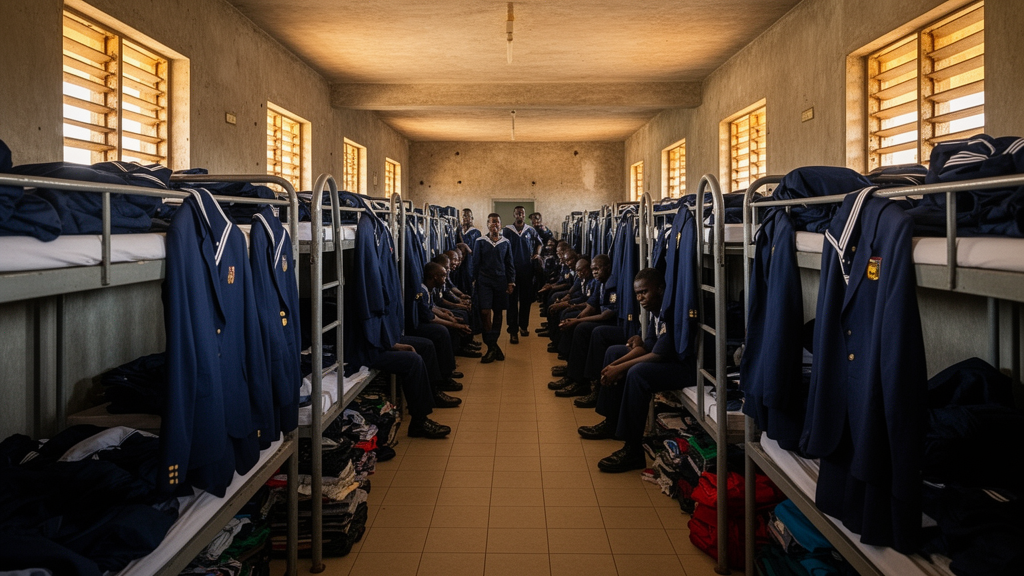
Students at the Nigerian Navy College of Health Sciences in Offa, Nigeria, reported widespread perceptions of hostel overcrowding, adverse health-related experiences and academic engagement challenges in a descriptive cross-sectional survey conducted from May to June 2026. The study assessed accommodation density and students’ perceptions of their residential environment, well-being and academic engagement at the institution. Its abstract reports that 315 students were housed in facilities designed for 251 occupants, a deficit of 64 bed spaces and an occupancy excess of 25.5%. These figures describe institutional capacity rather than the source of the accommodation data.
The survey population comprised 315 registered students residing in institutional hostels. Yamane’s formula produced a minimum sample size of 176, and participants were selected through proportionate stratified random sampling across seven academic departments. A validated, structured, self-administered questionnaire collected responses on perceived overcrowding, health-related experiences, academic engagement challenges and proposed mitigation measures. Of 176 questionnaires distributed, 167 were completed and analyzed, a response rate of 94.9%. Respondents were 55.7% female, while 49.1% were aged 18–21 years. The sample was distributed across three academic levels: ND I at 32.3%, ND II at 34.7% and HND/Final Year at 33.0%.
Among the 167 respondents, 71.3% reported that their rooms accommodated more than four people. Frequent environmental and spatial constraints included inadequate personal space, reported by 85.0%; poor ventilation, 82.0%; and excessive noise, 81.4%. Questionnaire respondents also commonly reported headaches (97.6%), sleep disturbances (95.2%), stress (85.0%), physical discomfort (82.0%) and mental fatigue (78.5%). Reported academic engagement challenges included reduced classroom participation (95.8%), limited time for private study (94.0%), impaired reading or learning ability (92.2%) and reduced concentration during lectures (83.2%). These were self-reported experiences, not clinical diagnoses.
Composite questionnaire scores indicated a high perceived burden across the assessed domains. Mean scores were 16.55 ± 2.39 for overcrowding perception, 21.61 ± 3.10 for health effects and 21.59 ± 2.41 for academic effects, with per-item means of 4.14, 4.32 and 4.32, respectively. The mitigation-measures domain had a mean score of 22.90 ± 2.60 and a per-item mean of 4.58. A revised 14-item Perceived Overcrowding Burden Index, covering perception, health and academic domains, was dichotomized at the sample median of 60. Pearson’s chi-square analysis found an association between perceived burden and level of study (χ² = 8.361, df = 2, p = 0.015). High perceived burden was reported by 51.9% of Year 1 students, 62.1% of Year 2 students and 78.2% of final-year students, but the cross-sectional design does not establish a temporal progression.
The findings are limited to questionnaire-reported perceptions and experiences among students at one health-training institution. The supplied abstract does not report multivariable adjustment, and the cross-sectional analysis cannot establish that accommodation conditions caused the reported health symptoms or academic challenges. It also cannot determine whether differences by academic level reflect duration of exposure, other cohort characteristics or another factor. The authors called for institutional strategies to improve accommodation capacity and environmental quality and to align enrolment with available infrastructure in support of student well-being and learning conditions. The source is an accepted early version of the open-access article and states that further edits may appear in its final Version of Record.
Subject of Research: A cross-sectional survey of perceived hostel overcrowding, health-related experiences and academic engagement among 167 students at the Nigerian Navy College of Health Sciences.
Article Title: Evaluating Accommodation Spatial Capacity, Trainee Well-Being, and Academic Engagement at the Nigerian Navy College of Health Sciences: An Institutional Quality Assurance Survey
Article References: Muhammad, U. B., Temeoweimiene, G., Tarfa, P. T., Odegbemi, O. B., Ochagu, O. R., Salihu, M. J., & Zipele, E. A. (2026). Evaluating Accommodation Spatial Capacity, Trainee Well-Being, and Academic Engagement at the Nigerian Navy College of Health Sciences: An Institutional Quality Assurance Survey. BMC Medical Education. https://doi.org/10.1186/s12909-026-10486-2
Image Credits: AI Generated
DOI: 10.1186/s12909-026-10486-2
Keywords: hostel overcrowding, student accommodation, well-being, academic engagement, Nigerian Navy, health sciences education, cross-sectional survey, perceived burden, residential environment, Evaluating, Accommodation, Spatial
Cite Scienmag News
Courtney Benton. (October 20, 2026). Cross-sectional survey links perceived hostel overcrowding with health and academic challenges at Nigerian Navy health college. Scienmag. https://scienmag.com/cross-sectional-survey-links-perceived-hostel-overcrowding-with-health-and-academic-challenges-at-nigerian-navy-health-college/
Courtney Benton. "Cross-sectional survey links perceived hostel overcrowding with health and academic challenges at Nigerian Navy health college." Scienmag, 20 October 2026, https://scienmag.com/cross-sectional-survey-links-perceived-hostel-overcrowding-with-health-and-academic-challenges-at-nigerian-navy-health-college/. Accessed 20 October 2026.
Courtney Benton. "Cross-sectional survey links perceived hostel overcrowding with health and academic challenges at Nigerian Navy health college." Scienmag. October 20, 2026. https://scienmag.com/cross-sectional-survey-links-perceived-hostel-overcrowding-with-health-and-academic-challenges-at-nigerian-navy-health-college/


