


WASHINGTON, Aug. 13, 2024 – Key to winning a cricket match is tricking the other team’s batters – no small feat as bowlers bowl cricket balls nearly 100 miles per hour. In recent years, a bowling technique that has become popular involves keeping the arm almost entirely horizontal during delivery, notably used by Sri Lankan stars Lasith Malinga and Matheesha Pathirana. The aerodynamics of such deliveries have perplexed sports physicists.

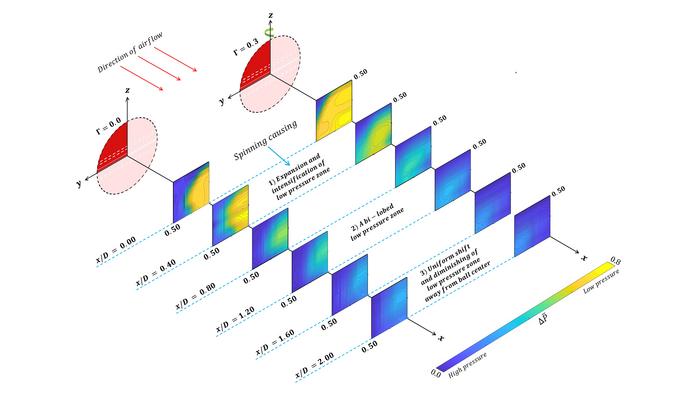
Credit: Aafrein Begam Faazil, Abdul Rahim Farhatnuha and Kizhakkelan Sudhakaran Siddharth
WASHINGTON, Aug. 13, 2024 – Key to winning a cricket match is tricking the other team’s batters – no small feat as bowlers bowl cricket balls nearly 100 miles per hour. In recent years, a bowling technique that has become popular involves keeping the arm almost entirely horizontal during delivery, notably used by Sri Lankan stars Lasith Malinga and Matheesha Pathirana. The aerodynamics of such deliveries have perplexed sports physicists.
In Physics of Fluids, by AIP Publishing, researchers have started to unravel the mysteries of how such a bowling action leads to such tough-to-hit balls. Using a wind tunnel, Faazil et al. have described the changes in pressure fields surrounding a ball due to the spinning brought on by bowling with a near-horizontal arm.
“The unique and unorthodox bowling styles demonstrated by cricketers have drawn significant attention, particularly emphasizing their proficiency with a new ball in early stages of a match,” said author Kizhakkelan Sudhakaran Siddharth. “Their bowling techniques frequently deceive batsmen, rendering these bowlers effective throughout all phases of a match in almost all formats of the game.”
The amount and way that a cricket ball jukes along its trajectory heavily relies on the interplay between the spin of the ball and operational Reynold’s number, a dimensionless quantity that relates fluid density, ball dimension, air speed, and fluid viscosity.
To get to the heart of their question, the team employed a wake survey rake device made of multiple tubes designed to capture the pressure downstream of the ball. This was complemented by an imaging system capable of detecting pressure variations sensed in the connected manometers. The study examined the flow dynamics of cricket balls rotating up to 2,500 revolutions per minute in a wind tunnel.
“The simultaneous traversal-imaging technique combined with the traditional manometers utilized in this study yielded remarkable precision, exceeding all expectations,” Siddharth said. “This demonstrated to be an outstanding approach for replicating the intricate and dynamic situations experienced in sports contexts within a wind tunnel setting.”
The group found that low-pressure zones expanded and intensified near the ball when spinning, while these zones shifted and diminished downstream. At higher spin rates, the low-pressure zone begins to change to a persistent bilobed shape.
The results lend support to the theory that these newer bowling techniques tap into the Magnus effect, in which high-speed spinning creates effects that shift the ball midflight.
Siddharth hopes the work stokes further interest in understanding the physics of cricket ball dynamics. The group looks to investigate how other factors, such as wear on the ball, affect aerodynamics.
###
The article “Unraveling the near vicinity pressure field of a transversely spinning cricket ball” is authored by Aafrein Begam Faazil, Abdul Rahim Farhatnuha, and Kizhakkelan Sudhakaran Siddharth. It will appear in Physics of Fluids on Aug. 13, 2024 (DOI: 10.1063/5.0215749). After that date, it can be accessed at https://doi.org/10.1063/5.0215749.
ABOUT THE JOURNAL
Physics of Fluids is devoted to the publication of original theoretical, computational, and experimental contributions to the dynamics of gases, liquids, and complex fluids. See https://aip.scitation.org/journal/phf.
###
Journal
Physics of Fluids
Article Title
Unraveling the near vicinity pressure field of a transversely spinning cricket ball
Article Publication Date
13-Aug-2024
Cite Scienmag News
Katie Riggs. (August 13, 2024). Cricket physics: Science behind the modern bowler technique tricking batters. Scienmag. https://scienmag.com/cricket-physics-science-behind-the-modern-bowler-technique-tricking-batters/
Katie Riggs. "Cricket physics: Science behind the modern bowler technique tricking batters." Scienmag, 13 August 2024, https://scienmag.com/cricket-physics-science-behind-the-modern-bowler-technique-tricking-batters/. Accessed 4 September 2026.
Katie Riggs. "Cricket physics: Science behind the modern bowler technique tricking batters." Scienmag. August 13, 2024. https://scienmag.com/cricket-physics-science-behind-the-modern-bowler-technique-tricking-batters/

