


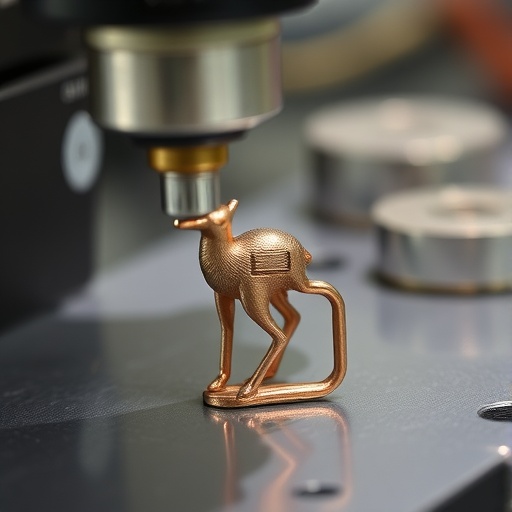
Scientists at the California Institute of Technology have pioneered a groundbreaking technique for fabricating ultra-small three-dimensional metallic microstructures with unparalleled precision. This innovative method allows the construction of complex shapes at the nanoscale, unlocking new possibilities for engineering applications across fields ranging from biomedical devices to outer space exploration. Remarkably, the metallic parts created exhibit exceptional mechanical strength despite possessing highly porous microstructures riddled with defects—a feat previously thought unattainable for materials of this scale and porosity.
The core of this advancement lies in the sophisticated use of two-photon lithography. This process leverages a femtosecond laser beam, which emits pulses lasting just a quadrillionth of a second, to selectively cure a light-sensitive hydrogel resin. By meticulously scanning the focused laser across the resin, researchers achieve voxel-by-voxel control to sculpt intricate 3D geometries with nanoscale resolution. Following this, the hydrogel template is infused with metallic salt precursors, such as copper nitrate or nickel nitrate, priming it for subsequent chemical transformation.
Key to the method’s success is the dual-stage thermal treatment the researchers employ. During the initial heating step, the organic components of the hydrogel are incinerated, yielding a metal oxide scaffold that maintains the original geometry but undergoes significant volumetric shrinkage. At this juncture, some applications require only this oxide form, particularly in optical devices. However, to obtain pure metallic parts, the team subjects the structure to a second reduction process in a specialized furnace environment that removes oxygen atoms, converting the oxides into metals with retained fidelity to the initial nanoscale design.
This thermal reduction sequence induces dramatic shrinkage—often up to 90% by volume—effectively miniaturizing the fabricated structures to dimensions smaller than 50 microns. The resulting metallic nano-architectures feature building blocks measured in mere nanometers, combining ultra-fine structural granularity with elaborate macro geometries. This approach enables the production of tiny lattices, heat exchangers, and other mechanically robust components with unprecedented control over shape and material composition.
Beyond fabrication, the research team meticulously examined the internal microstructure of these nano-engineered metals using scanning electron microscopy. Their observations unveiled numerous imperfections including large voids, nanoscale pores, grain boundaries, and even elemental inclusions. Conventionally, such defects in larger-scale metals would compromise mechanical integrity and prompt rejection of the part. Contrastingly, these nano-architected metals defy expectations, exhibiting strengths far exceeding those of comparable bulk materials despite their pronounced porosity and imperfections.
The anomalous strength arises from the unique mechanical phenomena intrinsic to nanoscale architectures—commonly referred to as the “smaller is different” effect. Here, size-dependent mechanisms such as restricted defect propagation and altered dislocation dynamics enable the nanolattices to sustain remarkable loads. The researchers corroborated these effects through physically grounded computational models developed in collaboration with experts at Nanyang Technological University. Importantly, these simulations incorporate digitally reconstructed microstructures derived directly from experimental imaging, capturing the true complexity of the materials rather than relying on idealized assumptions.
This pioneering integration of empirical microstructural data into predictive modeling marks a significant leap forward. Prior attempts at forecasting mechanical behavior of metallic parts typically ignored realistic defect distributions or treated materials as flawless continua. By embedding observed imperfections into the computational framework, the team achieved unprecedented accuracy in predicting the strength and deformation of their fabricated nano-architected metals. This level of reliability sets the stage for confident design and deployment of nanomanufactured components with tailored properties.
Professor Julia R. Greer, leading the initiative at Caltech, emphasized the transformative potential of these findings. She highlighted that future manufacturing paradigms could leverage additive nano-architecturing to create custom parts with properties that are both predictable and optimized, even in the presence of defects that would traditionally disable materials performance. This paradigm shift eliminates the need to discard parts solely due to microstructural irregularities, broadening the landscape for sustainable and high-performance nanomaterial systems.
The implications of these advances resonate across multiple scientific and engineering domains. In healthcare, nano-architected metals could enable microscale implants or sensors with exceptional strength and biocompatibility. In electronics, miniaturized heat exchangers and interconnects engineered via this process could enhance device efficiency and longevity. Moreover, the aerospace industry stands to benefit from lightweight, robust components capable of enduring extreme environments encountered in space missions.
The research, meticulously documented in the paper titled “Nanoporosity-driven deformation of additively manufactured nano-architected metals,” was published in the February 2026 issue of Nature Communications. The study represents a collaboration between Caltech’s Greer Lab and researchers at Tsinghua University and Nanyang Technological University. The work received support from the US Department of Energy and Singapore’s Agency for Science, Technology and Research, reflecting its international significance and multidisciplinary impact.
A testament to the meticulous methodology, the electron microscopy images reveal the complex interplay of defects and porosity at the tens of microns scale, with nanometer-scale nodes exhibiting concentrated variations in material density. Despite inherent irregularities, the nano-architected structures consistently demonstrate mechanical strengths predicted by their sophisticated, physically realistic models. This synergy between experimental innovation and computational precision pushes the frontier of nanoscale materials science forward.
In summary, the development of this advanced additive manufacturing technique for metallic nanostructures delivers both unprecedented fabrication control and enhanced mechanical performance. By embracing defect-laden microstructures within nano-architected metals, rather than shunning them, the research challenges conventional material paradigms. This opens the pathway toward future technologies where intricate, robust metallic parts can be custom-designed and reliably produced at the nanometer scale on demand.
News Publication Date: 28-Feb-2026
Web References:
https://www.nature.com/articles/s41467-026-69845-8#citeas
http://dx.doi.org/10.1038/s41467-026-69845-8
Keywords
Additive manufacturing, nanostructures, nano-architected metals, two-photon lithography, femtosecond laser, nanoscale fabrication, porous microstructure, metallic nanolattices, mechanical strength, materials science, computational modeling, thermal reduction process
Cite Scienmag News
Denise Maddox. (March 17, 2026). Creating Miniature 3D Metal Components with Precision Engineering. Scienmag. https://scienmag.com/creating-miniature-3d-metal-components-with-precision-engineering/
Denise Maddox. "Creating Miniature 3D Metal Components with Precision Engineering." Scienmag, 17 March 2026, https://scienmag.com/creating-miniature-3d-metal-components-with-precision-engineering/. Accessed 4 September 2026.
Denise Maddox. "Creating Miniature 3D Metal Components with Precision Engineering." Scienmag. March 17, 2026. https://scienmag.com/creating-miniature-3d-metal-components-with-precision-engineering/


