


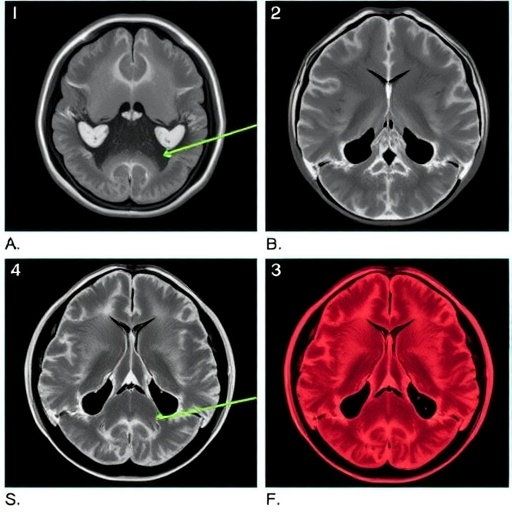
In a groundbreaking study published in BMC Cancer, researchers at Tangdu Hospital, Air Force Medical University, have presented a comprehensive comparative analysis of surgical approaches for recurrent craniopharyngioma—one of the most challenging brain tumors treated by neurosurgeons today. This retrospective study shines a new light on the ongoing debate regarding the optimal surgical method for managing recurrent craniopharyngioma, evaluating traditional craniotomy versus the relatively newer endoscopic endonasal surgery (EES).
Craniopharyngiomas, benign but locally aggressive tumors located near the pituitary gland, pose substantial surgical challenges due to their proximity to critical neurovascular structures. Their high recurrence rates require many patients to undergo second surgeries, yet there remains no consensus regarding whether transcranial surgery (TCS) or EES offers better outcomes for recurrent tumors. This ambiguity spurred Wu et al. to undertake a methodical comparison to clarify surgical efficacy and safety in these reoperations.
The study examined 399 craniopharyngioma patients treated at a single institution over an 11-year period, narrowing down to 91 individuals who underwent surgery for recurrent tumors. These patients were categorized into two cohorts: 57 patients receiving transcranial surgery and 34 patients undergoing endoscopic endonasal resection. Detailed analyses assessed demographics, clinical presentation, surgical complications, and long-term survival outcomes.
One of the pivotal findings revealed that both surgical approaches achieved comparable levels of tumor resection, debunking the notion that traditional open surgery might be inherently superior in removing recurrent craniopharyngioma masses. Statistically, there was no significant difference in the extent of tumor removal between TCS and EES, suggesting that minimally invasive approaches have matured to rival conventional methods in technical efficacy.
Postoperative complications were a crucial endpoint. Notably, the risk profile between the two techniques diverged. Cerebrospinal fluid (CSF) leaks were significantly more frequent in the EES group, occurring in 14.71% of patients, whereas none were observed in the TCS cohort. This increased incidence reflects the anatomical complexities and challenges inherent in the endonasal route and underscores the necessity for meticulous surgical technique and robust skull base reconstruction during EES procedures.
Despite this drawback, the EES cohort demonstrated striking advantages in other clinical parameters. The operative time was notably shorter, averaging just under four hours compared to nearly five hours for transcranial surgeries. Such reduction in surgical duration can translate into decreased anesthesia exposure and faster patient recovery, both critical factors in neurosurgical care.
Visual outcomes also favored EES. Among patients presenting with visual field defects, a remarkable 82.35% showed postoperative improvement in the endoscopic group compared to only 42.11% in the transcranial group. This finding highlights the enhanced visualization and delicate dissection capabilities afforded by endoscopic instrumentation, enabling better preservation and decompression of the optic apparatus.
Another vital consideration was endocrine function. New onset hypopituitarism—a debilitating complication involving deficiency in pituitary hormones—occurred less frequently after EES (14.71%) than after TCS (36.84%). Preservation of pituitary integrity is paramount in craniopharyngioma surgery, influencing long-term quality of life, and this data may tip the balance toward an endonasal approach when considering functional outcomes post-reoperation.
Overall survival (OS) and progression-free survival (PFS) after the second surgery did not significantly differ between the two groups over the average mean follow-up period of 33.5 months. This suggests that both surgical techniques can offer durable tumor control in the recurrent setting, and the choice between approaches may hinge more on balancing risk profiles and functional results rather than oncological outcomes alone.
The study further elucidates that the endoscopic transnasal approach, once considered experimental by some, is now safe and effective for removing recurrent craniopharyngioma, offering a less invasive route with improved visual and endocrine outcomes. Nevertheless, surgeons must remain vigilant to mitigate the higher CSF leak rates associated with EES through advanced reconstructive strategies and rigorous intraoperative techniques.
This analysis also sheds light on the evolving landscape of neurosurgical treatment modalities, where minimally invasive interventions not only rival but may surpass traditional open surgeries in select clinical metrics. With growing surgical experience and technological advancements, endoscopic approaches are positioned to become standard care in managing recurrent skull base tumors like craniopharyngioma.
As the study is confined to a single institution and retrospective in design, further multicenter prospective trials will be important to validate these findings and fine-tune patient selection criteria. Nonetheless, the comprehensive patient sample and robust follow-up underscore the reliability of these conclusions, marking a pivotal step forward in neurosurgical oncology.
In summary, the comparative analysis by Wu et al. advances our understanding of surgical management for recurrent craniopharyngioma, affirming that endoscopic endonasal surgery is not only a feasible alternative to craniotomy but also offers advantages in operative time, functional vision recovery, and preservation of pituitary function. Future surgical protocols can integrate these insights to optimize outcomes for this challenging patient population.
Such innovative research underpins the essential evolution of neurosurgery, bridging the gap between radical tumor control and quality-of-life preservation. As endoscopic technology and surgical expertise continue to mature, patients facing recurrent craniopharyngioma surgery may increasingly benefit from less invasive yet highly effective treatment paradigms.
The findings published in this landmark 2025 study carry implications far beyond craniopharyngioma. They catalyze ongoing exploration of endoscopic techniques across various intracranial pathologies, reshaping surgical norms and expanding the therapeutic frontier with patient-centered precision.
The study’s meticulous methodology, including statistical rigor and longitudinal monitoring, enhances trust in the demonstrated equivalence of oncological outcomes across surgical avenues, meanwhile emphasizing critical differences in complication profiles. This depth of analysis provides neurosurgeons with vital evidence to inform nuanced clinical decision-making tailored to individual patient needs.
Ultimately, this work exemplifies how targeted innovation paired with comprehensive clinical data can transform complex brain tumor care, offering hope for improved survival and function in recurrent disease settings long regarded as neurosurgical dilemmas.
Cite Scienmag News
Nathaniel Bowman. (November 18, 2025). Craniotomy vs. Endoscopy: Recurrent Craniopharyngioma Outcomes. Scienmag. https://scienmag.com/craniotomy-vs-endoscopy-recurrent-craniopharyngioma-outcomes/
Nathaniel Bowman. "Craniotomy vs. Endoscopy: Recurrent Craniopharyngioma Outcomes." Scienmag, 18 November 2025, https://scienmag.com/craniotomy-vs-endoscopy-recurrent-craniopharyngioma-outcomes/. Accessed 4 September 2026.
Nathaniel Bowman. "Craniotomy vs. Endoscopy: Recurrent Craniopharyngioma Outcomes." Scienmag. November 18, 2025. https://scienmag.com/craniotomy-vs-endoscopy-recurrent-craniopharyngioma-outcomes/


