


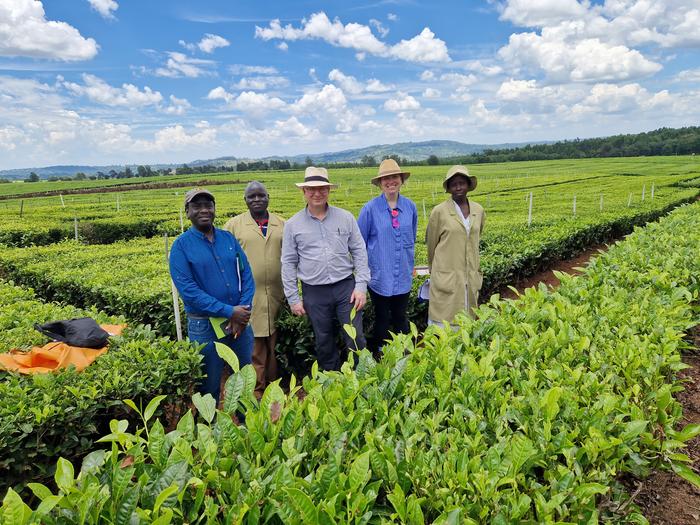
The project, supported by the Biotechnology and Biological Sciences Research Council (BBSRC) and UK Tea & Infusions Association (UKTIA), aims to improve tea production standards and create data and resources that can benefit the whole industry. The project is co-led and managed by Dr Helen Saini, Head of R&D Sustainable Agriculture at LIPTON Teas and Infusions, and Andrew Thompson, Professor of Molecular Plant Science and Head of Soil, Agrifood and Biosciences at Cranfield University.

Credit: Cranfield University
The project, supported by the Biotechnology and Biological Sciences Research Council (BBSRC) and UK Tea & Infusions Association (UKTIA), aims to improve tea production standards and create data and resources that can benefit the whole industry. The project is co-led and managed by Dr Helen Saini, Head of R&D Sustainable Agriculture at LIPTON Teas and Infusions, and Andrew Thompson, Professor of Molecular Plant Science and Head of Soil, Agrifood and Biosciences at Cranfield University.
Tea has the second lowest carbon footprint after tap water but about a quarter of its total greenhouse gas emissions are attributed to fertiliser use. In addition, climate change is threatening tea-growing regions of East Africa with deeper and longer dry seasons. Part-funded by the BBSRC as a Prosperity Partnership, trials are now underway in the Kericho region of Kenya to develop solutions to reduce nitrogen fertilizer-related emissions, and to accelerate the breeding of drought resistant varieties of tea using advanced technologies for selection.
The partnership will use drone imagery and analysis for improved crop management, precision farming, and high-throughput canopy phenotyping to develop climate resilient tea plant strains.
Recorded emissions data will also inform a new tea typology led by the UKTIA, the Tea & Herbal Association of Canada and the Tea Association of the USA, enabling tea producers to calculate their carbon footprint with greater accuracy, with results that are comparable across the tea industry. This is intended for use by the whole tea industry.
The trials will add to scientific understanding of tea production, leading to better quality tea, less wastage, and a lower environmental footprint. It builds on previous work by LIPTON Teas and Infusions and Cranfield University, including the development of an Internet of Things platform dedicated to tea crop management called IoTeaTM that incorporates tea plant growth and development modelling.
The research findings will contribute to industry-wide progress through the Lipton Tea Innovation & Technology Academy curricula. This Academy, inaugurated with the Government of Kenya and the University of Kabianga earlier this year, provides vocational training as well as degrees up to doctoral level to develop the highest standards of tea cultivation, harvesting, and processing. LIPTON Teas and Infusions is licensing its Intellectual Property to the Academy for free.
Taisa Hansen, Chief Research & Innovation Officer of LIPTON Teas and Infusions, said: “Combining our experience of tea growing with Cranfield University’s specialist research capabilities will enable us to identify the key innovations that this industry requires. We are moving fast because climate change will not wait. Our profound thanks go to BBSRC and UKTIA as, together, this multi-million-euro project will support the entire tea industry and further our mission to create value for all.”
Professor Leon Terry, Pro-Vice-Chancellor of Research and Innovation at Cranfield University, said: “The BBSRC grant, the deep technical expertise of our leading scientists, and the support of a tea company with the scale and experience of LIPTON Teas and Infusions, will ensure well-informed first-class research supports a sustainable future for tea.”
Cite Scienmag News
Alan Morgan. (July 5, 2024). Cranfield and LIPTON Teas and Infusions begin advanced climate change mitigation and resilience field trials. Scienmag. https://scienmag.com/cranfield-and-lipton-teas-and-infusions-begin-advanced-climate-change-mitigation-and-resilience-field-trials/
Alan Morgan. "Cranfield and LIPTON Teas and Infusions begin advanced climate change mitigation and resilience field trials." Scienmag, 5 July 2024, https://scienmag.com/cranfield-and-lipton-teas-and-infusions-begin-advanced-climate-change-mitigation-and-resilience-field-trials/. Accessed 4 September 2026.
Alan Morgan. "Cranfield and LIPTON Teas and Infusions begin advanced climate change mitigation and resilience field trials." Scienmag. July 5, 2024. https://scienmag.com/cranfield-and-lipton-teas-and-infusions-begin-advanced-climate-change-mitigation-and-resilience-field-trials/

