


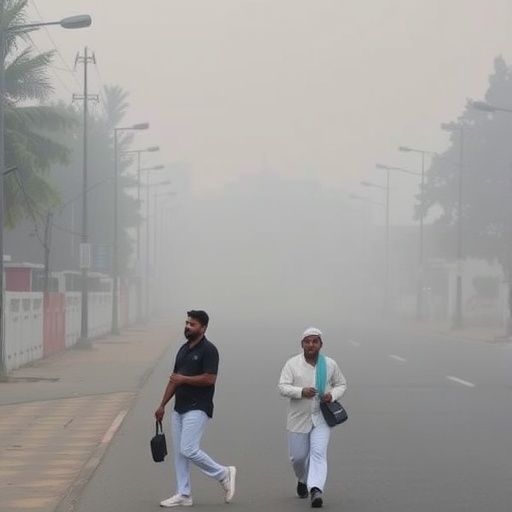
In a groundbreaking study, researchers N. Arshad, N. Mazhar, and A. Ahmad have brought to light the fluctuations in air quality across Punjab, Pakistan, particularly in the context of COVID-19 lockdowns. Utilizing data obtained from the European Space Agency’s Sentinel-5P satellite, this research meticulously investigates how lockdown measures impacted air pollution levels during one of the most unprecedented global health crises. The intricacies of this analysis reveal vital insights into air quality dynamics that are of paramount importance for policymakers and environmental advocates alike.
The COVID-19 pandemic necessitated widespread lockdowns, leading to significant alterations in human behavior and industrial operations. Consequently, one might expect considerable changes in air quality metrics. The researchers adeptly harnessed satellite-derived atmospheric composition data, leveraging Sentinel-5P’s comprehensive capabilities. This satellite is equipped with state-of-the-art sensors capable of monitoring various pollutants, including nitrogen dioxide, sulfur dioxide, and particulate matter, thereby rendering it an ideal tool for such an examination.
This analysis underscores the remarkable reduction in air pollution levels during the lockdown periods. Specifically, major urban centers within Punjab experienced dramatic declines in nitrogen dioxide concentrations, a common byproduct of vehicular emissions and industrial activity. The data indicated that average nitrogen dioxide levels dropped significantly during March and April 2020 when stringent lockdown measures were enforced. This has led to a surge in evidence suggesting that immediate, temporary reductions in pollution are achievable through drastic lifestyle and economic changes.
The implications of these findings extend beyond mere statistical anomalies. The research highlights an urgent need to reassess urban planning and industrial regulations within Punjab. Historically, Punjab has grappled with substantial air quality issues, contributing to a myriad of health problems among residents. By demonstrating that air quality can drastically improve in a short span, this study advocates for sustainable practices that could maintain those improvements in a post-COVID world.
Equally important is the methodology employed by the researchers, which employs advanced remote sensing techniques. The Sentinel-5P satellite’s measurement capabilities allow for the detection of trace gases and particulate matter across vast areas with excellent accuracy. This technique not only provides a comprehensive view of air quality but also eliminates ground-based monitoring discrepancies. As policymakers strive to forge a healthier environment, such precise data is invaluable in crafting effective interventions.
The research also delves into the long-term implications of sustained air quality improvements. The health benefits associated with reduced pollution levels are substantial, including decreases in respiratory diseases, cardiovascular problems, and overall mortality rates. Moreover, improved air quality can enhance quality of life, as clearer skies and cleaner air elevate both physical and mental well-being.
An essential takeaway from Arshad and colleagues’ findings is the correlation between human activity and environmental impact. As the world gradually moves towards a business-as-usual scenario post-pandemic, the challenge lies in balancing economic activity with environmental stewardship. This nuanced approach will require collaboration across sectors and levels of government to implement policies that favor sustainability without hindering economic progress.
Additionally, the research opens avenues for further inquiry concerning how the lessons learned during the pandemic can be translated into actionable strategies for air quality management in Punjab. Potential initiatives could include promoting public transport usage, incentivizing electric vehicles, and fostering green spaces in urban areas—all aimed at alleviating the intense pollution levels historically experienced in the region.
One compelling aspect of this study is its provision of a quantitative framework for measuring air quality variations in real-time. Future studies could build upon these findings, employing similar methodologies to assess other regions afflicted by air pollution. Such expansive research efforts could lead to the development of global standards for monitoring and improving air quality, fostering international collaboration against a backdrop of shared environmental challenges.
In this intricate panorama of environmental science, the role of satellite technology cannot be understated. As the efficacy of Sentinel-5P has been proven in this research, commitment to enhancing satellite capabilities can yield profound insights into the health of our atmosphere. These advancements will be crucial as humanity combats the dual challenges of climate change and urbanization.
In conclusion, the assessment of air quality variations in Punjab provides a compelling case study of how human responses to crises can lead to immediate improvements in air quality. By capturing the dynamics of pollution during lockdown periods, the research not only reveals the fragility of our relationship with the environment but also inspires hope for a cleaner, healthier future. As we emerge from the shadows of the pandemic, the lessons learned must guide us toward sustainable solutions that prioritize both economic vitality and ecological integrity.
Arshad, N., Mazhar, N. & Ahmad, A. Assessment of air quality variations in Punjab, Pakistan, using Sentinel-5P during COVID-19 lockdowns.
Environ Monit Assess 197, 1328 (2025). https://doi.org/10.1007/s10661-025-14551-z
Cite Scienmag News
Russell Cooper. (November 12, 2025). COVID-19 Lockdowns: Air Quality Changes in Punjab. Scienmag. https://scienmag.com/covid-19-lockdowns-air-quality-changes-in-punjab/
Russell Cooper. "COVID-19 Lockdowns: Air Quality Changes in Punjab." Scienmag, 12 November 2025, https://scienmag.com/covid-19-lockdowns-air-quality-changes-in-punjab/. Accessed 4 September 2026.
Russell Cooper. "COVID-19 Lockdowns: Air Quality Changes in Punjab." Scienmag. November 12, 2025. https://scienmag.com/covid-19-lockdowns-air-quality-changes-in-punjab/


