


A research team consisting of Professor Yong-Tae Kim, Dr. Sang-Mun Jung, and Yoona Kim, an MSc, from the Department of Materials Science and Engineering at Pohang University of Science and Technology (POSTECH) worked with a research team led by Professor Jeong Woo Han from Seoul National University in a recent collaboration to develop a hydrogen evolution reaction catalyst. This catalyst minimizes degradation caused by reverse current in alkaline water electrolysis systems. Their research was published as a cover paper in the international journal Advanced Functional Materials on July 3.

Credit: POSTECH
A research team consisting of Professor Yong-Tae Kim, Dr. Sang-Mun Jung, and Yoona Kim, an MSc, from the Department of Materials Science and Engineering at Pohang University of Science and Technology (POSTECH) worked with a research team led by Professor Jeong Woo Han from Seoul National University in a recent collaboration to develop a hydrogen evolution reaction catalyst. This catalyst minimizes degradation caused by reverse current in alkaline water electrolysis systems. Their research was published as a cover paper in the international journal Advanced Functional Materials on July 3.
The electricity generated from the renewable energy sources such as solar, wind, hydro, and geothermal are not constant; it fluctuate with weather and climate conditions. To harness and utilize this energy, it must be reliably stored and delivered to the grid, and hydrogen plays a crucial role in this process.
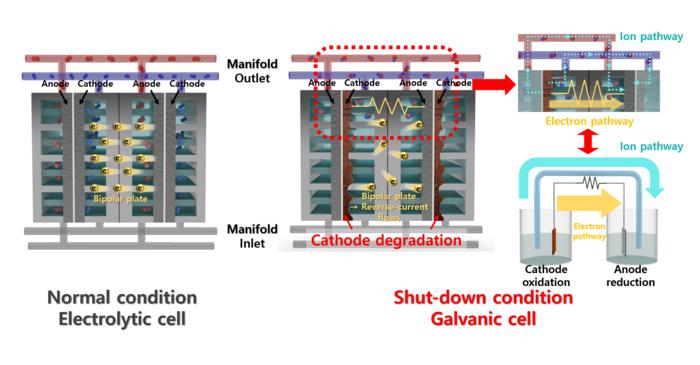
A common method for producing hydrogen is the water electrolysis system which generates hydrogen by electrolyzing water. The alkaline water electrolysis system (AWE), which utilizes an alkaline solution, offers advantages such as relatively low cost and high durability. However, the intermittent energy supply can lead to degradation of the electrolyzer. When power is not supplied, the reverse current can damage the electrodes and reduce their durability.
To address this issue, the research team introduced a lead (Pb) coating on a nickel (Ni) catalyst. Although lead is typically not used as a catalyst due to its low activity in hydrogen evolution reactions, the study found that coating nickel, a hydrogen evolution reaction catalyst, with lead enhances its performance. The lead acts as a co-catalyst, promoting both proton desorption and water dissociation, thus increasing the efficiency of hydrogen evolution reaction.
Additionally, the research team demonstrated that the catalyst have a strong resistance to reverse current through the repetitive oxidation reactions when the AWE was repeatedly started and stopped. Unlike previous catalysts that required additional equipment to address the reverse current issue in AWEs, this newly developed catalyst enhances hydrogen evolution reaction efficiency with just a lead coating and resists reverse current simultaneously.
Professor Yong-Tae Kim of POSTECH who led the research remarked, “This is the first study to address the degradation caused by reverse current in AWEs with a material solution.” He expressed his expectation by saying, “We hope that this research will improve the durability of AWEs and advance the era of a green hydrogen economy.”
The research was conducted with support from the Future Material Discovery Program of the Ministry of Science and ICT.
Journal
Advanced Functional Materials
Article Title
Reverse-Current Tolerance for Hydrogen Evolution Reaction Activity of Lead-Decorated Nickel Catalysts in Zero-Gap Alkaline Water Electrolysis Systems
Article Publication Date
3-Jul-2024
Cite Scienmag News
Bethany Barker. (July 11, 2024). Could lead overcome reverse current and advance a green hydrogen economy? Scienmag. https://scienmag.com/could-lead-overcome-reverse-current-and-advance-a-green-hydrogen-economy/
Bethany Barker. "Could lead overcome reverse current and advance a green hydrogen economy?" Scienmag, 11 July 2024, https://scienmag.com/could-lead-overcome-reverse-current-and-advance-a-green-hydrogen-economy/. Accessed 6 September 2026.
Bethany Barker. "Could lead overcome reverse current and advance a green hydrogen economy?" Scienmag. July 11, 2024. https://scienmag.com/could-lead-overcome-reverse-current-and-advance-a-green-hydrogen-economy/

