

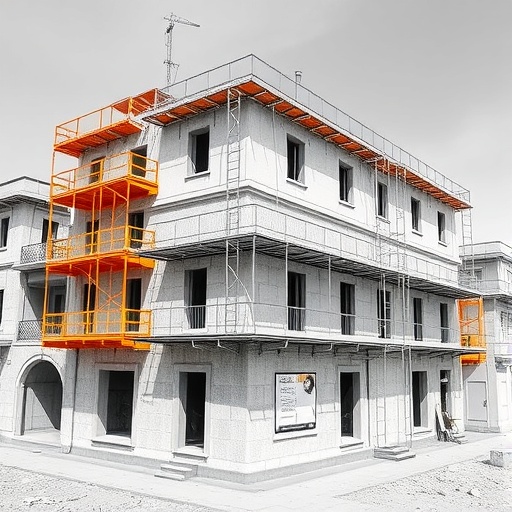
A correction to a widely discussed artificial-intelligence framework for assessing earthquake risk has substantially revised the reported performance of the system, lowering its headline validation accuracy while still leaving it ahead of the conventional machine-learning methods tested in the study. The framework, known as Building Structural Type Prediction using Graph Neural Networks, or BSPGNN, is designed to infer the structural categories of buildings from physical and spatial information. Its purpose is not simply to label buildings, but to improve estimates of how urban areas may respond when an earthquake strikes. Such estimates are central to seismic-risk assessment, because emergency planners need to know which structures are likely to be vulnerable, how damage may be distributed across a city, and where rescue or reinforcement efforts should be concentrated. The correction, published in the International Journal of Disaster Risk Science, states that mistakes in version control caused an earlier draft of the text and data to remain in the final article. The authors say all models were re-evaluated under a unified protocol during revision, but the synchronized results were not correctly transferred into the published version.
The changes affect the study’s central comparison between BSPGNN and three alternative approaches: a random forest model, a support vector machine, and a conventional graph convolutional network. In the corrected account, BSPGNN achieved 85.51 percent validation accuracy. The revised figure replaces the previously reported performance of 87.31 percent, which had been presented as a major advantage over the baselines. The corrected results also revise the scores attributed to the other methods. Random forest achieved 69.79 percent, support vector machine reached 66.75 percent, and the conventional graph convolutional network obtained 79.04 percent. These numbers preserve a substantial lead for BSPGNN, but they alter the scale of that lead and clarify that the comparison concerns validation accuracy rather than training accuracy. That distinction is crucial in machine learning. Training accuracy measures how well a model reproduces labels in the data used to develop it, whereas validation accuracy measures performance on data held aside for evaluation. A model can perform extremely well on its training examples while failing to generalize to unfamiliar buildings, a problem known as overfitting.
The framework addresses a difficult classification problem. Urban buildings can be grouped by structural type, including reinforced-concrete buildings, steel structures, confined masonry, unreinforced masonry, and masonry whose specific status is unknown. The source article abbreviates these categories as RC, S, MCF, MUR, and MR, respectively. Structural type matters because buildings made from different materials and assembled according to different construction practices can respond very differently to ground motion. Yet those categories are not always easy to identify from remotely available data. A building’s footprint, height, and number of stories may provide useful clues, but visually or geometrically similar structures can belong to different classes. In dense neighborhoods, for example, reinforced or confined masonry buildings may share comparable outlines, while unreinforced and unknown masonry categories can overlap in the available measurements. The correction retains the authors’ conclusion that these ambiguities cannot be resolved reliably by examining every building as an isolated object. Information about neighboring structures and the organization of the surrounding urban fabric can supply additional signals that individual-building models cannot access.
That is where the graph-based design enters. In a graph representation of a city, each building can be treated as a node, while connections between nearby or otherwise related buildings form edges. The node can carry attributes such as footprint geometry, height, and story count. The edges encode spatial relationships, allowing the model to combine a building’s own characteristics with information from its neighborhood. BSPGNN uses a GraphSAGE-based inductive architecture, a class of graph neural-network methods that learns how to aggregate information from sampled neighbors. “Inductive” means the system is intended to generate predictions for nodes not seen during the original training process, rather than merely memorizing labels for a fixed graph. Neighborhood sampling also makes it possible to process large networks without repeatedly examining every building in an entire city. The corrected article says the framework uses aggregation functions, including examples such as long short-term memory aggregators, to combine information from surrounding nodes. Through repeated aggregation, the system can capture not only immediate adjacency but higher-order topological dependencies extending through local clusters.
This mechanism differs from the way the conventional baselines operate. A support vector machine seeks a decision boundary that separates classes in a feature space, while a random forest combines the outputs of many decision trees trained on variations of the data and features. Both can detect relationships among footprint, height, and story count, but in the comparison described by the authors they do not directly model the spatial network linking buildings. The conventional graph convolutional network does incorporate neighboring information, yet BSPGNN is reported to perform better under the corrected validation protocol. The authors attribute that advantage to GraphSAGE’s neighborhood sampling and aggregation strategy, which they argue can preserve useful structural context while reducing the influence of local noise in crowded urban environments. The corrected text states that BSPGNN improved on the graph convolutional network by more than 6 percentage points and exceeded random forest by more than 15 points. It also says the model produced the highest precision across most categories, with particularly strong results for the challenging MUR and MR classes. Precision, in this context, measures how often buildings assigned to a category actually belong to that category, an important consideration when predictions are used to estimate exposure to earthquake damage.
The correction also changes the interpretation of the traditional models’ performance. The earlier article had described support vector machine accuracy as 76.22 percent and suggested that both non-spatial methods reached a plateau near 78 percent. The revised text instead reports 66.75 percent for support vector machine and 69.79 percent for random forest. The authors continue to argue that the individual building features possess meaningful discriminative power, particularly for categories with distinctive vertical characteristics. High-rise reinforced-concrete buildings, for instance, may display combinations of height and story count that distinguish them from many lower-rise structures. But the corrected results indicate that those features alone are less powerful than the original publication suggested. The revision therefore strengthens, rather than weakens, the case for testing spatially informed methods: if isolated-building models remain around the 70 percent level while a graph model reaches 85.51 percent on the synchronized validation set, the surrounding urban context appears to contribute important predictive information. At the same time, the correction is a reminder that a strong numerical result is meaningful only when the data splits, evaluation procedures, and model comparisons are consistently documented.
To make the revised findings visible, the authors updated Table 1 and Figures 6 and 7. Table 1 presents the performance-based comparison of BSPGNN with the other methods. Figure 6 compares metrics for each structural class, allowing readers to see whether a model’s overall score is driven by easy categories or reflects balanced performance across difficult ones. Figure 7 compares predicted and actual building labels in the validation set, providing a more direct view of classification errors. These updates are not cosmetic. In multi-class prediction, a single overall accuracy can conceal systematic failures, especially when some categories are much more common than others. A model might achieve a high aggregate score by correctly identifying a dominant class while misclassifying a less frequent but highly vulnerable building type. Class-wise precision and related measures can expose that imbalance. Likewise, a comparison of predicted and actual labels can reveal whether errors are concentrated between structurally similar categories, such as the two masonry groupings, or distributed across the entire classification task. The corrected figures are intended to align those visual summaries with the final, synchronized validation results rather than with the outdated draft.
The authors have also amended the study’s conclusion. The original statement described BSPGNN as achieving a training accuracy of 87.3 percent, compared with 77.94 percent for random forest, 76.2 percent for support vector machine, and 82.38 percent for the graph convolutional network. The corrected conclusion now identifies the relevant measure as validation accuracy and gives the revised values: 85.51 percent for BSPGNN, 69.79 percent for random forest, 66.75 percent for support vector machine, and 79.04 percent for the graph convolutional network. For earthquake science, the practical importance of the framework will depend on more than a single benchmark. Its predictions would need to be tested across cities, construction eras, mapping systems, and earthquake-prone regions with different building traditions. Training data must also represent the full range of structural conditions, including informal construction and uncertain labels. Nevertheless, the correction leaves a clear technical message: building-level seismic exposure models may benefit from representing cities as interconnected systems rather than collections of independent structures. By combining physical attributes with neighborhood topology, graph neural networks could help transform incomplete urban data into more informative maps of earthquake vulnerability, provided their performance is evaluated with rigorous, reproducible protocols.
Cite this news
SCIENMAG. (August 27, 2026). Correction: Graph Neural Networks Improve Building Structure Characterization for Seismic Risk Assessment. https://scienmag.com/correction-graph-neural-networks-improve-building-structure-characterization-for-seismic-risk-assessment/
SCIENMAG. "Correction: Graph Neural Networks Improve Building Structure Characterization for Seismic Risk Assessment." Scienmag, 27 August 2026, https://scienmag.com/correction-graph-neural-networks-improve-building-structure-characterization-for-seismic-risk-assessment/. Accessed 27 August 2026.
SCIENMAG. "Correction: Graph Neural Networks Improve Building Structure Characterization for Seismic Risk Assessment." Scienmag. August 27, 2026. https://scienmag.com/correction-graph-neural-networks-improve-building-structure-characterization-for-seismic-risk-assessment/


