

Friday, July 10, 2026
Science
No Result
View All Result
  • Login
  • HOME
  • SCIENCE NEWS
  • CONTACT US
  • HOME
  • SCIENCE NEWS
  • CONTACT US
No Result
View All Result
Scienmag
No Result
View All Result
Home Science News Biology

Corn’s ‘missing link’

August 7, 2024
in Biology
Reading Time: 3 mins read
0
Corn’s ‘missing link’
67
SHARES
607
VIEWS
Share on FacebookShare on Twitter
ADVERTISEMENT

Cold Spring Harbor Laboratory (CSHL) has begun to unravel a mystery millennia in the making. Our story begins 9,000 years ago. It was then that maize was first domesticated in the Mexican lowlands. Some 5,000 years later, the crop crossed with a species from the Mexican highlands called teosinte mexicana. This resulted in cold adaptability. From here, corn spread across the continent, giving rise to the vegetable that is now such a big part of our diets. But how did it adapt so quickly? What biological mechanisms allowed the highland crop’s traits to take hold? Today, a potential answer emerges.

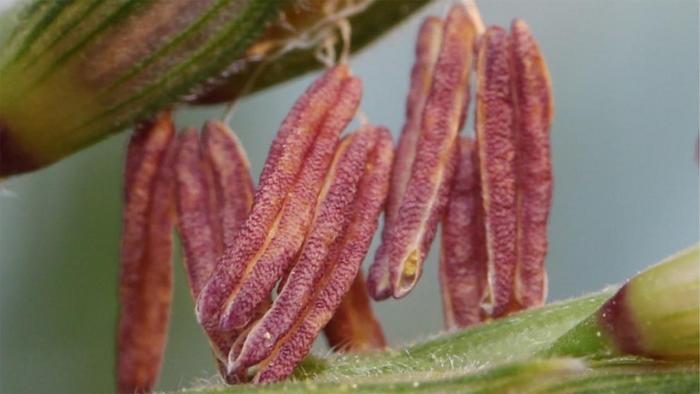
maize-teosinte hybrid

Credit: Jon Cahn/Martienssen lab

Cold Spring Harbor Laboratory (CSHL) has begun to unravel a mystery millennia in the making. Our story begins 9,000 years ago. It was then that maize was first domesticated in the Mexican lowlands. Some 5,000 years later, the crop crossed with a species from the Mexican highlands called teosinte mexicana. This resulted in cold adaptability. From here, corn spread across the continent, giving rise to the vegetable that is now such a big part of our diets. But how did it adapt so quickly? What biological mechanisms allowed the highland crop’s traits to take hold? Today, a potential answer emerges.

CSHL Professor and HHMI Investigator Rob Martienssen had been studying RNA interference, the process of small RNAs silencing genes, for more than 20 years when University of Wisconsin researcher Jerry Kermicle reached out with a curious observation. His experiments crossing semi-sterile teosinte hybrids with traditional maize had caused their offspring to behave very unusually. With normal inheritance, the offspring should have eventually become completely sterile or fertile. But no matter how many times Kermicle crossed the hybrids with maize, all the offspring were semi-sterile, too. What was happening?

To figure it out, Martienssen and graduate student Ben Berube sequenced the genomes from hundreds of pollen grains of the semi-sterile offspring. They discovered the same sections from the teosinte genome were present in each. 

“There were two pieces of the genome, one on chromosome 5 and one on chromosome 6, that were always inherited. That told us the genes responsible must be in those regions,” says Martienssen. 

On chromosome 5, they found that a gene called Dicer-like 2 makes a group of small RNAs that are always in semi-sterile hybrids but not traditional maize. With that finding, the Martienssen lab was able to pinpoint what they call Teosinte Pollen Drive (TPD). This “selfish” genetic system eliminates competing pollen grains that lack the gene drive. It causes maize-teosinte hybrids to pass certain traits through males more often than females. The discovery could have significant implications for the agriculture industry. But in Martienssen’s eyes, the finding is even bigger than its potential weed control applications. 

“I’m more excited by the evolutionary aspects, what it might mean for the process of domestication, and how it could have been much quicker than we thought,” says Martienssen. 

If teosinte mexicana is “the Neanderthal of maize,” Martienssen may have found in TPD corn’s “missing link.” The breakthrough could explain how corn came to thrive across America—but also why certain small RNAs are so common in plant and animal sperm cells, including ours.


Journal

Nature

DOI

10.1038/s41586-024-07787-1

Article Publication Date

7-Aug-2024

Share27Tweet17
Previous Post

Link discovered between sensory neurons and breast cancer metastasis

Next Post

Some e-cigarette chemicals mimic nicotine, possibly bypassing regulation

Related Posts

New Therapy Accelerates Bone Marrow Recovery by Targeting Microenvironment
Biology

New Therapy Accelerates Bone Marrow Recovery by Targeting Microenvironment

July 10, 2026
Study Challenges Rising Global Trade in Critically Endangered Sand Tiger Sharks
Biology

Study Challenges Rising Global Trade in Critically Endangered Sand Tiger Sharks

July 10, 2026
Drosophila as a Key Genetic Model for Studying Extracellular Vesicles
Biology

Drosophila as a Key Genetic Model for Studying Extracellular Vesicles

July 10, 2026
BU receives $4.6M grant to advance lung science research training
Biology

BU receives $4.6M grant to advance lung science research training

July 10, 2026
Unmedicated Depressed Women Show Reduced Heat Tolerance Compared to SSRI Users
Biology

Unmedicated Depressed Women Show Reduced Heat Tolerance Compared to SSRI Users

July 9, 2026
Balancing Pollinator Protection and Climate Change Efforts
Biology

Balancing Pollinator Protection and Climate Change Efforts

July 9, 2026
Next Post
Some e-cigarette chemicals mimic nicotine, possibly bypassing regulation

Some e-cigarette chemicals mimic nicotine, possibly bypassing regulation

  • Mothers who receive childcare support from maternal grandparents show more

    Mothers who receive childcare support from maternal grandparents show more parental warmth, finds NTU Singapore study

    27656 shares
    Share 11059 Tweet 6912
  • University of Seville Breaks 120-Year-Old Mystery, Revises a Key Einstein Concept

    1061 shares
    Share 424 Tweet 265
  • Bee body mass, pathogens and local climate influence heat tolerance

    682 shares
    Share 273 Tweet 171
  • Researchers record first-ever images and data of a shark experiencing a boat strike

    546 shares
    Share 218 Tweet 137
  • Groundbreaking Clinical Trial Reveals Lubiprostone Enhances Kidney Function

    531 shares
    Share 212 Tweet 133
Science

Embark on a thrilling journey of discovery with Scienmag.com—your ultimate source for cutting-edge breakthroughs. Immerse yourself in a world where curiosity knows no limits and tomorrow’s possibilities become today’s reality!

RECENT NEWS

  • Brain Circuit Between Dentate Gyrus and Cortex Controls Bone Healing in Mice
  • Offshoring Skews Perceptions of True Energy Decarbonization Progress
  • Definitions and Factors of Extrauterine Growth Restriction in Colombian Preterm Infants
  • Newborns Missing Vitamin K Shots Linked to Bleeding Risks and Predictors

Categories

  • Agriculture
  • Anthropology
  • Archaeology
  • Athmospheric
  • Biology
  • Biotechnology
  • Blog
  • Bussines
  • Cancer
  • Chemistry
  • Climate
  • Earth Science
  • Editorial Policy
  • Marine
  • Mathematics
  • Medicine
  • Pediatry
  • Policy
  • Psychology & Psychiatry
  • Science Education
  • Social Science
  • Space
  • Technology and Engineering

Subscribe to Blog via Email

Enter your email address to subscribe to this blog and receive notifications of new posts by email.

Join 5,146 other subscribers

© 2025 Scienmag - Science Magazine

Welcome Back!

Login to your account below

Forgotten Password?

Retrieve your password

Please enter your username or email address to reset your password.

Log In
No Result
View All Result
  • HOME
  • SCIENCE NEWS
  • CONTACT US

© 2025 Scienmag - Science Magazine

Discover more from Science

Subscribe now to keep reading and get access to the full archive.

Continue reading
