

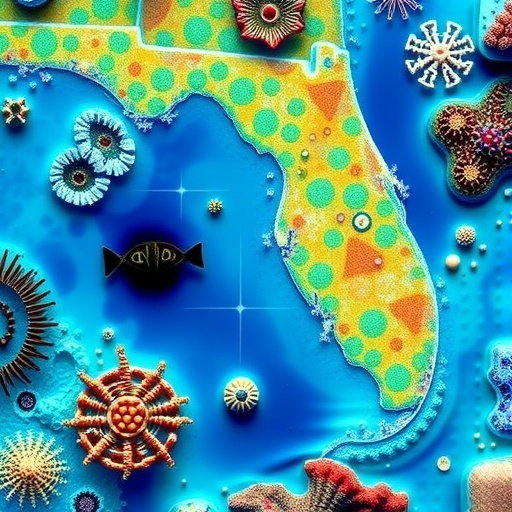
Coral reefs are among the planet’s most vital ecosystems, providing habitat for a multitude of marine organisms and serving as a crucial buffer against coastal erosion. However, they are currently facing severe threats from climate change, pollution, and overfishing. In a groundbreaking study, Dobbelaere and colleagues explore the intricate dynamics of coral connectivity over decades and across multiple species. By employing advanced modeling techniques, this research sheds light on how coral populations interact, survive, and thrive in the changes wrought by human activity and natural fluctuations. The findings could be instrumental in shaping future restoration and conservation efforts in Florida, a region home to some of the world’s most diverse coral species.
The researchers initiated their work by examining the historical data on coral populations, as well as the various factors that influence their connectivity. This included environmental parameters such as water temperature, salinity, and ocean currents, which all play significant roles in the dispersal of coral larvae. Understanding these variables is critical, as they can dictate the success or failure of coral populations to recover from disturbances. The use of sophisticated models allows scientists to create predictive frameworks that simulate how different coral species will respond to changing conditions, enabling targeted conservation strategies.
Coral connectivity is a complex phenomenon that involves larval dispersal and survival, which are affected by both natural and anthropogenic factors. The study emphasizes that without adequate connectivity, isolated coral populations can dwindle, reducing genetic diversity and diminishing the potential for resilience. The implications of this are dire, as many coral species are already facing existential threats. Through their modeling, the team identified key habitats that function as crucial stepping stones for coral larvae. Protecting these sites is essential for ensuring healthy and interconnected coral populations.
One striking revelation from the study is the significant variability in connectivity between different coral species. Some species exhibit high levels of connectivity, while others remain more isolated. This distinction is crucial for conservationists aiming to prioritize efforts. By focusing on the species that are more vulnerable to disconnection, resources can be allocated more effectively, potentially leading to greater overall success in conservation initiatives.
As coral reefs continue to decline, understanding the complexities of their ecosystems becomes ever more urgent. Late-stage interventions often focus on restoring dead or dying reefs without addressing the underlying issues of connectivity. This research highlights the necessity of taking a holistic approach, where the interdependencies between species are acknowledged and incorporated into management plans. This perspective shifts the focus from simply restoring individual populations to ensuring the sustainability of entire ecosystems.
In addition to revealing insights on connectivity, the modeling effort provides a framework for evaluating different restoration strategies. By simulating various approaches to coral restoration, the researchers uncover which methods are most likely to succeed in promoting long-term stability and resilience within coral communities. This has profound implications for policymakers and marine managers, as it equips them with data-driven insights to guide their decision-making processes.
Moreover, the research emphasizes the importance of local knowledge and community involvement in conservation efforts. Engaging with local stakeholders can enrich scientific understanding of the ecosystems they inhabit while fostering a sense of ownership and responsibility for conservation initiatives. The intersection between science and community action can enhance the odds of success for restoration projects, ultimately promoting healthier and more robust coral ecosystems.
Another layer of complexity that the study addresses is the role of climate change in futuro-corals, particularly as ocean temperatures rise and acidification increases. The researchers acknowledge that while their models offer a glimpse into the dynamics of coral connectivity, the realities of a changing climate could vastly alter these predictions. As such, adaptive management strategies that incorporate flexibility will be essential in the face of ongoing environmental changes.
In their conclusions, the researchers urge for a shift in conservation paradigms. Instead of viewing coral reefs as isolated entities, they should be recognized as interconnected systems where the health of one reef influences broader marine biodiversity. This holistic outlook can lead to more effective conservation frameworks, ultimately fostering resilience and enhancing biodiversity.
The research posits that the future of coral reefs hinges significantly on our ability to understand and manage these connections. It advocates for integrated approaches that encompass both scientific inquiry and community engagement. By prioritizing collaboration across disciplines and sectors, stakeholders can collectively take action that aligns with ecological realities, paving the way for healthier and more sustainable marine habitats.
While the study focuses on Florida’s coral ecosystems, the implications of its findings are globally relevant. As coral reefs all around the world face similar threats, the principles of connectivity and multi-species management resonate far beyond local ecosystems. As marine scientists continue to unravel the complexities of coral biology, investigations like this represent critical steps toward the long-awaited resurgence of coral reefs.
In conclusion, the team led by Dobbelaere has laid out a comprehensive roadmap for understanding coral connectivity. Their work underscores the significance of collaboration across different fields and highlights the need for ongoing assessment of coral populations. As conservation efforts ramp up globally, their findings will play a pivotal role in guiding interventions aimed at fostering resilience, restoration, and recovery in coral ecosystems for generations to come. The threat to coral reefs reminds us of our interconnectedness with the natural world, making the need for informed stewardship more pressing than ever.
Subject of Research: Coral connectivity modeling for conservation and restoration in Florida.
Article Title: Decadal and multispecies coral connectivity modeling for conservation and restoration prioritization in Florida.
Article References:
Dobbelaere, T., Chabotte, R., Figueiredo, J. et al. Decadal and multispecies coral connectivity modeling for conservation and restoration prioritization in Florida. Coral Reefs (2025). https://doi.org/10.1007/s00338-025-02790-y
Image Credits: AI Generated
DOI: https://doi.org/10.1007/s00338-025-02790-y
Keywords: Coral reefs, connectivity, conservation, restoration, climate change, marine ecosystems.


