


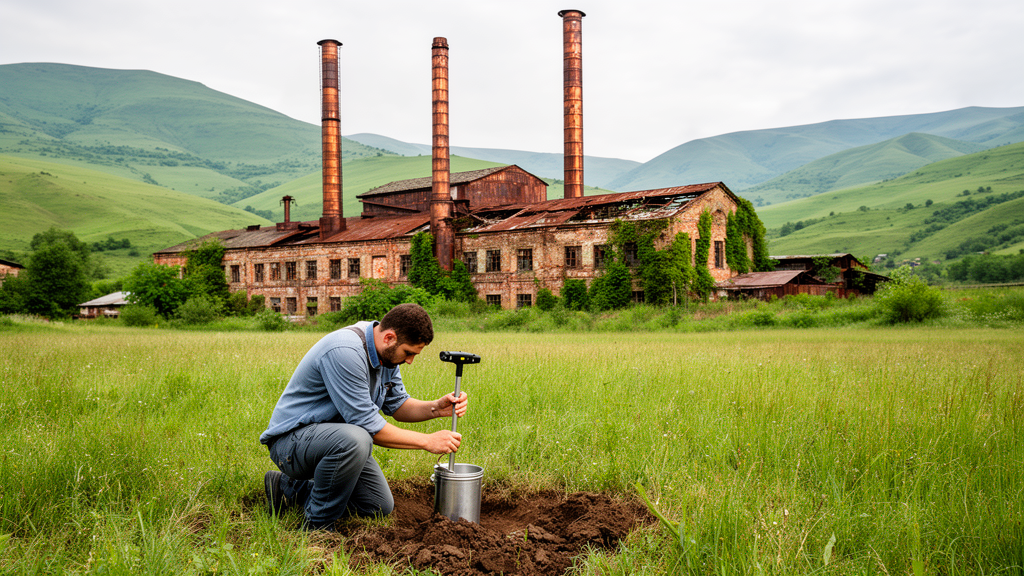
Deep in western Bulgaria, a semi-enclosed mountain valley has been quietly recording nearly fifty years of industrial history in its soils. A new study published in BioRisk traces how copper emitted by the Aurubis Bulgaria smelter in the Zlatitsa–Pirdop Valley accumulated in surface soils between 1973 and 2021, revealing a striking transformation in pollution patterns that mirrors the technological evolution of the smelter itself. The findings show that even after major emission reductions, the valley’s soils retain a strong environmental memory of past industrial activity.
The research team collected soil samples along an eastward transect extending from the smelter into the eastern part of the valley, at distances ranging from approximately 3.65 to 10.5 kilometers. Sampling targeted the 0–5 cm surface horizon, the layer most directly affected by atmospheric deposition of particulate-bound contaminants. At each site, composite samples were prepared from multiple subsamples collected within a 5-meter radius to minimize local-scale heterogeneity. Identical sampling locations were used across all three campaigns, in 1973, 1995, and 2021, ensuring spatial and temporal comparability across the 48-year interval.
Chemical analysis relied on standardized aqua regia digestion followed by atomic absorption spectrometry for the 1973 and 1995 datasets, and microwave-assisted digestion with inductively coupled plasma optical emission spectrometry for the 2021 samples. The authors acknowledge that the evolution of laboratory instrumentation over nearly five decades introduces some methodological variability, but they emphasize that interpretation is based on relative metrics such as concentration coefficients, spatial gradients, and temporal trends, which are less sensitive to systematic differences between analytical techniques.
The results reveal a pronounced shift in contamination patterns over time. In 1973, copper concentrations exhibited a clear decrease with distance from the emission source, indicating localized deposition dominated by low-stack emissions and limited atmospheric dispersion. The most distal site at 9.7 kilometers showed concentrations below local background values. In contrast, data from 1995 and 2021 reveal a more complex spatial pattern, with persistently elevated copper levels at greater distances from the smelter. In 2021, sites located 9.7 to 10.5 kilometers away actually showed higher copper concentrations than sites situated only 3.65 kilometers from the plant, indicating a non-monotonic spatial distribution.
The temporal concentration coefficient confirms substantial accumulation between 1973 and 1995, reaching up to 5.7-fold at individual sites. Over the full study period, the increase ranges from 2.5 to 5 times depending on location. The highest overall copper concentrations were recorded in 1995, while a general decreasing trend is observed in 2021, particularly at sites in close proximity to the smelter. Across all periods, copper concentrations exceeded reference values for world soils, European topsoils, and Bulgarian technogenic soils. Enrichment factors relative to European soils reached as high as 30.8 in 1995 and 15.2 in 2021.
The authors attribute the transformation of the spatial pattern to modifications in emission release height, atmospheric dispersion conditions, and long-term redistribution processes. The installation of a higher chimney and subsequent technological changes at the smelter altered the vertical dispersion of emissions, allowing finer particulate matter to be transported over longer distances. Consequently, contamination is no longer restricted to the immediate vicinity of the plant but is redistributed across the valley system.
Topography plays a critical amplifying role in this process. The valley is a semi-enclosed depression bordered by the Balkan Mountains to the north, the Sredna Gora Mountains to the south, and the Koznitsa Hills to the west, with elevations ranging from 700 to 1000 meters above sea level. This configuration limits air exchange and enhances pollutant retention. Prevailing western winds direct emissions toward the eastern part of the valley, while calm atmospheric conditions, occurring 34 percent of the year and reaching 65 percent in winter, and frequent temperature inversions further enhance deposition of fine particulate matter by reducing vertical dispersion.
Soil acidity adds another layer of complexity. The pH of soils in the study area ranges from 4.3 to 5.9, indicating slightly to moderately acidic conditions that favor the presence of more bioavailable copper forms in the soil solution. Under these conditions, copper participates in reactions with the soil uptake complex and is actively extracted by plants and microorganisms, yet it remains largely retained in the upper soil horizon. The study confirms that copper behaves as a persistent and poorly mobile contaminant in surface soils, with limited natural attenuation over decadal time scales.
An additional challenge is the influence of the local lithogeochemical background, which appears to contribute significantly to observed copper levels. In several sampling sites, copper concentrations approach or exceed values attributable to anthropogenic input alone, indicating a mixed geogenic and anthropogenic signal. This complicates spatial interpretation and highlights the importance of baseline geochemical characterization in environmental assessments of industrial regions.
Despite significant improvements in emission control technologies after industrial privatization, including advanced gas-cleaning systems installed between 2006 and 2016, historical deposition continues to dominate current soil contamination levels. The study demonstrates that soil contamination in the region is controlled not only by present-day emissions but also by cumulative historical deposition and landscape-specific environmental conditions. The findings underscore the necessity of incorporating long-term temporal analyses into environmental risk assessments rather than relying solely on current emission levels, and provide a scientific basis for improving environmental monitoring programs, pollution risk assessments, and future remediation strategies in mountainous industrial landscapes.
Subject of Research: Environmental geochemistry
Article Title: Spatial and temporal analysis of the distribution of copper in soils affected by the long-term impact of copper smelter—Aurubis Bulgaria AD
Article References: Nikolova, N., & Zhiyanski, M. (2026). Spatial and temporal analysis of the distribution of copper in soils affected by the long-term impact of copper smelter—Aurubis Bulgaria AD. BioRisk, 24, 223-226. https://doi.org/10.3897/biorisk.24.192687
Image Credits: AI Generated
DOI: 10.3897/biorisk.24.192687
Keywords: copper pollution, soil contamination, heavy metals, Bulgaria, copper smelter, atmospheric deposition, environmental monitoring, Zlatitsa-Pirdop Valley, Spatial, temporal, analysis, distribution
Cite Scienmag News
Russell Cooper. (October 17, 2026). Copper smelter legacy lingers in Bulgarian valley soils for nearly five decades. Scienmag. https://scienmag.com/copper-smelter-legacy-lingers-in-bulgarian-valley-soils-for-nearly-five-decades/
Russell Cooper. "Copper smelter legacy lingers in Bulgarian valley soils for nearly five decades." Scienmag, 17 October 2026, https://scienmag.com/copper-smelter-legacy-lingers-in-bulgarian-valley-soils-for-nearly-five-decades/. Accessed 17 October 2026.
Russell Cooper. "Copper smelter legacy lingers in Bulgarian valley soils for nearly five decades." Scienmag. October 17, 2026. https://scienmag.com/copper-smelter-legacy-lingers-in-bulgarian-valley-soils-for-nearly-five-decades/


