


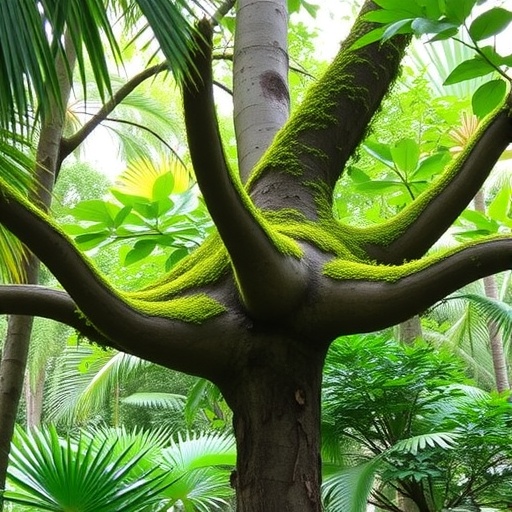
In the face of accelerating environmental change, the survival of tree species inhabiting tropical dry forests (TDF) hinges crucially on their ability to maintain functional connectivity across fragmented landscapes. A new study breaks ground by dissecting the complex landscape drivers that govern gene flow in Bursera cuneata, a co-dominant tree species native to the TDF in central Mexico, known commonly as copal. This research not only reveals spatial patterns of genetic differentiation shaped by natural terrain and human land-use but also offers fresh insights into how conservation strategies can be tailored effectively at multiple ecological scales.
Bursera cuneata occupies a vital ecological niche within central Mexico’s tropical dry forests, ecosystems that have witnessed substantial habitat loss due to agricultural expansion, urbanization, and resource extraction. Such anthropogenic pressures disrupt the continuity of native vegetation, impeding gene flow—which is essential for maintaining genetic diversity and adaptive potential in tree populations. By employing an extensive genomic dataset, consisting of over 10,000 single-nucleotide polymorphisms (SNPs) sampled from 227 individual trees distributed across 33 populations in five distinct hydrological basins, the researchers embarked on an ambitious effort to unravel the genetic architecture underpinning connectivity in this threatened species.
The study’s genetic clustering analyses uncovered clear structure corresponding to geographic basins, revealing that populations isolated by physical distance and landscape barriers showed greater genetic differentiation. These findings underscore habitat fragmentation’s tangible impact, pinpointing isolated populations at elevated risk of genetic bottlenecking. The geographic component of the investigation highlighted western, central, and southern Mexico as regions where landscape features variably influence gene flow, illustrating a mosaic of connectivity shaped by both natural and anthropogenic factors.
To deepen their understanding, the researchers applied gravity models—a sophisticated analytical framework traditionally used in human mobility and epidemiology—that integrate both local population conditions and inter-population landscape characteristics influencing the probability of gene exchange. Within-site variables included microenvironmental features like slope and east-facing aspects of terrain that affect tree reproductive success and seed dispersal. Between-site factors encompassed measures of terrain roughness, habitat suitability, and TDF cover, each hypothesized to modulate the movement of pollen and seeds across the landscape.
One of the study’s most striking results was the scale-dependent nature of functional connectivity. At finer spatial resolutions ranging between 1000 to 3000 meters, terrain roughness emerged as the predominant driver of gene flow. Rough, uneven terrain likely poses physical obstacles to dispersal vectors, including wind and potential animal pollinators or seed dispersers, thus constraining genetic exchange across short distances. Conversely, at broader regional scales beyond 4000 meters, the extent of tropical dry forest cover became the critical determinant, emphasizing the role of continuous habitat patches in sustaining connectivity across large geographic expanses.
These insights carry profound implications for conservation planning. Protecting large tracts of tropical dry forest is essential not only to preserve biodiversity in situ but also to maintain evolutionary processes that hinge on gene flow. The study advocates leveraging urban natural parks as strategic green corridors that bridge fragmented rural and urban populations of Bursera cuneata. This novel idea opens avenues for integrative conservation that synergizes urban development with biodiversity preservation, aligning with emerging paradigms of urban ecology.
The researchers further stress that gene flow is not a static property of the landscape but a dynamic phenomenon influenced by the interaction between biological traits and environmental heterogeneity. A nuanced understanding of such interactions enables the design of landscape management protocols that can mitigate the isolating effects of human activities. The study’s methodology, blending high-resolution genomic data with landscape ecological models, represents a powerful approach that can be extended to other tree species and ecosystems under similar threat.
By mapping connectivity drivers across multiple scales, this investigation highlights how fine-scale physical features and broad-scale habitat distributions jointly frame the genetic landscape of plants. The importance of scale-specific conservation cannot be overstated; interventions effective at one spatial resolution might fail or be less impactful at another. Thus, biodiversity conservation strategies for TDF should embed scale-aware frameworks to optimize their outcomes.
The genetic markers used in this study, SNP loci, offer high-resolution signals of genetic variation that surpass traditional approaches relying on fewer, less informative markers. This technological advancement strengthens the ability to detect subtle genetic patterns induced by landscape heterogeneity. The robust sampling design spanning numerous populations across hydrological basins furthers the comprehensiveness of results, ensuring that conclusions drawn have wide applicability.
Moreover, the coupling of terrain analyses with genetic data underlines the multi-dimensional nature of ecological connectivity. Physical geography constraints such as slope and ruggedness can create “genetic islands,” where limited dispersal causes populations to diverge genetically. However, maintaining or restoring habitat continuity at larger scales can counterbalance such effects, enabling recolonization and gene exchange, which are crucial for adapting to shifting environmental conditions under climate change.
This research poignantly demonstrates conservation genomics’ power to inform actionable policies. Tropical dry forests support an extraordinary array of species and ecosystem services but remain one of the most threatened tropical biomes globally. The findings resonate beyond Mexico, providing a scalable model for other TDF regions facing similar fragmentation and connectivity challenges. By emphasizing landscape connectivity’s scale dependency, the work encourages an integrative vision of habitat protection, reconciling fine-scale topographic constraints with regional forest cover conservation.
To safeguard Bursera cuneata and its tropical dry forest neighbors, management efforts must focus on preserving existing habitat patches, restoring degraded areas to enhance forest cover, and enhancing connectivity through green infrastructure, including parks and protected corridors, especially near urban centers. Public awareness and policy initiatives that acknowledge these scientific insights could play transformative roles in reversing gene flow impairment trends.
Ultimately, this study is a clarion call to harmonize landscape ecology, population genetics, and conservation policy. Maintaining genetic flow in Bursera cuneata is not purely an ecological or genetic objective but a multifaceted challenge integrating geography, land use planning, and community engagement. By deciphering the landscape-level genetic connectivity puzzle, the researchers reveal actionable paths toward sustaining the resilience of tropical dry forests in a rapidly changing world.
The implications for future studies are vast. Continued monitoring of genetic connectivity patterns vis-à-vis land-use changes can evaluate landscape interventions’ effectiveness over time. The integration of remote sensing data with genomic information may refine habitat suitability models further. Exploration of animal-mediated seed dispersal roles, coupled with genomics, might uncover additional layers influencing connectivity. As such, Bursera cuneata serves as a flagship species, modeling how landscape genetics can inform conservation in fragmented tropical ecosystems.
In conclusion, the research underscores that landscape genetics is indispensable for understanding and managing biodiversity under anthropogenic pressures. Protecting genetic corridors at the local and regional levels ensures that tree species like Bursera cuneata retain their evolutionary potential amid global change, preserving not only individual species but entire ecosystem functions dependent on the intricate tapestry of gene flow.
Cite Scienmag News
Juliet Wilcox. (June 24, 2026). Copal Tree Genetics Reveal Tropical Forest Connectivity. Scienmag. https://scienmag.com/copal-tree-genetics-reveal-tropical-forest-connectivity/
Juliet Wilcox. "Copal Tree Genetics Reveal Tropical Forest Connectivity." Scienmag, 24 June 2026, https://scienmag.com/copal-tree-genetics-reveal-tropical-forest-connectivity/. Accessed 3 September 2026.
Juliet Wilcox. "Copal Tree Genetics Reveal Tropical Forest Connectivity." Scienmag. June 24, 2026. https://scienmag.com/copal-tree-genetics-reveal-tropical-forest-connectivity/


