


Carbon dioxide is the greenhouse gas, singlehandedly responsible for 78% of the change in energy balance in Earth’s atmosphere between 1990 and 2022.

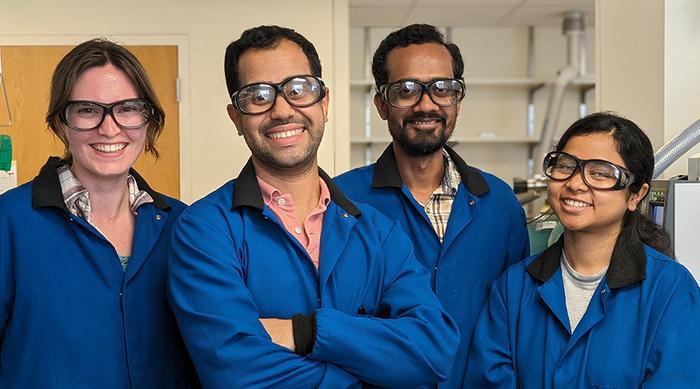
Credit: UChicago Pritzker School of Molecular Engineering
Carbon dioxide is the greenhouse gas, singlehandedly responsible for 78% of the change in energy balance in Earth’s atmosphere between 1990 and 2022.
A byproduct of burning fossil fuels, carbon dioxide enters the atmosphere from car exhaust and coal-fired power plants. Even some renewable energy resources produce a small amount of carbon dioxide, although at a tiny fraction of the amount coal and natural gas create.
At its core, this molecule is just an arrangement of one carbon and two oxygen atoms that can be reorganized through a process called electrochemical carbon dioxide reduction (CO2R) into clean fuels and useful chemicals. But the process is often done at a loss, with competing processes pulling the atoms in unwanted directions that create unwanted byproducts.
In a paper published today in Nature Catalysis, researchers from the UChicago Pritzker School of Molecular Engineering’s Amanchukwu Lab outlined a way to manipulate water molecules to make CO2R more efficient, with the ultimate goal of creating a clean energy loop.
Through their new method, the team was able to perform CO2R with nearly 100% efficiency under mildly acidic conditions, using either gold or zinc as catalysts.
“Imagine we can have green electricity from solar and wind, and then use this electricity to convert any carbon dioxide back into fuels,” said PME PhD candidate Reggie Gomes, first author of the new paper.
Competing with HER
Electrochemically disassembling a molecule is like the break shot in a game of pool. The previous arrangement disappears and the balls scatter across the table, coming to rest in new combinations – not always the ones the player intended.
Similarly, researchers performing CO2R use electricity and water to break up and rearrange the harmful greenhouse gas. This sends atoms of carbon and oxygen from the carbon dioxide caroming across the table with hydrogen atoms from the water.
If it works as intended, the atoms form other, more desirable molecules that can be used as fuels or chemicals.
But as the atoms scatter, stable pairings of two hydrogen atoms often form, a process called the hydrogen evolution reaction (HER). This makes CO2R less efficient, as energy and atoms that become hydrogen gas can’t be part of the molecules the scientists were trying to create.
Even in small quantities of water, CO2R is always competing with HER.
The Amanchukwu Lab – which is most notable for its battery research – applied insights from aqueous batteries to the problem, hypothesizing that controlling the water with organic solvents could provide a solution.
All that glitters
Both CO2R and HER rely on water as a proton donor. Using organic solvents and acid additives, the team was able to tune the water behavior, finding the sweet spot where it donated the right amount of protons to create the intended molecules, not the hydrogen gas and other unwanted materials like carbonates.
“In general chemistry we learn that carbon dioxide reacts with hydroxide to form carbonate. That’s undesired because it depletes the molecule we want to valorize,” said Neubauer Family Assistant Professor of Molecular Engineering Chibueze Amanchukwu.
Many of the most-effective ways to perform CO2R rely on precious metals.
“Platinum, silver, gold – for research purposes, they’re great catalysts,” Gomes said. “They’re very stable materials. But when you’re thinking about industrial applications, they become cost-prohibitive.”
By engineering the electrolyte, the new method can get similar results using cheaper, more abundant materials.
“Right now, the best way to do this electrochemically at room temperature is to use precious metals. Gold and silver can suppress the hydrogen evolution reaction a little bit,” Amanchukwu said. “Because of our discovery, we can now use an earth-abundant metal, zinc, because we now have a separate way to control water.”
The American Chemical Society’s Chemical & Engineering News recently named Amanchukwu one of its yearly Talented Twelve“young scientists who are making the world a better place through chemistry.”
Citation: “Modulating water hydrogen bonding within a non-aqueous environment controls its reactivity in electrochemical transformations,” Gomes, et al, Nature Catalysis, May 24, 2024. DOI:
Funding: This work was primarily supported by the U.S. Department of Energy Office of Science Basic Energy Sciences, Early Career Research Program (DE-SC0024103). Chibueze Amanchukwu was supported by the CIFAR Azrieli Global Scholars Program and Reggie Gomes was partially supported by the Roberto Rocca Fellowship Program.
Journal
Nature Catalysis
Subject of Research
Not applicable
Article Title
Modulating water hydrogen bonding within a non-aqueous environment controls its reactivity in electrochemical transformations
Article Publication Date
24-May-2024
Cite Scienmag News
Denise Maddox. (May 24, 2024). Controlling water, transforming greenhouse gases. Scienmag. https://scienmag.com/controlling-water-transforming-greenhouse-gases/
Denise Maddox. "Controlling water, transforming greenhouse gases." Scienmag, 24 May 2024, https://scienmag.com/controlling-water-transforming-greenhouse-gases/. Accessed 3 September 2026.
Denise Maddox. "Controlling water, transforming greenhouse gases." Scienmag. May 24, 2024. https://scienmag.com/controlling-water-transforming-greenhouse-gases/

