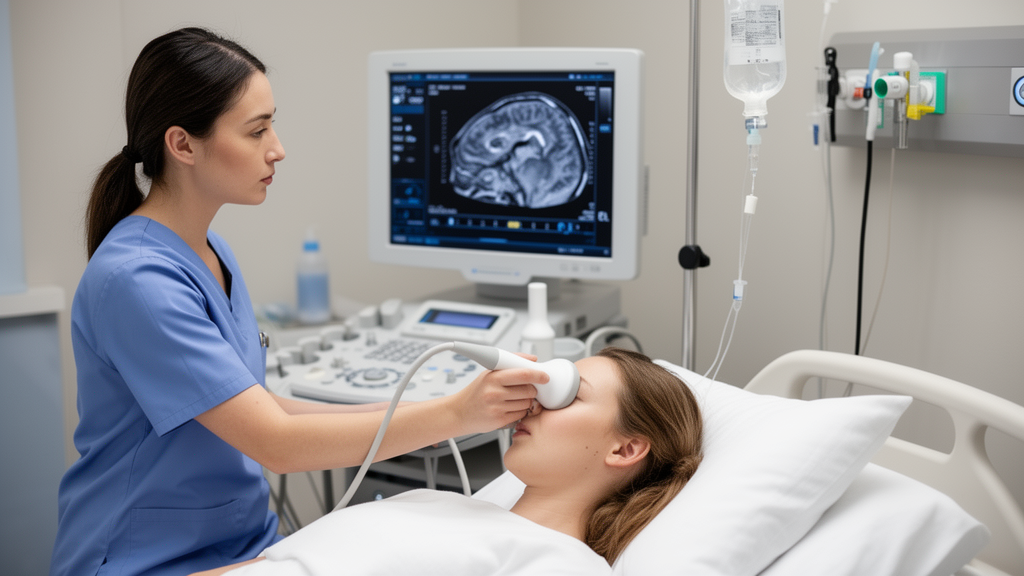
Neuro-point-of-care ultrasound, or NeuroPOCUS, is an emerging bedside technique that extends the neurological examination by allowing real-time assessment of cerebral structure and blood-flow dynamics in neurocritical care. A new narrative review argues that a familiar tool from specialist neurosonology—ultrasound contrast agents—could help overcome one of the technique’s most persistent obstacles: poor image quality.
It is a clinically oriented synthesis of existing literature rather than a new clinical trial, drawing on studies, reviews and guideline documents retrieved from PubMed/MEDLINE, Embase and Scopus through June 2026.
The core problem the authors address is the acoustic window. According to the review, implementation is often hampered by inadequate acoustic windows and poor image and Doppler signal quality, frequently leading to nondiagnostic examinations. The result is frequently a nondiagnostic examination, which undermines efforts to integrate the modality into routine clinical pathways—even though international guidelines have endorsed transcranial ultrasound-based neuromonitoring.
According to the review, the available evidence indicates that these agents improve Doppler signal quality, enhance visualization of intracranial vessels, and increase the proportion of diagnostic examinations in patients with limited acoustic windows. In practical terms, that means more bedside hemodynamic assessments become interpretable when they would otherwise have failed.
The authors organize the evidence by clinical application. The applications they examine include monitoring for vasospasm, assessing intracranial pressure, evaluating steno-occlusive cerebrovascular disease, and determining cerebral circulatory arrest, along with other neurocritical care uses. For each, the review descriptively synthesizes what contrast-enhanced transcranial ultrasound has shown so far.
The review is candid about the barriers that remain. Implementation is constrained by operator dependence, heterogeneous acquisition and interpretation protocols, and limited standardization. The authors also flag the need for structured training and for validated, application-specific velocity cutoffs.
Looking ahead, the authors suggest that contrast enhancement may expand the scope of bedside neurovascular assessment, including in emergency and acute-care settings where dedicated probes and presets are not readily available. They also note the agents’ favorable safety profile and the enhanced bedside feasibility that contrast provides, which they argue may help bridge the gap between guideline recommendations and actual clinical practice.
That bridge, however, is not yet built. The review emphasizes that further technical and clinical validation is needed before contrast-enhanced ultrasound can be said to have a defined role in frontline NeuroPOCUS. Because this is a narrative review synthesizing available evidence rather than a prospective study, its conclusions describe where the field stands and what must be standardized, not a demonstrated clinical benefit at the bedside.
For clinicians in neurocritical care, the takeaway is that the technology to recover diagnostic information in difficult-to-image patients already exists in specialist practice, and the review maps out what would need to happen—training, protocols, validated thresholds—for it to move reliably into frontline bedside use.
Subject of Research: Use of ultrasound contrast agents to improve bedside transcranial ultrasound in neurocritical care
Article Title: Contrast-Enhanced NeuroPOCUS in Neurocritical Care: Overcoming Technical Barriers to Bedside Transcranial Ultrasound
Article References: Bianchini, A., Malferrari, G., Zanoni, A., Volpe, G., Felicani, C., Modolon, C., & Zangheri, E. (2026). Contrast-Enhanced NeuroPOCUS in Neurocritical Care: Overcoming Technical Barriers to Bedside Transcranial Ultrasound. Neurocritical Care. https://doi.org/10.1007/s12028-026-02683-0
Image Credits: AI Generated
DOI: 10.1007/s12028-026-02683-0
Keywords: NeuroPOCUS, transcranial ultrasound, ultrasound contrast agents, neurocritical care, cerebral hemodynamics, vasospasm, intracranial pressure, cerebral circulatory arrest, acoustic windows, narrative review, Contrast-Enhanced, Neurocritical
Cite Scienmag News
Cassandra Pierce. (October 28, 2026). Contrast Agents May Rescue Failing Bedside Brain Ultrasound Exams. Scienmag. https://scienmag.com/contrast-agents-may-rescue-failing-bedside-brain-ultrasound-exams/
Cassandra Pierce. "Contrast Agents May Rescue Failing Bedside Brain Ultrasound Exams." Scienmag, 28 October 2026, https://scienmag.com/contrast-agents-may-rescue-failing-bedside-brain-ultrasound-exams/. Accessed 28 October 2026.
Cassandra Pierce. "Contrast Agents May Rescue Failing Bedside Brain Ultrasound Exams." Scienmag. October 28, 2026. https://scienmag.com/contrast-agents-may-rescue-failing-bedside-brain-ultrasound-exams/