

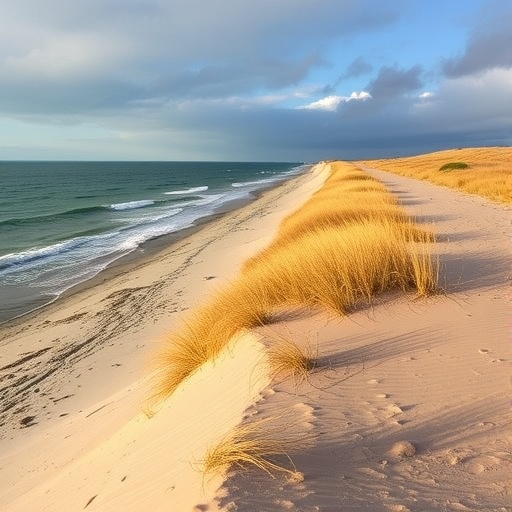
In a groundbreaking study published recently in Nature Communications, researchers have uncovered the pivotal role that connectivity between grass patches plays in the formation and amplification of coastal dunes. This insight not only deepens our fundamental understanding of coastal geomorphology but also has profound implications for coastal ecosystem management, especially in the face of global climate change and rising sea levels.
Coastal dunes act as natural barriers against storm surges and erosion, safeguarding inland areas and human settlements. Traditionally, dune formation has been considered a product of sediment supply, wind dynamics, and vegetation growth. However, this new study challenges and refines this view by introducing the concept of a critical connectivity threshold between grass patches, revealing how spatial arrangement among vegetation patches can drastically influence dune dynamics.
The research team, led by Berghuis, Reijers, and van de Koppel, employed a combination of field observations, spatial analysis, and modeling approaches to quantify the connectivity properties of grass patches along coastal zones. Grass patches are known to stabilize sand and facilitate sediment accumulation, but this study reveals that it is not merely their presence but how they connect that ultimately shapes dune formation.
Through detailed mapping and empirical data collection, the researchers identified that when grass patches surpass a particular level of spatial connectivity, a tipping point is reached, triggering accelerated dune growth. This threshold effect means that a landscape with isolated or sparsely located grass patches behaves very differently from one where patches form a connected network. In the latter, the interconnected vegetative structure maximizes sediment trapping efficiency, leading to pronounced dune development.
This discovery was supported by robust computational modeling, which simulated various scenarios of grass patch distributions and their effects on sediment dynamics and dune morphology. The models incorporated complex feedback loops between plant growth, sediment deposition, and wind flow patterns. The results consistently indicated that connectivity profoundly influences the system’s emergent properties—the self-organized patterns that define coastal dune landscapes.
Importantly, the authors underline that the relationship between grass patch connectivity and dune formation is nonlinear. Before reaching the connectivity threshold, incremental increases in patch connectivity yield minimal changes in dune size or resilience. But once crossed, even small gains in connectivity lead to disproportionate dune amplification. These findings introduce a new framework for interpreting coastal landscape stability and response to environmental perturbations.
The ecological implications of this study are significant because coastal dune vegetation not only physically shapes the landscape but also supports biodiversity by providing habitat and influencing nutrient cycles. Understanding the connectivity dynamics offers new strategies for habitat restoration, erosion control, and climate adaptation initiatives. For instance, targeted planting strategies aimed at enhancing connectivity could optimize dune restoration efforts in degraded coastal areas.
Furthermore, this research contributes to the broader theoretical understanding of spatial ecology by illustrating how patch connectivity interacts with physical processes to drive emergent landforms. It highlights a critical intersection between ecological principles—such as metapopulation connectivity—and geomorphological outcomes, bridging previously siloed scientific disciplines.
The methodology developed by the team also opens new avenues for coastal monitoring and management. Remote sensing technologies and geospatial analysis techniques can be harnessed to track grass patch connectivity in real time, offering predictive insights for dune evolution under varying environmental conditions including climate change scenarios.
This study also underscores the vulnerability of coastal systems to human activities. Anthropogenic impacts like vegetation removal, habitat fragmentation, and land-use changes can disrupt grass patch connectivity, potentially deteriorating dune resilience or preventing dune recovery after storms. These findings call for integrated coastal management policies that prioritize maintaining or restoring landscape connectivity.
Berghuis and colleagues’ work ultimately frames coastal dunes not simply as static physical structures but as dynamic complex systems driven by interactive biological and physical processes. Their identification of a connectivity threshold adds a vital piece to the puzzle of how coastal landscapes self-organize and adapt over time, enhancing both ecological resilience and human safety.
The implications reach beyond academia too. Coastal planners, environmental managers, and policymakers are encouraged to incorporate these connectivity principles into practical conservation strategies. By promoting vegetative linkages along the shores, communities can harness natural processes to fortify coastlines against the increasing threats posed by climate change.
This innovative research exemplifies the power of interdisciplinary collaboration—combining ecology, geomorphology, physics, and computational modeling—to unravel complex natural phenomena. It not only advances our understanding but offers actionable knowledge for sustainable environmental stewardship.
As our world faces unprecedented environmental change, such fundamental insights into the mechanisms governing natural barriers offer hope for more effective adaptation and mitigation strategies. The revelation of this connectivity threshold is poised to reshape how we think about and interact with our coastal environments in the decades to come.
The scientific community eagerly anticipates further studies building upon these findings, aiming to translate theoretical discoveries into tangible ecosystem benefits. Future research may explore additional vegetation types, diverse coastal contexts, and the influence of climate variability, enriching our grasp of these intricate natural systems.
The study by Berghuis et al. thus marks a milestone in coastal science, highlighting the nuanced interplay between biological patchiness and physical landscape evolution. Its viral potential lies in not only advancing ecological theory but providing a hopeful narrative of nature’s capacity for self-organization and resilience when connectivity is preserved or restored.
Subject of Research: Coastal dune formation and the role of vegetation patch connectivity.
Article Title: A connectivity threshold between grass patches amplifies coastal dune formation.
Article References: Berghuis, P.M.J., Reijers, V.C., van de Koppel, J. et al. A connectivity threshold between grass patches amplifies coastal dune formation. Nat Commun 17, 2534 (2026). https://doi.org/10.1038/s41467-026-70552-7
Image Credits: AI Generated
DOI: https://doi.org/10.1038/s41467-026-70552-7


