


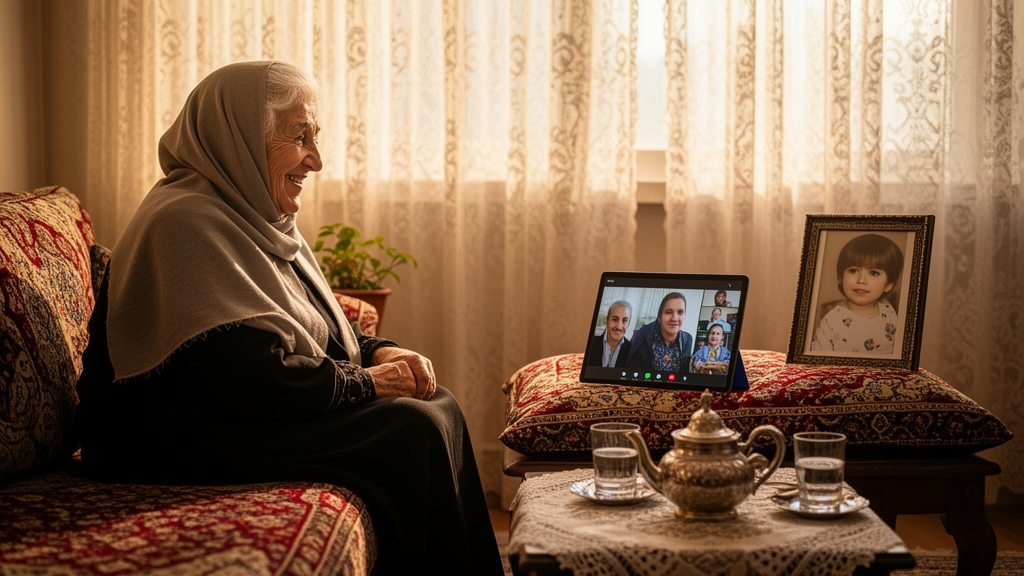
Among 300 urban older adults in Kerman, Iran, those who reported stronger social network connectedness and greater confidence in using digital technologies also reported less loneliness, according to a cross-sectional study published in BMC Public Health. The researchers measured digital self-efficacy with a researcher-developed questionnaire, social connectedness with the 6-item Lubben Social Network Scale, and loneliness with the UCLA Loneliness Scale, then tested how the two explanatory variables related to loneliness both on their own and after accounting for demographic and contextual characteristics.
The correlational pattern was consistent across the measures. Social network connectedness was positively correlated with digital self-efficacy (Spearman’s rho = 0.283, p < 0.001) and negatively correlated with loneliness (rho = −0.445, p < 0.001). Digital self-efficacy was also negatively correlated with loneliness (rho = −0.481, p < 0.001). In other words, older adults who felt more capable with digital tools tended to have larger and more active social networks, and both qualities moved in the opposite direction from loneliness scores.
The regression analysis suggested that these associations held independently. After adjustment for demographic and contextual characteristics, both social network connectedness and digital self-efficacy remained associated with loneliness. Adding the two variables to the model increased the explained variance by 22.4 percentage points (ΔR² = 0.224, p < 0.001), and the final model accounted for 35.1% of the variance in loneliness. Because the data come from a single point in time, the authors note that longitudinal and intervention studies are needed to clarify the temporal and causal relationships between these factors.
The study also documented how the three outcomes varied across social groups. Social network connectedness differed significantly by education level, residence status, occupation, and insurance coverage. Digital self-efficacy varied significantly by gender, number of children, education level, occupation, and disease status. Loneliness differed significantly by number of children, education level, occupation, and insurance coverage. These differences indicate that the experience of loneliness, and the resources linked to it in this study, are not evenly distributed among urban older adults in the study population.
The findings add to a body of work examining whether digital technologies can help older adults maintain social connections, an idea the authors frame as important because loneliness remains a significant concern in later life. Digital self-efficacy, in this framing, may influence how confident older adults feel in using digital technologies and in maintaining social connectedness. The observed negative correlation between digital self-efficacy and loneliness is consistent with that possibility, although a cross-sectional design cannot establish whether confidence with technology reduces loneliness, whether lonelier older adults feel less capable with technology, or whether other factors shape both.
Statistically, the choice of methods reflected the data. The researchers used descriptive statistics, Mann–Whitney U and Kruskal–Wallis tests for group comparisons, Spearman’s rank-order correlation for the bivariate associations, and hierarchical multiple linear regression for the adjusted models, with analyses performed in SPSS version 17. The hierarchical approach allowed the team to quantify how much explanatory power digital self-efficacy and social network connectedness added beyond demographic and contextual characteristics, which is where the 22.4 percentage-point gain in explained variance emerged.
For public health practice, the results highlight two characteristics associated with loneliness in this population: connectedness within existing social networks and confidence in using digital tools. The authors emphasize, however, that their conclusions are associative. Because the study was conducted among urban older adults in a single Iranian city, and because the digital self-efficacy questionnaire was developed by the researchers rather than a previously validated instrument, the findings are best understood as evidence motivating longitudinal and intervention studies rather than as proof that boosting digital skills or network connectedness will reduce loneliness.
The article was published as an open-access research paper, shared early to provide faster access to peer-reviewed, accepted research. The publisher notes that this version is citable and carries a permanent DOI, but remains subject to further edits and will be replaced automatically by the final Version of Record.
Subject of Research: Associations of digital self-efficacy and social network connectedness with loneliness among urban older adults in kerman, iran: a cross-sectional study
Article Title: Associations of digital self-efficacy and social network connectedness with loneliness among urban older adults in kerman, iran: a cross-sectional study
Article References: Hajinamaki, Z., Dehghan, F., Mirkhajooyi, N., & Alizadeh, S. (2026). Associations of digital self-efficacy and social network connectedness with loneliness among urban older adults in kerman, iran: a cross-sectional study. BMC Public Health. https://doi.org/10.1186/s12889-026-30044-1
Image Credits: AI Generated
DOI: 10.1186/s12889-026-30044-1
Keywords: Associations, digital, self-efficacy, social, network, connectedness, loneliness, urban, older, adults, kerman, iran
Cite Scienmag News
Ophelia Keating. (October 26, 2026). Confidence with Technology and Social Ties Both Track with Lower Loneliness in Older Iranians. Scienmag. https://scienmag.com/confidence-with-technology-and-social-ties-both-track-with-lower-loneliness-in-older-iranians/
Ophelia Keating. "Confidence with Technology and Social Ties Both Track with Lower Loneliness in Older Iranians." Scienmag, 26 October 2026, https://scienmag.com/confidence-with-technology-and-social-ties-both-track-with-lower-loneliness-in-older-iranians/. Accessed 26 October 2026.
Ophelia Keating. "Confidence with Technology and Social Ties Both Track with Lower Loneliness in Older Iranians." Scienmag. October 26, 2026. https://scienmag.com/confidence-with-technology-and-social-ties-both-track-with-lower-loneliness-in-older-iranians/


