


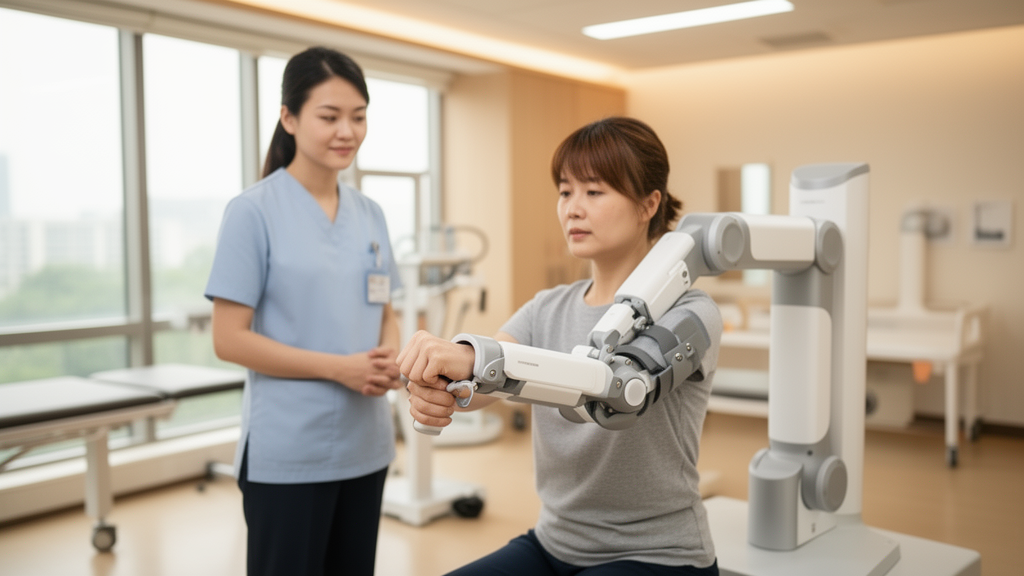
An advanced robotic-assisted rehabilitation program in Taiwan generated an estimated NT$6.86 in social value for every NT$1 invested, according to a Social Return on Investment (SROI) analysis published open-access in BMC Health Services Research. The retrospective evaluative study mapped the program's outcomes across a 31-month mature operational cycle running from January 1, 2022, to July 31, 2024, within Taiwan's single-payer healthcare context. Its authors frame the work as an empirical, macroeconomic justification intended to inform universal health insurance reimbursement policy, arguing that robotic rehabilitation should be treated as a high-yield socioeconomic catalyst rather than an institutional financial drain.
From a total investment input of NT$18,932,518 (USD 587,966), the total present value of net social outcomes reached NT$129,868,110 (USD 4,033,171), yielding a net present value of NT$110,935,592 (USD 3,445,205). Methodologically, the analysis followed the SROI framework aligned with Social Value International standards, constructing a systemic Theory of Change that traced how program activities translate into outcomes for each stakeholder group. The multi-stakeholder ecosystem encompassed 133 adult neurological patients, 59 pediatric early-intervention patients, 8 frontline therapists, and the sponsoring medical center.
Because many of the program's effects, such as psychosocial wellbeing and reduced family burden, are not traded in markets, the researchers derived localized financial proxies from national occupational wage statistics and healthcare benchmarks to attach monetary values to these non-market outcomes. This proxy-based monetization is the mechanism by which the study converts stakeholder-reported changes into a single aggregate ratio, and it is also the step most dependent on the assumptions embedded in each proxy. To insulate the model from over-claiming, the team applied econometric deflators to the calculated value: deadweight, attribution, and annual drop-off, each assigned empirically within a range of 0% to 30%.
The deflated model was then validated through adversarial sensitivity analyses, an approach the authors describe as stress-testing the headline figure against worst-case combinations of its uncertain parameters. This is a model-based economic evaluation of one program, not a randomized comparison of robotic rehabilitation against conventional therapy, so the ratio reflects the monetized social value estimated for this specific setting and period. The distribution of estimated value across stakeholders was notably broad.
Adult patients captured NT$46,247,300, or 35.61% of the total present value, while pediatric patients and their family caregivers co-created NT$33,975,610, or 26.16%. The sponsoring medical center realized NT$40,167,840, accounting for 30.93%, and frontline therapists accounted for NT$9,477,360, or 7.30%. Two caregiving-related channels dominated the monetized outcomes: adult functional independence reduced informal caregiving costs by an estimated NT$26,400,000, and pediatric therapy mitigated a substantial parental care burden valued at NT$22,554,000.
These figures represent the study's monetized estimates of burden avoided by families, derived from the wage-based and benchmark-based proxies rather than from direct market transactions. The adversarial stress tests indicated considerable robustness in the headline result: even under combined worst-case conditions across the deflator ranges, the SROI ratio remained 4.99:1, meaning the model still estimated nearly five units of social value per unit of investment when its most conservative assumptions were applied simultaneously. The authors conclude that incorporating robotic rehabilitation into tiered universal health insurance coverage could offer a scalable policy blueprint to mitigate long-term care financial liabilities while advancing value-based clinical resource allocation.
As with any single-program SROI analysis, the estimates depend on the chosen proxies, the stakeholder sample, and the Taiwan single-payer context, and the published version is an early shared copy subject to further editorial revision. Within those limits, the study provides a quantified economic case that reimbursement authorities can weigh alongside clinical evidence when deciding how robotic-assisted rehabilitation should be financed.
Subject of Research: Social Return on Investment analysis of advanced robotic-assisted rehabilitation in Taiwan's single-payer healthcare system
Article Title: Socioeconomic evaluation of Advanced Robotic-Assisted Rehabilitation in Taiwan: a Social Return on Investment (SROI) analysis and policy justification for universal health insurance inclusion
Article References: Chang, Y.-J., Hou, W.-H., Hsu, Y.-H. E., Tseng, S.-H., Huang, C.-I., & Yang, Y.-T. (2026). Socioeconomic evaluation of Advanced Robotic-Assisted Rehabilitation in Taiwan: a Social Return on Investment (SROI) analysis and policy justification for universal health insurance inclusion. BMC Health Services Research. https://doi.org/10.1186/s12913-026-15884-2
Image Credits: AI Generated
DOI: 10.1186/s12913-026-15884-2
Keywords: robotic rehabilitation, SROI, social return on investment, Taiwan, health economics, universal health insurance, neurological rehabilitation, pediatric early intervention, informal caregiving, health policy, value-based healthcare, sensitivity analysis
Cite Scienmag News
Ophelia Keating. (October 26, 2026). Robotic rehabilitation returns NT$6.86 per NT$1 invested, Taiwan analysis finds. Scienmag. https://scienmag.com/robotic-rehabilitation-returns-nt6-86-per-nt1-invested-taiwan-analysis-finds/
Ophelia Keating. "Robotic rehabilitation returns NT$6.86 per NT$1 invested, Taiwan analysis finds." Scienmag, 26 October 2026, https://scienmag.com/robotic-rehabilitation-returns-nt6-86-per-nt1-invested-taiwan-analysis-finds/. Accessed 26 October 2026.
Ophelia Keating. "Robotic rehabilitation returns NT$6.86 per NT$1 invested, Taiwan analysis finds." Scienmag. October 26, 2026. https://scienmag.com/robotic-rehabilitation-returns-nt6-86-per-nt1-invested-taiwan-analysis-finds/


