


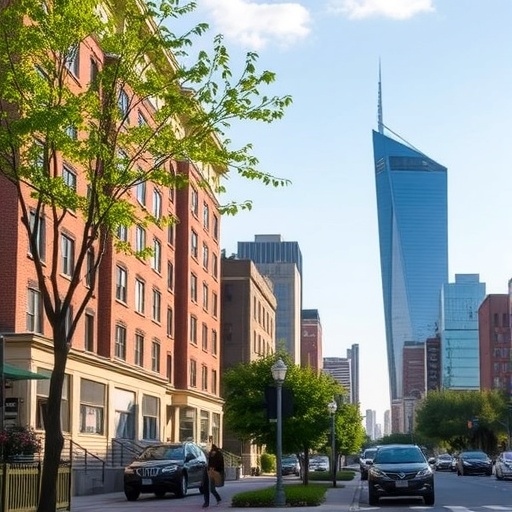
In an era where urban heat is a mounting threat to public health and quality of life, a groundbreaking study conducted by researchers at Concordia University’s Next Generation Cities Institute and the Loyola Sustainability Research Centre sheds critical light on the uneven cooling benefits that vegetation provides across city neighborhoods. Utilizing cutting-edge satellite imagery, LiDAR technology, and detailed demographic data, this research explores the complex spatial interplay between urban green infrastructure and social equity within Montreal, revealing stark disparities that demand urgent attention from planners and policymakers alike.
Urban vegetation, particularly trees, plays an indispensable role in moderating temperatures within densely built environments. The investigative team leveraged the high-resolution land surface temperature data obtained from Landsat satellites alongside the Metropolitan Canopy Index developed by the Communauté métropolitaine de Montréal, which meticulously maps vegetation coverage across the island. This combination enabled a precise quantification of how varying densities and arrangements of trees, shrubs, and grasses influence localized heat levels, an essential step toward designing cooler, healthier cities.
The researchers discovered that increasing tree canopy coverage by a mere ten percent can yield an average reduction in ground surface temperature of approximately 1.4 degrees Celsius. In contrast, a corresponding increase in lower vegetation such as shrubs and grasses reduces surface temperatures by about 0.8 degrees Celsius. Notably, their analysis highlighted that extensive, contiguous tree patches offer significantly greater cooling effects compared to fragmented or scattered clusters, emphasizing the importance of thoughtful spatial design in urban forestry initiatives.
Beyond the biophysical impacts of green infrastructure, this study critically examined the demographic dimensions of cooling accessibility. By integrating vegetation data with the 2021 Canadian Census, the team identified a troubling correlation: wealthier neighborhoods with higher education levels and predominantly white populations enjoy more abundant and effective green cover, resulting in superior cooling benefits. Conversely, poorer districts characterized by greater racial diversity tend to suffer from insufficient vegetative cooling, exposing residents to heightened heat stress.
This spatial inequity is compounded by the demographic composition of vulnerable populations. Areas underserved by urban greenery frequently host higher proportions of individuals under five and over sixty-five years old—age groups most susceptible to heat-related illnesses. The researchers argue that this mismatch between “cooling supply” and “cooling demand” must be addressed to ensure environmental justice and protect the health of the most heat-sensitive urban residents.
To quantify this mismatch, the team developed a novel statistical model incorporating three critical variables: the percentage of high vegetation cover (tree canopy), the percentage of low vegetation (shrubs and grass), and a large patch index of high vegetation that measures the scale and connectivity of tree clusters. This model accounted for approximately 80 percent of the variability in land surface temperatures across Montreal, providing robust evidence that not only the amount but also the spatial configuration of vegetation is vital for urban cooling.
From a social perspective, the researchers introduced indices to assess “cooling supply” (reflecting the intensity of vegetative cooling) and “cooling demand” (representing the proportion of vulnerable residents within neighborhoods). The comparison of these indices unveiled critical heat inequities: affluent regions such as Outremont and the West Island displayed ample tree coverage meeting or exceeding cooling demands, whereas disadvantaged zones like Saint-Léonard, Montréal-Nord, and Anjou were found to have insufficient tree canopy relative to their vulnerable populations.
Lead author Lingshan Li, a PhD candidate specializing in geography and urban environments, emphasizes the ethical imperative behind this research. “Urban green infrastructure is not just an environmental issue; it is fundamentally about social equity and protecting the most exposed populations,” Li notes. “Our findings demonstrate that current green space distribution often falls short of serving those who need it most, highlighting a pressing need for more targeted urban planning.”
The implications of this work extend to policy and urban design realms, where the trade-offs between limited urban space and the growing necessity for cooling solutions pose significant challenges. Urban planners must adopt strategies that prioritize the expansion of green infrastructure in under-served communities, focusing on creating large, interconnected tree corridors that amplify cooling efficiency as revealed by the large patch index metric used in the study.
Notably, the methodological rigor of this investigation leverages multisource remote sensing data—combining optical satellite footage with LiDAR’s 3D vegetation structure characterization—along with granular demographic statistics. This integrative approach enables a nuanced understanding of urban microclimates and their socio-spatial dynamics, marking a significant advancement over previous studies that often lacked demographic context.
Funded by the Trottier Family Foundation and the Natural Sciences and Engineering Research Council of Canada, this research represents a collaborative effort among experts from multiple disciplines, including geography, biology, and civil engineering. Their combined expertise enriches the study’s comprehensiveness, fostering holistic insights into the intricate nexus of environmental science and social justice.
Ultimately, this study offers a compelling blueprint for future urban sustainability initiatives. By aligning green infrastructure expansion with the needs of heat-vulnerable populations and emphasizing connected vegetation patches, cities can not only mitigate the health risks of extreme heat but also promote greater social equity. In an increasingly warming world, such scientifically informed urban planning is essential for building resilient, inclusive cities.
Cite Scienmag News
Courtney Benton. (October 14, 2025). Concordia Study Reveals Connection Between Urban Heat in Montreal and Disparities in Greenspace Access. Scienmag. https://scienmag.com/concordia-study-reveals-connection-between-urban-heat-in-montreal-and-disparities-in-greenspace-access/
Courtney Benton. "Concordia Study Reveals Connection Between Urban Heat in Montreal and Disparities in Greenspace Access." Scienmag, 14 October 2025, https://scienmag.com/concordia-study-reveals-connection-between-urban-heat-in-montreal-and-disparities-in-greenspace-access/. Accessed 4 September 2026.
Courtney Benton. "Concordia Study Reveals Connection Between Urban Heat in Montreal and Disparities in Greenspace Access." Scienmag. October 14, 2025. https://scienmag.com/concordia-study-reveals-connection-between-urban-heat-in-montreal-and-disparities-in-greenspace-access/


