


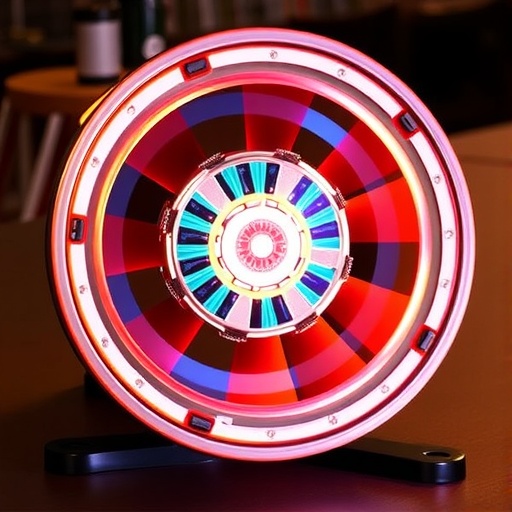
In a remarkable fusion of computational design and advanced manufacturing, a novel thermoelectric generator (TEG) has been developed that defies traditional design paradigms and delivers power generation efficiency more than eightfold greater than that of conventional models. This transformative breakthrough was achieved not through incremental material improvements, but via a sophisticated computational approach known as topology optimization, which enables the autonomous identification of optimal device geometries tailored precisely to operational environments. The work, emerging from a collaborative effort between Pohang University of Science and Technology (POSTECH) and Ulsan National Institute of Science and Technology (UNIST), represents a paradigm shift in energy harvesting technology and was detailed in the prestigious journal Nature Communications.
Thermoelectric generators harness the Seebeck effect, converting temperature gradients directly into electrical power without moving parts or fuel consumption. Despite decades of research enhancing material properties to boost thermoelectric performance, practical device efficiencies have struggled under real-world conditions. This discrepancy arises largely because device geometry significantly influences heat transfer pathways, electrical resistance distribution, and the impact of interface contact resistances—factors that interplay in complex ways to dictate overall system efficiency. Historically, TEG designs have relied heavily on human intuition, guided by classical geometric constraints such as simple rectangular shapes that facilitate fabrication but limit performance.
Recognizing these limitations, the research team deployed topology optimization, a computational strategy that enables the design of three-dimensional structures by iteratively refining shapes to maximize a specified objective—in this case, power-generation efficiency—subject to real-world thermal and electrical boundary conditions. Unlike conventional optimization methods, topology optimization does not require predefining the shape; instead, it explores vast design spaces unrestricted by preconceived notions, allowing the computer to “invent” novel geometries that human designers might never visualize.
The computational analyses revealed unconventional geometries, including asymmetric hourglass and I-shaped configurations, which strategically guide heat flow to enhance the temperature difference maintained across the thermoelectric module. By engineering these tailored pathways, heat is concentrated in a manner that optimizes the conversion efficiency while simultaneously mitigating electrical losses through minimized resistance and reduced contact degradations. These geometries cannot be realized with traditional design techniques and underscore the power of computational creativity in engineering innovation.
To validate their designs experimentally, the team utilized advanced additive manufacturing technologies—specifically 3D printing—to fabricate the complex structures predicted by the optimization algorithms. This capability to translate highly irregular and intricate topologies from virtual models to physical devices marks a significant milestone for thermoelectric devices, which have traditionally been constrained by fabrication challenges. Subsequent performance testing demonstrated an astonishing 8.2-fold increase in power-generation efficiency compared to a benchmark rectangular TEG, corroborating the computational predictions with remarkable fidelity.
The implications of this research are profound for the future of sustainable energy systems. Waste heat, abundantly produced in automotive exhausts, heavy industrial processes, semiconductor manufacturing, and even from the human body, has long been an untapped resource. The ability to convert this otherwise lost thermal energy into usable electrical power promises significant advances in energy efficiency and carbon footprint reduction. The geometry-driven optimization approach introduced here suggests that further leaps in thermoelectric technology will arise not only from better materials but from smarter, tailored designs optimally tuned to their operating environments.
Professor Jae Sung Son, leading the study from POSTECH’s Department of Chemical Engineering, highlighted that the research transcends material-centric improvements and pioneers a holistic design framework that integrates thermal, electrical, and geometric factors. This approach holds the potential to revolutionize the way thermoelectric devices are conceived and deployed, making them far more practical and efficient for widespread applications in energy harvesting and power systems.
Complementing this perspective, Professor Hayoung Chung of UNIST emphasized the role of artificial intelligence and machine learning integration, envisioning a future where device structures evolve dynamically from input conditions without manual intervention or extensive trial-and-error iterations. Such convergence of computational optimization and AI could accelerate the design cycle, foster innovation, and expand the applicability of thermoelectric generators across diverse fields.
Beyond the immediate application to energy harvesting, the methodology developed here demonstrates a broader principle relevant to materials engineering and device fabrication: by embracing topology optimization combined with additive manufacturing, engineers can unlock new performance regimes previously unattainable due to design and manufacturing constraints. This synergy opens new frontiers in engineering, from thermal management to electronics, where complex geometries provide tailored functional advantages.
The research was underpinned by significant support from the Korean National Research Foundation (NRF) through the Mid-Career Researcher Program and the Nano & Material Technology Development Program, funded by the Ministry of Science and ICT. Such funding underscores the strategic importance of advancing alternative and renewable energy technologies to address global energy challenges.
This innovative work not only lays the foundation for next-generation thermoelectric devices but also exemplifies how computational sciences and cutting-edge manufacturing can jointly propel sustainable technologies forward. As industries and societies strive for improved energy efficiency and reduced emissions, breakthroughs like this set a powerful precedent for the future of thermal energy harvesting and beyond.
As the research community digests these findings, the prospects for integrating topology-optimized thermoelectric generators into practical systems are promising. Whether embedded in automotive heat recovery units, industrial waste heat systems, or portable power generators, these newly conceptualized designs might redefine energy efficiency standards and fuel the transition towards smarter, greener energy solutions worldwide.
News Publication Date: 19-Feb-2026
Web References: DOI link
Cite Scienmag News
Reid Dalton. (April 28, 2026). Computer-Designed Thermoelectric Generator Boosts Efficiency Over Eightfold. Scienmag. https://scienmag.com/computer-designed-thermoelectric-generator-boosts-efficiency-over-eightfold/
Reid Dalton. "Computer-Designed Thermoelectric Generator Boosts Efficiency Over Eightfold." Scienmag, 28 April 2026, https://scienmag.com/computer-designed-thermoelectric-generator-boosts-efficiency-over-eightfold/. Accessed 4 September 2026.
Reid Dalton. "Computer-Designed Thermoelectric Generator Boosts Efficiency Over Eightfold." Scienmag. April 28, 2026. https://scienmag.com/computer-designed-thermoelectric-generator-boosts-efficiency-over-eightfold/


