Measuring how well a person can feel the world is one of the most deceptively difficult tasks in clinical medicine. Sensation cannot be photographed or scanned directly; it must be coaxed out of the nervous system through carefully controlled stimuli and a patient’s verbal reports. For people living with spinal cord injury, this measurement matters enormously, because the boundary between feeling and numbness defines the level and severity of their impairment. A team of biomedical engineers and clinicians in Toronto has now built a machine designed to take the guesswork out of that conversation, replacing a manual, examiner-dependent procedure with a computer-controlled system that tests dozens of skin territories in a single standardized session.
The technology, described in a study published in BioMedical Engineering OnLine, is called the multi-dermatome computer-controlled electrical perceptual threshold test, or multi-dermatome CCEPT. It was developed by Siti Nurfaezah Binti Zahari, Milos R. Popovic and colleagues at the Institute of Biomedical Engineering at the University of Toronto and the KITE Research Institute at University Health Network. Their goal was to modernize electrical perceptual threshold testing, a form of quantitative sensory assessment already used to evaluate sensory impairment after spinal cord injury, but one whose conventional implementation has long been hampered by variability in how stimuli are delivered, how responses are logged, and how much manual work the examiner must perform.
Electrical perceptual threshold testing works on a simple principle: a small, carefully calibrated electrical current is applied to the skin, and the intensity is gradually adjusted until the person being tested reports that they feel it. The lowest current that produces a reliable sensation is the perceptual threshold. Because the current stimulates the nerve endings in the skin directly, the test can probe specific dermatomes, the band-like regions of skin each supplied by a single spinal nerve root. Mapping thresholds across many dermatomes therefore offers a way to trace the functional integrity of the spinal cord segment by segment, information that complements the standardized neurological examination known as ISNCSCI, the international classification system used by clinicians worldwide.
The problem, the researchers argue, is that the conventional approach leaves too much to chance and to the examiner. Stimulus delivery can vary between sessions and between testers, response logging is typically done by hand, and the workflow is laborious enough that broad clinical adoption has been limited. Each of these sources of variability erodes reproducibility, and without reproducibility, a sensory test cannot reliably track whether a therapy is working or whether an injury is changing over time. The Toronto team set out to close those gaps by integrating the entire procedure, from stimulation to data capture, into a single computer-controlled pipeline.
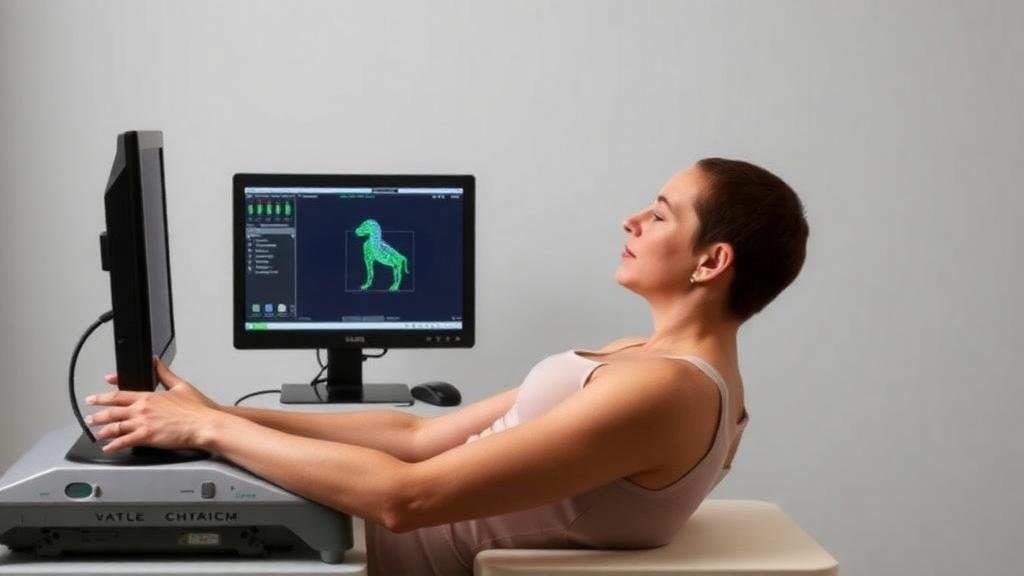
The resulting prototype delivers a standardized stimulation protocol across 28 dermatomes on both sides of the body, presenting the stimuli in randomized order so that neither the participant nor the examiner can anticipate what comes next. Critically, the system does not simply automate the current. It programmatically controls every parameter of the electrical pulse train, including pulse width, the number of pulses delivered at each step, the current amplitude, and the size of the increments by which the current rises. At the same time, it synchronizes the participant’s responses with examiner verification and digital data logging, so that every threshold measurement arrives with a complete, structured record of how it was obtained.
Because this was an engineering design and protocol-selection study, the team evaluated the system and a set of candidate protocol parameters in five non-disabled participants. One early question was which type of electrode to use, and a preliminary comparison found no significant difference in the minimum electrical perception threshold, abbreviated EPTmin, between the two electrode types tested. That result simplified one design choice, but the more consequential findings concerned how the stimulation itself should be structured. The researchers discovered that both the pulse count and the size of the current steps measurably influenced the thresholds they recorded, a reminder that even a seemingly objective test is shaped by the physics of its stimulus.
Specifically, delivering three pulses per step produced significantly lower EPTmin values than delivering a single pulse per step, meaning participants reported feeling the stimulus at lower currents when each step contained a brief burst of pulses rather than a solitary one. Likewise, increasing the current in fine 0.1 milliampere increments yielded significantly lower threshold values than coarser 0.2 milliampere steps, because a finer staircase simply offers more opportunities for the sensation to first cross into awareness. Weighing these responses against practical considerations such as testing time, the team selected three pulses per step combined with a 0.2 milliampere current increment as the protocol for subsequent testing, a compromise between sensitivity and clinical feasibility.
With the protocol fixed, the researchers generated a representative bilateral dermatomal profile from their pilot data. The pattern was strikingly consistent with what earlier studies of electrical perceptual thresholds have reported: thresholds tended to be lower in the cervical and thoracic dermatomes of the neck and trunk and higher in the lumbosacral dermatomes of the lower back and legs. This rostrocaudal gradient, running from the top of the spinal cord downward, suggests that the automated system reproduces the physiological signatures that clinicians and researchers already recognize, an encouraging sign that automation has not distorted the underlying measurement.
The authors are careful to frame the achievement as a demonstration of technical feasibility rather than a finished clinical instrument. The prototype combines computer-controlled stimulus delivery, automated channel routing between the 28 electrode sites, synchronized response capture, and structured digital data acquisition within one workflow, but the study’s sample was small and limited to non-disabled participants. Before the multi-dermatome CCEPT can enter routine use, further studies with the finalized protocol will be needed to establish test-retest reliability, to build healthy reference profiles for each dermatome, and to demonstrate clinical feasibility and validity in people actually living with spinal cord injury, whose sensory systems may behave very differently from those of able-bodied volunteers.
Even so, the direction of travel is clear. Quantitative sensory testing has long promised an objective window into the nervous system, but that promise has been constrained by the human hands delivering the stimulus and recording the answer. By handing those tasks to a computer that treats every dermatome, every pulse, and every response identically, the Toronto team has taken a concrete step toward sensory assessment that is standardized, auditable, and scalable. If reliability and validation studies succeed, the technology could sharpen how clinicians map sensory recovery after spinal cord injury, how trials of regenerative therapies are judged, and ultimately how the invisible landscape of human sensation is charted in the clinic.
Subject of Research: Development of a computer-controlled multi-dermatome electrical perceptual threshold system for standardized quantitative sensory testing after spinal cord injury
Article Title: A multi-dermatome computer-controlled electrical perceptual threshold test: system development for standardized quantitative sensory assessment
Article References: A multi-dermatome computer-controlled electrical perceptual threshold test: system development for standardized quantitative sensory assessment. (n.d.). https://doi.org/10.1186/s12938-026-01636-0
Image Credits: AI Generated
DOI: 10.1186/s12938-026-01636-0
Keywords: electrical perceptual threshold, quantitative sensory testing, spinal cord injury, dermatomes, biomedical engineering, sensory assessment, automation, medical devices, rehabilitation, neurophysiology, clinical measurement, University of Toronto
Cite Scienmag News
Cassandra Pierce. (October 13, 2026). Computer-Controlled Sensory Test Aims to Standardize Nerve Assessment After Spinal Cord Injury. Scienmag. https://scienmag.com/computer-controlled-sensory-test-aims-to-standardize-nerve-assessment-after-spinal-cord-injury/
Cassandra Pierce. "Computer-Controlled Sensory Test Aims to Standardize Nerve Assessment After Spinal Cord Injury." Scienmag, 13 October 2026, https://scienmag.com/computer-controlled-sensory-test-aims-to-standardize-nerve-assessment-after-spinal-cord-injury/. Accessed 13 October 2026.
Cassandra Pierce. "Computer-Controlled Sensory Test Aims to Standardize Nerve Assessment After Spinal Cord Injury." Scienmag. October 13, 2026. https://scienmag.com/computer-controlled-sensory-test-aims-to-standardize-nerve-assessment-after-spinal-cord-injury/